Healing Backbends and Spinal Flexibility
Gentle, prop-supported techniques to open your spine and ease tension. We don't rush; we build strength at your pace.
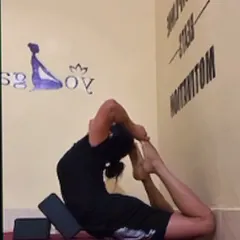
A student uses a stack of blocks and the wall for a deep, supported backbend, targeting the upper back and shoulders.
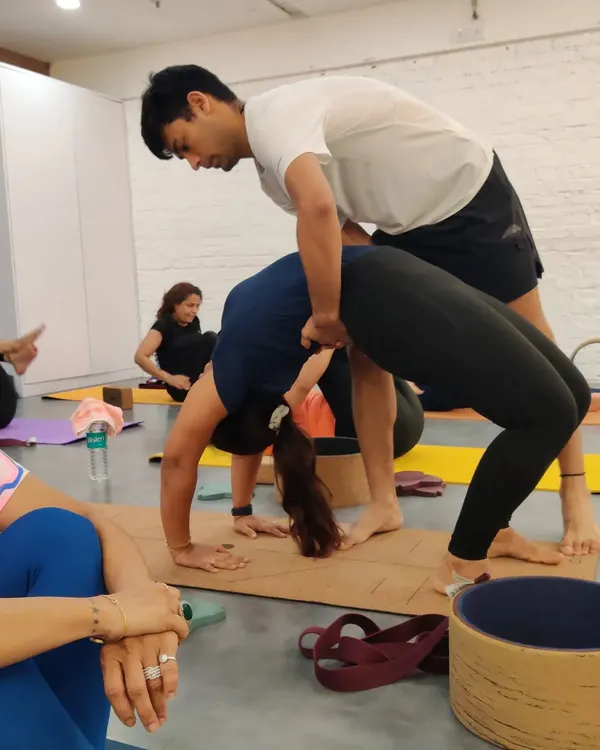
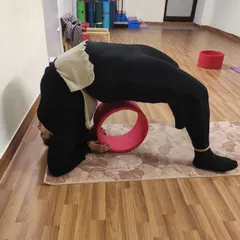
With the help of instructors, a student practices a deep backbend over a yoga wheel and blocks. This level of support ensures the pose is therapeutic, not strenuous.
A student performs a chair split, which opens the hips, combined with a rope-assisted backbend for a full-body opening.
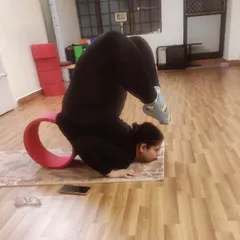
A student practices a scorpion pose variation using a chair for support. This advanced backbend is made accessible through the careful use of props.
Students practicing supported bridge pose on chairs, a fantastic way to open the chest and strengthen the back without straining the neck.
A backbend workshop in progress, with students using the wall and ropes to deepen their Anjaneyasana (low lunge) and open the hip flexors.
A student practices a backbend over a specialized prop, with instructors providing support. This is part of our focus on therapeutic and safe alignment.
A student uses a chair and a specialized backbending prop to gently open the spine. This restorative approach is key to our therapeutic method.
A student performs a graceful backbend over a chair, demonstrating the strength and flexibility that can be built over time with consistent practice.
A student uses blocks to support a deep backbend, ensuring the lower back is protected while the upper back and shoulders open.
About Healing Backbends & Spinal Flexibility
Backbends shouldn't hurt. At my studio, we use heavy-duty chairs, wall ropes, and blocks to create a cocoon of support around your spine. This isn't about reaching for your feet immediately; it is about creating space in your thoracic spine while keeping your lower back completely safe. Ruko: we move only when your body is ready.
Precision Over Performance
In many modern classes, backbends are treated as performance poses. Here, they are tools for recovery. If you are dealing with chronic stiffness, a desk-bound lifestyle, or minor orthopedic issues, a 'standard' backbend is often exactly what your spine doesn't need. We take a different route.
How We Use Props
We rely on Iyengar-inspired equipment to deconstruct complex postures:
- Wall Ropes (Kurunta): We use these for spinal traction. They allow you to decompress the vertebrae without the strain of fighting gravity, which is crucial if you have limited mobility.
- Supportive Chairs: These are not just for sitting. We use chairs to support the lower back during bridge poses and backbends, allowing the chest to open without causing neck or lumbar discomfort.
- Blocks and Bolsters: These help bridge the gap between where your body is today and where you want to go. They provide stability, so your muscles can release tension rather than clenching to maintain balance.
A Note on Healing
Healing is not linear. When I tell students to 'Ruko' (hold/stop), it is because progress in yoga often happens in the stillness, not the effort. We focus on the 'how' rather than the 'how far'. Whether you are working through Spondylitis, Sciatica, or just typical daily fatigue, this approach helps you reclaim your posture naturally, one breath at a time. Join us at our Santacruz West studio to experience a practice that respects your physical boundaries.
Similar work from other experts
Browse through Curated picks from other experts on mytribe
Safe Spinal Health & Backbending Yoga with Props
Backbends & Flexibility: Safe, Prop-Based Training in Janakpuri
Backbending and Spinal Flexibility Classes in Rajouri Garden
 8
8
Therapeutic Yoga Classes for Back Pain Relief
Backbend Yoga Training: Safe Heart Opening with Props
Deep Flexibility and Backbends Training in Rohini
More from Therapeutic & Medical Yoga by Body Temple Yoga Studio
More services by Body Temple Yoga Studio