Yoga Pose Alignment: Master Your Practice Safely
Yoga is not about perfectly straight lines or touching your toes on day one. It is about learning how to move with intention. Here, I break down the mechanics of foundational asanas so you can practice without fear of injury.
This is Warrior III (Virabhadrasana III). I've marked the key alignment points to help you create that stable 'T' shape. Focus on keeping your hips even and grounding down through the standing foot to find your balance.
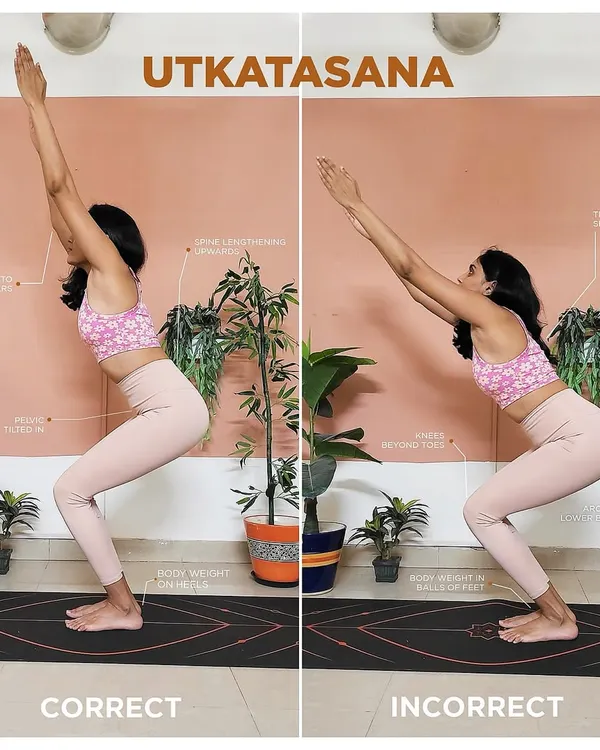
Here is the full expression of Chair Pose (Utkatasana). Notice how the core is engaged and the shoulders are relaxed, even as the arms reach up. The goal is to sink the hips back as if sitting in an imaginary chair.
If holding your arms up in Chair Pose feels like too much, this modification with hands at the heart is a great option. It allows you to focus on strengthening your legs and core without straining your shoulders.
Proper spinal alignment is crucial in Boat Pose. The top image shows a common mistake of collapsing the spine. Instead, focus on keeping the spine long and the chest open, as shown in the bottom image, to fully engage your core.
About Pose Breakdowns: Master Your Alignment
Many students worry about their form looking exactly like what they see on social media. The reality is that if your back is rounding in Boat Pose or your knees are locking in Warrior III, you are not engaging the muscles you need. My sessions focus on these specific micro-adjustments—like drawing your navel in or grounding through your standing heel—that turn a standard stretch into a safe, sustainable practice.
Why Alignment Matters
Alignment in Hatha and Vinyasa is not about how the pose looks; it is about how the pose feels and its longevity for your body. Whether you are doing a deep lunge or balancing in Virabhadrasana (Warrior Pose), incorrect form can lead to unnecessary strain on your joints. I prefer you hold a pose with correct, gentle engagement rather than rushing through a flow to get your heart rate up.
How I Teach Form
My classes—both the small group batches and the 1-on-1 sessions—are designed around live feedback. I watch your camera feed to catch those tiny details, like your shoulders shrugging toward your ears or your weight shifting incorrectly into your knees. We go beyond basic cues. We look at the anatomy, the squeeze-and-soak action of twists, and the core engagement that keeps you stable.
Modifying for Your Body
If you have tight hamstrings or struggle with balance, you do not need to force yourself into a 'perfect' pose. Using blocks, straps, or even a wall is a standard part of my teaching. If you cannot touch your toes, we do not collapse your spine to get there. We bend your knees until you can find the length in your back. You do not need to be flexible to start; you just need to be willing to listen to your body and make adjustments as you go.
Similar work from other experts
Browse through Curated picks from other experts on mytribe
Mastering Yoga Asanas with Correct Alignment
 16
16
Master Your Yoga Pose Alignment and Safety
Guided Yoga Asana Tutorials for Correct Alignment
 8
8
Correct Your Yoga Form: Tutorials and Alignment Tips
Step-by-Step Yoga Asana Tutorials
Foundation & Alignment: Perfecting Your Yoga Poses
More from Yoga for Fitness and Flexibility by Sanjana
More services by Sanjana