Specialized Institutional Architecture and Design
Institutional spaces require a balance between rigid function and human comfort. Whether designing a healthcare facility or a government office, we focus on how people move through and experience the environment daily.
This is a ward at the Rukmani Devi Birla Hospital. The design prioritizes patient comfort and operational efficiency, with ample space between beds, clear circulation paths, and access to natural light from the windows.
A waiting area in a healthcare facility designed by us. We use clean lines, natural light, and views of the outdoors to create a calm and reassuring atmosphere for patients and their families during stressful times.
Another view of the Chief Justice of India's office, showcasing the bespoke, back-lit bookshelves designed to house an extensive law collection. The symmetrical design and refined detailing create a sense of order and prestige.
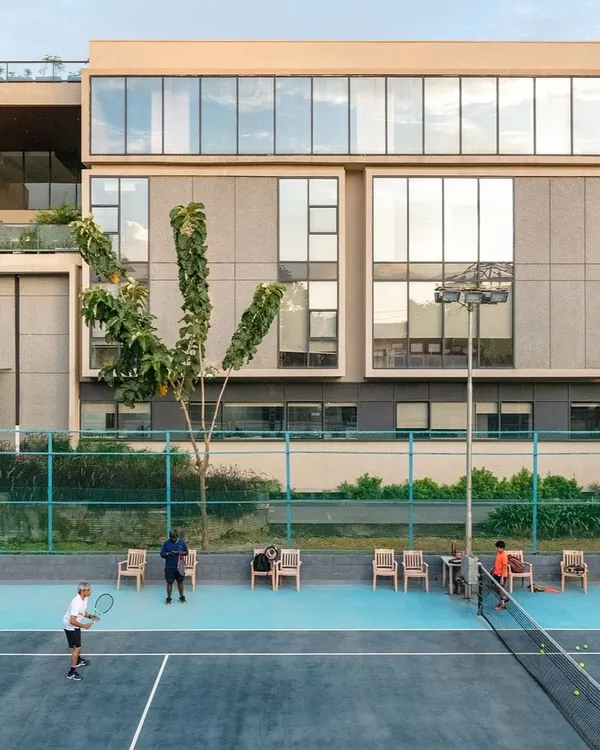
This image highlights our work in institutional design for the SMR Jaipuria School, a project that demonstrates our ability to respond to the unique purpose and people of a place.
About Specialized Institutional Spaces
When we approach institutional design, we look beyond the functional checklist of circulation paths and acoustic ratings. Our priority is to convert sterile environments into places that feel intentional and supportive, whether it is a high-security office or a healthcare ward. We focus on how the space performs for the user on a daily basis, ensuring that every design decision—from lighting to furniture placement—serves a human purpose.
Institutional design is rarely about a single building; it is about how that structure functions as a node within a larger community. At team3, we argue that an institution should never feel like a monolith. Our process starts with intensive site analysis and research into the specific typology—be it a school campus, a hospital ward, or an office of national importance.
The Architecture of Purpose
In our work for the Chief Justice of India's office, we did not just build storage for books; we created a space that demands focus and reflects authority through material selection and orderly geometry. Similarly, in our healthcare projects like the Rukmani Devi Birla Hospital, we prioritize patient comfort by mitigating the typical clinical feeling. We focus on maximizing natural light, reducing acoustic reverberation, and designing clear circulation that eases stress for both patients and medical staff.
Our Process in Action
We often find that institutional buildings suffer from 'dead space'—corridors or courtyards that serve no purpose. We actively convert these areas into active hubs. Whether it is adding seating to a hallway or creating breakout zones in an office, our designs are meant to foster connection. We utilize physical models and digital simulations to test these ideas before a single brick is laid, ensuring that the final construction is durable, climate-responsive, and practical. We design for the long term, avoiding temporary trends in favor of layouts that adapt as the institution itself evolves.
Similar work from other experts
Browse through Curated picks from other experts on mytribe
 9
9
Commercial and Institutional Architectural Designs
Institutional and Commercial Architecture
 52
52
Institutional Architecture for Healing and Learning Spaces
 16
16
Commercial and Institutional Space Design
 7
7
Public and Institutional Architecture Design
 14
14
Large-Scale Multi-Specialty Hospital Architecture and Design
More from Institutional Architecture by Team3