Urban Oases and Master Planning Design
We look beyond individual structures to design entire urban ecosystems. Our master planning focuses on restoring the balance between high-density living and nature, creating democratic spaces where community and environment can thrive.
This animated diagram shows our concept for a groundbreaking project in Hyderabad that integrates a forest into the urban landscape. The design blends commercial spaces, a serene water body, and vibrant public areas to create a harmonious coexistence of nature and city life.
This is our vision for an "Urban Oasis." The animation flies through a dense, man-made forest in the city, with discrete minimalist buildings, an actively flowing stream, and spaces for people to gather, relax, and connect with nature.
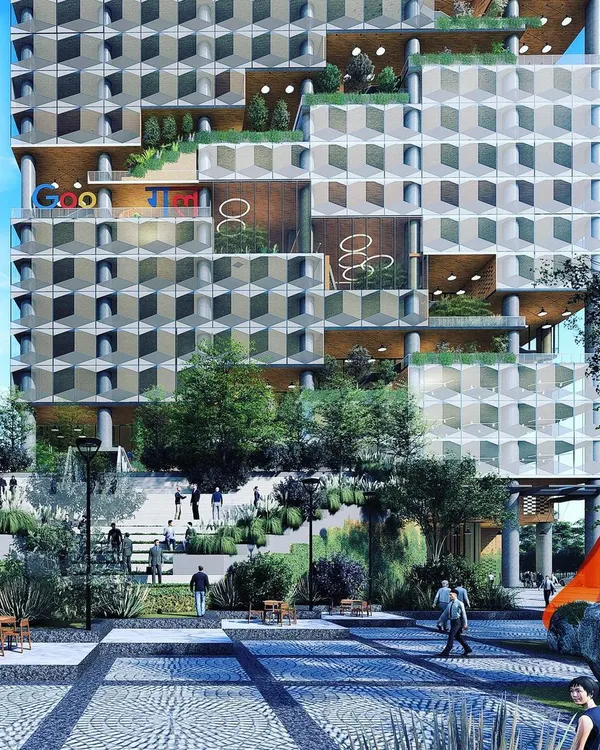
"The Minarets" is an urban oasis, a place for all. This building, with its fully reflective facade, disappears into the forest, becoming a part of the landscape. The architecture is discrete, allowing nature to be the protagonist.
An amphitheater and public seating area within the "Urban Oasis." We designed this 4-acre site to be a democratic space, with tons of activities for the whole family, centered around a stream of water, great food, and people.
A quiet moment in the "Urban Oasis." The minimalist, reflective buildings are set within a landscape designed to create a dense forest, providing a much-needed escape from the hustle and bustle of the city.
The "Minarets" are tall, slender towers that serve as vertical green lungs and observation points within the urban oasis. They are landmarks that signal the presence of this unique public space.
A physical model of the "Urban Oasis." This top-down view shows the layout of the minimalist buildings, the flowing stream, and the dense grid of trees that define this master plan.
An axonometric view of the "Urban Oasis" model. This shows our vision for a new kind of public space in our cities, a place for families to spend an entire day filled with activities, socializing, and great food.
About Urban Oases & Master Planning
In our master planning, we treat the ground plane as a porous, public asset rather than a private privilege. For projects like our urban oases, we prioritize vehicular segregation and native forestry, ensuring that even in dense developments, residents have direct access to water bodies, open plazas, and pedestrian-friendly sky-parks that actively cool the built environment.
Urban planning is not about filling space; it is about creating relationships between buildings, people, and the environment. At Studio Chintala, our process begins with intensive site analysis—studying solar paths, wind patterns, and topography to guide our zoning strategies. We move away from traditional, rigid site layouts to design vertical villages that integrate sky-parks, connecting bridges, and layered amenities. This approach keeps public areas accessible at all levels, preventing the isolation often found in typical high-rise environments.
We emphasize technical sustainability by planning for heat island reduction, native landscaping, and natural water management, effectively creating self-sustaining microclimates. Whether we are planning for large-scale township strategies or mixed-use tech campuses, our goal remains consistent: to design functional, democratic ecosystems that prioritize the pedestrian experience over vehicular convenience. We define our success by how effectively our master plans foster community interaction while minimizing the building footprint.
Similar work from other experts
Browse through Curated picks from other experts on mytribe
 26
26
Urban Master Planning & Community Hubs
 22
22
Thoughtful Landscape and Urban Design for Modern Spaces
Holistic Community Masterplanning for Integrated Spaces
 4
4
Community Master Planning and Urban Layout Design
 17
17
Urban Community Hubs and Landscape Design
 17
17
Master Planning for Urban Sanctuaries and Gated Communities
More from Architecture & Master Planning by Studio Chintala
More services by Studio Chintala