Urban Master Planning & Community Hubs
We design large-scale environments where people, nature, and infrastructure coexist. Our master planning focuses on creating community-centric spaces that encourage connection and belonging.
A ground-level view of the Urban Ladder campus concept, showing the interaction between the innovative building facade and the public green space. The design encourages social gathering and brings energy from the city into the workplace.
The Myhome Vipina clubhouse was conceived as a campus, not a single building. This render shows the central courtyard, a social hub with seating and greenery that connects the different functional blocks of the club.
An interior view of the Myhome Vipina clubhouse cafe, which opens directly onto the landscaped courtyard. The seamless connection between inside and outside is a key part of our design philosophy for creating breathable, open community spaces.
A closer look at the waterfall feature at the Myhome Vipina clubhouse. This element is not just decorative; it creates a relaxing ambiance and a unique gathering spot within the larger residential master plan.
The brick step-amphitheater at the Myhome Vipina clubhouse provides informal seating and a place for community events. It demonstrates our focus on creating versatile public spaces that residents can adapt for various uses.
This view of the Myhome Vipina clubhouse highlights the interplay of covered seating areas, open gardens, and water features. Our master planning focuses on creating a variety of experiences within a single community space.
A central tree becomes a focal point in the Myhome Vipina clubhouse courtyard. Preserving and highlighting natural elements is fundamental to how we approach site planning and landscape architecture.
The covered outdoor lounge at Myhome Vipina offers a comfortable, shaded space for residents to relax and socialize. The design uses natural materials and openings in the roof to maintain a connection with the sky and surrounding greenery.
The stepped seating at Myhome Vipina is integrated directly into the landscape, blurring the line between building and garden. This approach creates a more organic and inviting environment for community interaction.
The cafe at Myhome Vipina is designed as a transparent pavilion, allowing views and movement to flow through it. This reinforces the idea of the clubhouse as an open, interconnected campus.
About Urban Master Planning & Community Hubs
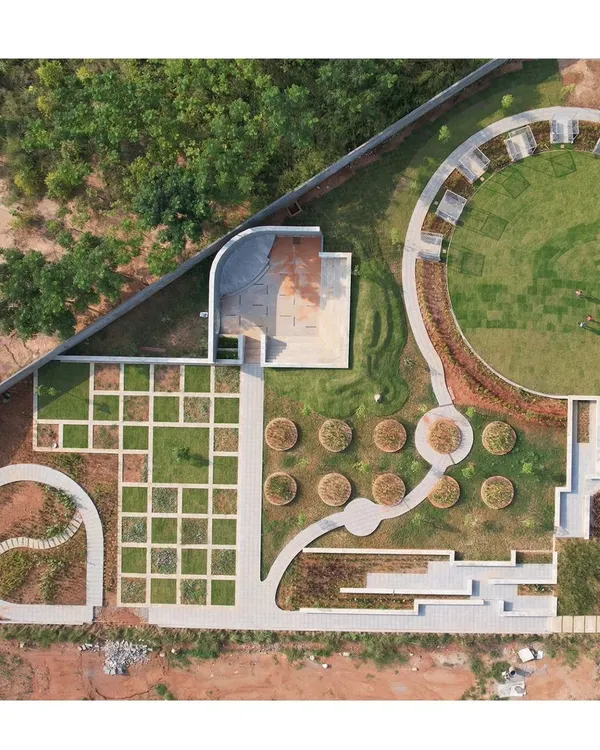
We don't treat master planning as a purely top-down exercise in zoning. Instead, we look at the 'in-between' spaces—the amphitheatres, green corridors, and courtyards—where residents and employees actually cross paths. Whether we are planning a commercial campus or a residential township, our process begins by mapping existing water flows, vegetation, and topography to ensure the site functions as a cohesive campus rather than just a collection of disconnected buildings.
Our Approach to Master Planning
For us, a master plan is a framework for living. It requires balancing high-density requirements with human-scale needs. We start with rigorous site diagnostics: analyzing sun paths for optimal orientation, mapping hydrology to preserve natural water flows, and conducting context studies to respect the local fabric.
Integrating Community and Nature
- Social Infrastructure: We prioritize shared spaces. In our work on projects like the Centre for Excellence or Myhome Vipina, we stitch public nodes—community halls, open-air amphitheatres, and garden plazas—into the site layout. These aren't afterthoughts; they are the anchors that bring the community together.
- Biophilic Design: Nature is non-negotiable. We often shift building footprints to preserve mature trees or layer green balconies and terraces into the facade design. This creates a campus-like feel where the indoors and outdoors constantly interact.
- Technical Rigor: Planning for 5-acre sites or million-square-foot hubs involves complex variables like vehicular circulation, FAR (Floor Area Ratio) management, and infrastructure efficiency. We create detailed design codes—specifying material palettes, facade guidelines, and building heights—so that while the site develops organically over time, the master plan maintains its integrity.
Our goal is to build spaces that feel right today and remain relevant as the city grows around them.
Similar work from other experts
Browse through Curated picks from other experts on mytribe
 4
4
Community Master Planning and Urban Layout Design
 17
17
Urban Community Hubs and Landscape Design
 22
22
Thoughtful Landscape and Urban Design for Modern Spaces
Holistic Community Masterplanning for Integrated Spaces
 15
15
Masterplanning Services for Residential Communities
Master Planning for Residential Communities
More from Urban Design & Master Planning by Architecture Dialogue
More services by Architecture Dialogue