Innovative Housing and Co-Living Architecture
We design residential environments that prioritize human connection and structural clarity. Our approach balances private living quarters with shared community amenities to create functional homes for the modern urban resident.
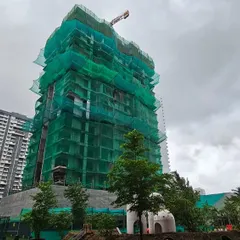
For this co-living project, we used a large, perforated mesh screen to wrap the facade. This allows for ample natural light while obscuring visual clutter like air conditioning units, maintaining a coherent and clean aesthetic.
A low angle view of the "LOCAL" co-living facade. The mesh screen gives the building a translucent, ethereal quality, while the bold graphics create a strong brand identity.
This video explains our design for a co-living project in Whitefield, Bengaluru. It addresses the need for affordable, hygienic, and community-oriented housing for young migrants, with a porous ground plane and a range of shared amenities.
A low angle view of our co-living project in Whitefield. The design features a transparent mesh facade that provides privacy for residents while creating a clean, modern aesthetic.
The ground plane of the co-living project is designed as a vibrant urban space, buzzing with activity. A rooftop cafeteria, open to the community, further engages the building with the city.
The "LOCAL" co-living project is designed to provide an exciting housing option for young professionals. The building's clean, modern form and a focus on shared amenities create a new standard for urban living.
The perforated mesh screen on the facade of the co-living building allows for natural light to diffuse into the living spaces while preserving outward views from within the units.
The Bagmane Co-living project is the future of campus design. It combines co-working, co-living, and retail in a single mixed-use project, allowing young tech employees to live, work, and socialize without arduous commutes.
A sectional diagram of the Bagmane Co-living project. This shows the vertical transportation cores and the "breathing" spaces, or open atriums, that allow for natural light and ventilation throughout the building.
These diagrams illustrate the design concept for the Bagmane Co-living project. They show the distribution of functions, from retail at the base to co-living towers above, and the integration of green spaces throughout the project.
About Innovative Housing Solutions
In projects like our Whitefield co-living development, we used perforated mesh facades to resolve the tension between admitting natural light and maintaining privacy. This architectural choice effectively screens visual clutter, such as air conditioning units, from the street view. It ensures the building maintains a clean, coherent aesthetic while allowing residents to enjoy a comfortable, diffused interior atmosphere.
Our approach to housing is rooted in the belief that design should foster community, not just provide shelter. In dense metropolitan environments like Bengaluru, the challenge is to create residential projects that remain breathable and social. We address this by focusing on the ground plane, designing it to be porous—integrating retail, cafeterias, and communal hubs that invite engagement with the city rather than turning inward.
For our Bagmane co-living project, we applied this logic to create a vertical village. We integrated co-working, co-living, and retail functions to minimize commute times and maximize quality of life for tech professionals. Structurally, this requires advanced large-span engineering to keep floor plates flexible and column-free, allowing the building to adapt as the needs of its occupants evolve.
We design for the reality of migration to modern cities. Young professionals need more than a bedroom; they require integrated amenities, study zones, and laundry facilities that function efficiently. Our goal is to move beyond the standard PG model by implementing rational, robust architecture that respects the resident's need for both solitude and social interaction. Every decision, from the facade composition to the distribution of green spaces, is driven by the logic of creating a sustainable, long-term urban asset.
Similar work from other experts
Browse through Curated picks from other experts on mytribe
 26
26
Innovative Co-Living & Student Housing Design
 10
10
Architecture for Community and Urban Living
 12
12
Designing Urban and Multi-Family Housing
 10
10
Modern Apartment and Community Architecture Design
 15
15
Urban Living Reimagined: Designing Sustainable Apartment Homes
 4
4
High-Rise Residential Communities
More from Architecture & Master Planning by Studio Chintala
More services by Studio Chintala