Community and Cultural Architecture Projects
We design spaces that bring people together, honoring tradition while embracing modern, functional architecture. From revitalizing sacred temple paths to creating ecosystems for rural artisans, our work seeks to empower communities through honest, sustainable design.
We are honored to be working on the design of the Mada Streets at the Tirumala Temple in Tirupati, one of the holiest spiritual places in the country. This animated diagram shows our concept for the circumambulatory path and surrounding infrastructure.
To save traditional crafts, we must elevate them to the status of "art." This video shows our design for a "Goldsmith's Souk" in Narayanpet, Telangana, a 6 acre live work campus with shops, workshops, and housing on a scenic hilltop.
The Amaron SDC Boys Hostel in Chittoor is a 20,000 sqft project that prioritizes functionality and the well being of its residents. The design, with its deep-set windows and vertical fins, is driven by the need for thermal comfort and natural ventilation.
The hostel is designed to be a safe, comfortable, and resilient environment for students. The clean, modern facade sits comfortably in the rural landscape, providing a sense of belonging and promoting physical well being.
This is our Weaver's Training Facility in Narayanpet, Telangana, under construction. The project is more than just a building; it is an ecosystem designed to celebrate tradition, foster innovation, and unite the local weaving community.
The concrete frame of the Weaver's Training Facility seen from the road. The simple, robust structure is designed to be a flexible and functional space for artisans, preserving an ancient art and providing a platform for creativity.
The Weaver's Center is designed as a series of interconnected blocks, creating courtyards and shaded walkways. This approach helps to break down the scale of the building and fosters a sense of community and interaction.
A rendering of the completed Weaver's Center, showing the vibrant street life we envision. The workshops will be open and transparent, allowing the public to engage with the artisans and their craft.
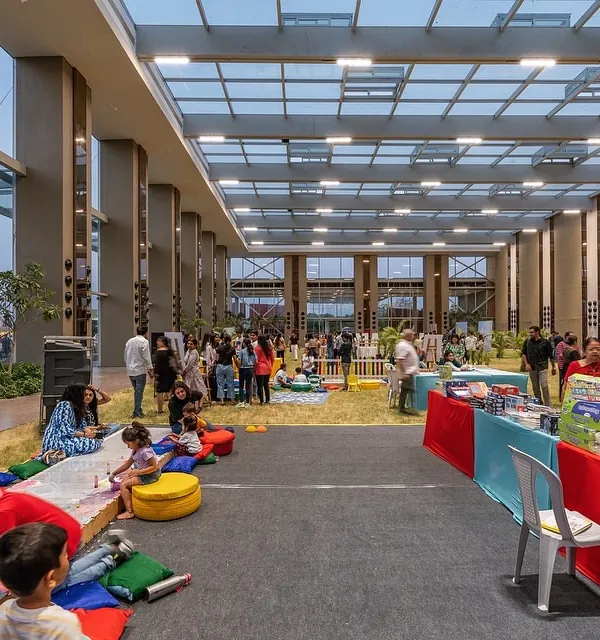
An Early Childhood Development Center should be a neutral space that allows children to evolve without the burden of a stylized environment. Our design uses a simple industrial structure with glass-walled classrooms opening onto a central, green corridor.
We question the assumption that children's spaces need to be thematically designed with an over emphasis on color. Here, we prioritize natural light, simple textures, and a connection to nature to emphasize the subtler aspects of experience.
About Community & Cultural Projects
When we design a community center, like our Weaver's Facility in Narayanpet, we are not simply building walls. We map the site circulation to encourage artisan interaction, optimize the structural frame for natural cross-ventilation to maintain thermal comfort, and use an exposed, robust skeleton that celebrates the raw, honest nature of the craft it houses. We build for the long term, ensuring the structure supports the activity, not the other way around.
Architecture as a Social Catalyst
Architecture is the stage upon which community life unfolds. Whether we are planning the Mada Streets at the Tirumala Temple or developing a training center for weavers, our objective remains the same: to create neutral, functional, and dignified backdrops that allow culture to flourish. We reject the idea that civic buildings must be grandiose or ornamental. Instead, we prioritize clarity, accessibility, and resilience.
Supporting Traditional Livelihoods
Traditional crafts are the backbone of our economy, yet they often struggle to compete with machine-made alternatives. Our approach to projects like the Goldsmith's Souk in Narayanpet is to integrate living and working. By designing campuses that combine shops, workshops, and housing, we create vibrant, self-sustaining ecosystems that elevate artisan work to the status of art, ensuring these traditions survive and thrive in a modern context.
Design for Well-being and Education
In our institutional work, such as the Amaron SDC Boys Hostel, we move beyond the standard dormitory model. We apply the same rigor here as we do in our luxury residential projects. This means focusing on deep-set windows for shading, logical layouts for passive cooling, and shared spaces that foster physical well-being. We believe a student hostel should be a safe, resilient environment that provides a sense of belonging, not just a place to sleep.
Our Methodology
Our process is rooted in logic. We conduct exhaustive research into site contours, wind patterns, and the specific needs of the community before drawing a single line. Sustainability is not an added feature for us, but the baseline of our design. We use local materials and passive engineering to minimize energy consumption, creating community infrastructure that is as efficient as it is welcoming.
Similar work from other experts
Browse through Curated picks from other experts on mytribe
 6
6
Community and Cultural Architecture Projects
 6
6
Designing for Education & Community: Spaces for Learning
 36
36
Thoughtful Spaces for Learning and Community
 5
5
Cultural and Community Architecture Design
 14
14
Hospitality, Cultural & Institutional Architecture Projects
 58
58
Public & Community Architecture for Social Impact
More from Architecture & Master Planning by Studio Chintala
More services by Studio Chintala