Architecture in Harmony with Nature
We design spaces that do not just sit on the land, but breathe with it. By integrating natural wind tunnels, preserving mature tree cover, and employing passive cooling, we ensure our architecture works with the environment rather than against it.
This presentation for the London Design Biennale highlights the botanical ecology of our Titan Integrity Campus. The design features extensive green roofs and preserves the site's natural water body, creating a thriving ecosystem.
Our water management strategy for the Titan Campus, which includes comprehensive rainwater harvesting and treatment. The system collects water, channels it through collection tanks, and reuses it, minimizing the project's water footprint.
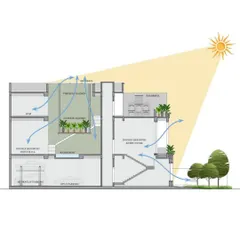
This video illustrates how the Titan Campus design responds to sunlight. The building's orientation and the use of green buffers on the western facade mitigate heat gain, ensuring thermal comfort through passive means.
The installation of a radiant cooling system at the School of Architecture, VIT. This energy-efficient system uses chilled water pipes in the floor slabs to lower the ambient temperature, providing a sustainable alternative to conventional air conditioning.
A duplicate image showing the radiant cooling pipe layout. This technology is a key part of our climate-responsive design approach for buildings in hot climates.
The academic blocks at VIT, designed with green screens and passive cooling strategies. The building's north-south orientation minimizes heat gain, while landscaped areas and wind tunnels help maintain a comfortable microclimate.
Another view of the VIT School of Architecture, where the design creates an interactive and environmentally responsive learning environment.
A diagram showing the planned wind tunnels at Brigade Parkside East. By strategically placing buildings, we create corridors for natural air movement, which helps in passively cooling the common areas and apartments.
This plan illustrates the distribution of green courts at the ground level of Brigade Parkside East. These landscaped spaces improve the microclimate, provide recreational areas, and ensure most apartments have a view of nature.
The site plan for the Karunashraya extension, showing how the new buildings were carefully placed to preserve all existing mango, jackfruit, and coconut trees. The architecture is woven around the landscape.
About Architecture in Harmony with Nature
We often replace standard air conditioning with radiant cooling systems integrated into floor slabs, significantly lowering ambient temperatures. This passive approach, combined with architectural elements like earth berms for natural insulation, allows our buildings to regulate climate internally rather than relying on heavy mechanical intervention.
Designing with the Site, Not Against It
Our design process begins long before we draw a line. We treat the existing site—its topography, soil, vegetation, and sun path—as the primary architect. By studying contour lines, we minimize land cutting and filling, ensuring the built form follows the natural slope of the terrain.
Climate-Responsive Techniques
We move beyond decorative green features to functional climate management. At the School of Architecture, VIT, we utilized radiant cooling, where chilled water pipes within floor slabs provide energy-efficient thermal comfort. At the DRL Leadership Academy, we used earth berms—large green mounds—to tuck classrooms into the ground, providing natural insulation and reducing heat gain.
Preserving Biodiversity
When a project site is rich with life, our goal is to weave the architecture around it. For the Karunashraya extension in Bengaluru, we mapped every existing mango, jackfruit, and coconut tree, adjusting our building footprint to ensure zero displacement of established flora.
Passive Cooling Strategies
Architecture in India does not require sealing a building from the outside. We use orientational strategies, such as north-south building blocks to capture wind tunnels, combined with green screens and water bodies, to create microclimates that remain comfortable throughout the year.
Similar work from other experts
Browse through Curated picks from other experts on mytribe
 24
24
Climate-Responsive & Biophilic Workplace Design
 27
27
Climate-Responsive & Sustainable Architecture
Architecture in Nature's Embrace: Design That Resonates
 10
10
Climate-Responsive Architecture and Passive Design
 33
33
Biophilic & Sustainable Residences in Delhi NCR
 14
14
Biophilic & Climate-Responsive Architectural Design
More from Multi-Family Residential Architecture by Mindspace
More services by Mindspace