Designing Architecture for Academic Communities
We approach academic campus design as a process of weaving new structures into an existing landscape, creating porous, human-centric spaces that encourage interaction and learning.
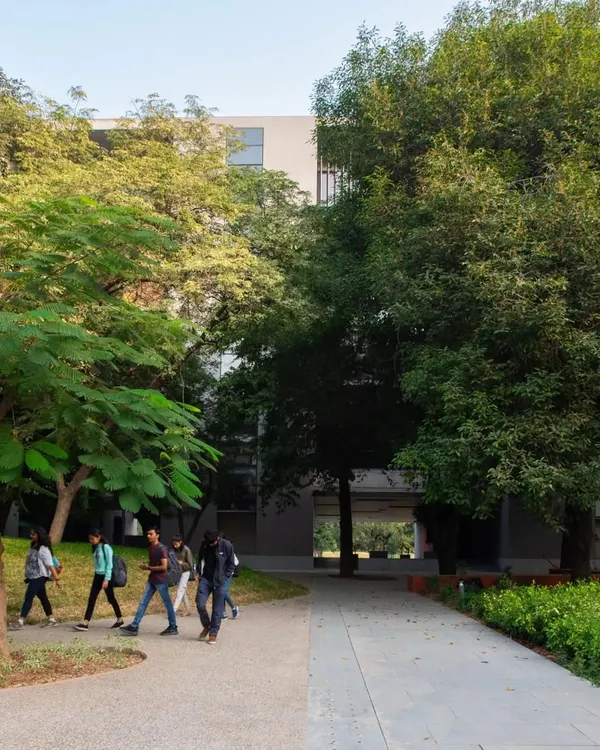
The entrance to the new hostel at IIM Bangalore, completed in 2022. The design uses a combination of exposed concrete and stone cladding to harmonize with the existing campus buildings designed by master architect B.V. Doshi.
A view into one of the hostel's internal courtyards. The building is designed to be porous, with openings and passages that allow for visual connections and natural light to penetrate deep into the block.
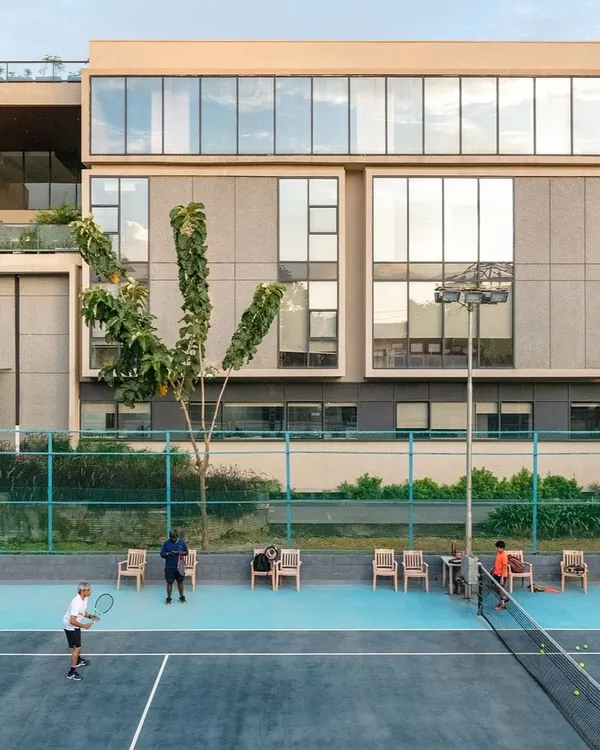
Students gathering in one of the interactive plazas at the IIM-B hostel. We designed these spaces to be vibrant hubs for events, sports, and informal gatherings, connecting different blocks and encouraging community life.
The curved hostel block at IIM-B, designed in two phases. The building's form wraps around a playground and preserves existing trees, creating a unique relationship between the architecture and the landscape.
The housing for married students at IIM-B, designed in 2002. This project explored a split-level, staggered arrangement to create dynamic spaces and provide each unit with either a private garden or a terrace.
The interior of a split-level unit for married students. The design creates interlocking spaces with free-flowing visual links, such as this view from the living area up to the study.
The IIM Sports Center, designed as a non-building that emerges from the green landscape. The structure is planned on two levels, responding to the site's contours and preserving existing trees.
The main circulation spine of the IIM Sports Center is a pergola-covered double-height space. The play of light and shadow from the pergola creates a dynamic experience while providing a sheltered connection between facilities.
We retained existing trees within the new hostel's courtyards. The stone retaining walls and paved walkways create usable outdoor spaces that respect the natural topography of the site.
A stone wall wraps the new hostel building, a direct response to the material language of the original campus. The main structure uses concrete and Tandur stone flooring for a neutral, timeless palette.
About Building Academic Communities
When we design for academic campuses, the most critical challenge is introducing higher density without disrupting the social fabric that already exists. In our work at IIM Bangalore, for instance, we resisted the impulse for high-rise blocks, opting instead for a G+4 structure that respects the existing campus height and preserves mature trees. We focus on using 'internal streets' and central courtyards to ensure that even as the student population grows, the building maintains an intimate, human scale that invites spontaneous interaction rather than isolation.
Our institutional work is rooted in the belief that buildings should not stand in competition with the landscape but should emerge from it. In the IIM Bangalore hostel project, we used a combination of exposed concrete and stone to echo the material language of the original campus, while using an aluminum pergola to mark the structure as a contemporary addition.
Balancing Density and Atmosphere
Academic life thrives on the spaces between classrooms and hostels. To facilitate this, we prioritize:
- Porous Circulation: Buildings are designed with corridors and atriums that allow for cross-ventilation and visual connectivity, ensuring students always feel connected to the larger campus.
- Adaptive Grids: Our institutional housing is planned with structural flexibility, allowing spaces to evolve as needs change, from study zones to medical bays if required.
- Material Continuity: We favor local materials like Tandur stone, which age gracefully and anchor new buildings into the existing context.
The 'Non-Building' Approach
For the IIM Sports Center, we challenged the definition of a standard facility. We conceived it as a 'non-building' that emerges from the green ground. By planning the facilities across two levels to respond to the site's natural contours, we created a structure that feels less like an imposing box and more like a series of platforms and sheltered walkways. This approach allows the sports center to serve as a hub for cultural activities, with wide steps and plazas that connect directly to the landscape, blending the boundaries between the built environment and the open air.
Similar work from other experts
Browse through Curated picks from other experts on mytribe
 5
5
Designing for Learning & Community: Porous Architectural Campuses
 10
10
Student and Co-Living Architecture Projects
 7
7
Public and Institutional Architecture Design
 13
13
Educational Architecture for Schools and University Campuses
 15
15
Sustainable Institutional Campus Architecture Design
 41
41
University & Academic Environments
More from Multi-Family Residential Architecture by Mindspace
More services by Mindspace