Science-Backed Training Principles for Peak Performance
Stop guessing your progress. We use force plates, movement data, and evidence-based protocols to build your capacity, prevent injury, and ensure your training actually moves the needle.
Eccentric strength, the ability to control force while a muscle lengthens, is the foundation that many athletes overlook. This anatomical view of the bicep illustrates the muscle action that is critical for absorbing impact and preventing injury.
Understanding the difference between concentric, eccentric, and isometric contractions is key to smarter training. Eccentric training, or the lengthening phase, is what helps athletes absorb impact, reduce load on joints, and improve movement quality.
If you only focus on getting stronger without building eccentric control, you are leaving performance on the table. Eccentric strength is what allows you to absorb load, protect your joints, and move efficiently at high speeds.
The science is very clear. Studies show that eccentric-focused training can reduce hamstring injury rates by over 40% and improve muscle fascicle length. Performance isn't just built, it's protected.
Building eccentric strength can be done with simple, practical applications. Nordic hamstring curls, tempo squats with controlled lowering phases, and slow eccentric push-ups are all effective ways to create measurable change.
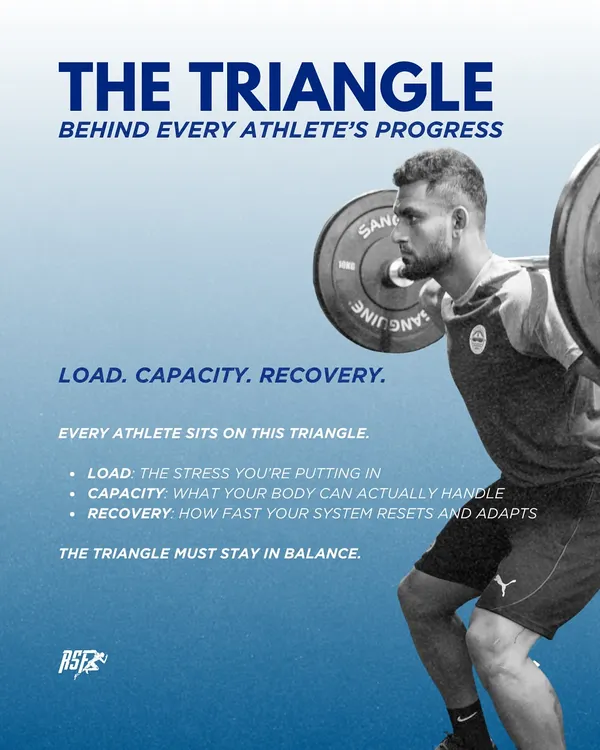
If you've hit a performance plateau, it's time to look at the balance between your training load, your body's capacity, and your recovery. Pushing hard without adequate recovery will leave you feeling flat and stop your progress.
Every athlete's progress sits on a triangle of load, capacity, and recovery. Load is the stress you apply, capacity is what your body can handle, and recovery is how it adapts. This triangle must stay in balance for you to improve.
Generic, one-size-fits-all training plans fail most athletes because they ignore hidden weaknesses, individual movement patterns, and specific sport demands. This often leads to plateaued progress or, even worse, re-injury.
Individualization is non-negotiable. Two footballers of the same age might look similar, but one may have explosive strength with poor deceleration, while the other has endurance but lacks force development. Their plans must be different, or one of them will break.
Injuries sideline athletes more than competition does. Research shows millions of sports-related injuries occur each year, with most happening during practice. This highlights the critical need for building resilience through smart, preventative training.
About Science-Backed Training Principles
We don't design programs based on what worked for someone else. Your training starts with a mandatory 90-minute diagnostic session using force plates and video analysis. By measuring your landing mechanics, quad-hamstring ratios, and rate of force development, we create a baseline that tells us exactly where you are strong and where you are prone to injury.
Moving Beyond Guesswork
Most fitness plans are built on assumptions. They assume everyone responds to volume the same way or that a generic squat will fix every movement deficit. At RSF, we treat training like a science experiment where we are constantly gathering data. Whether you are an elite athlete or a recreational lifter, your performance sits on a triangle: Load, Capacity, and Recovery. If these three factors are not balanced, your progress plateaus or you get injured.
Why Eccentric Strength Matters
Many athletes focus entirely on concentric strength—the 'up' phase of a lift. However, eccentric control—the ability to control force while a muscle is lengthening—is what keeps you on the field. This is the foundation of our injury prevention strategies. By incorporating movements like Nordic hamstring curls and tempo-controlled squats, we strengthen the muscle-tendon system, which significantly reduces the risk of strains and tears during high-speed activity.
Our Data-Driven Process
- Diagnostic Assessment: We use jump mats, dynamometers, and force plates to quantify your current abilities.
- Programming: Your plan is built using the TeamBuildr or Traqade app, ensuring your training load is monitored daily.
- Adjustment: We don't just track weight lifted; we track fatigue, cycle-synced adjustments (for female athletes), and stress levels. If your recovery metrics are down, we dial back the intensity to ensure you aren't training into a hole.
We provide a warehouse-style environment specifically designed for serious work. You won't find AC or mirrors here—just turf, sleds, Olympic platforms, and coaches who know how to read the data behind your lifts.
Similar work from other experts
Browse through Curated picks from other experts on mytribe
 9
9

Train with Purpose: Our Science-Backed Approach to Fitness
 12
12
The Science of Strength & Conditioning
The Science of Peak Performance in Basketball
Strength and Conditioning for Peak Athletic Performance
 6
6
Scientific Approach to Training for Athletes in Mumbai
 6
6
Science-Based Athlete Coaching and Performance Training
More from Female Athlete Training by Rapid Sport Fitness