Master Traditional Shaolin Forms
Develop discipline, coordination, and authentic martial movement through foundational Shaolin sequences. From basic sets to advanced forms, learn to move with structure and intent.
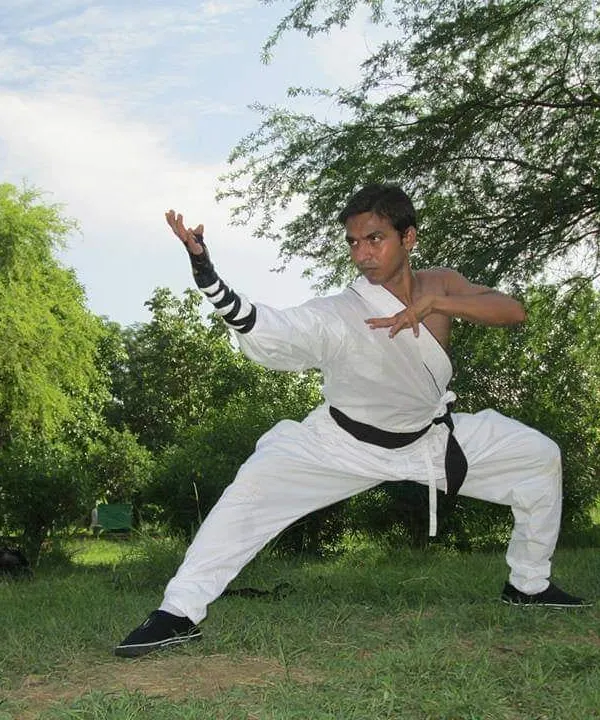
This is a demonstration of the Chakrapani form during a morning workout. The movements are designed to build internal energy and coordination, following specific patterns on the floor to ensure precision.
Another view of a morning workout practicing Shaolin Kung Fu forms. Consistent practice, even in simple settings, is the only way to master the art.
Training continues no matter the time or place. Here I am practicing a basic form at night, focusing on maintaining structure and power in every movement.
This is the traditional Shaolin salute, performed in my Delhi training hall. It represents respect for the art, the teacher, and fellow students, and is the start and end of every practice.
A student practices a fundamental Shaolin form. Notice the transition between stances and the coordination of hand and foot movements, which are essential for building a strong Kung Fu base.
This student is practicing the Gongfu Quan form outdoors. Training in nature helps connect the body's energy with the environment, enhancing the flow and spirit of the movements.
Performing a low stance from a traditional form at a temple in China. These stances build leg strength, stability, and a low center of gravity, which are crucial for generating power.
In front of the Thousand Buddha Hall at the Shaolin Temple, I practice a classic Kung Fu stance. The environment of the temple provides a powerful connection to the history of the art.
About Traditional Shaolin Forms
People often want to jump into complex sequences immediately, but here we focus on the stance first. If your body weight peeche rahega (stays back) or your center of gravity is too high, the form loses its power. We start with Ma Bu (horse stance) because that is where stability is born. You will spend time perfecting one movement before we ever move to the next.
Forms are the library of Shaolin. They are not just choreography; they are combat scenarios, breathing exercises, and conditioning drills all rolled into one. When you perform a sequence like Shaolin Tong Bi Quan or Gongfu Quan, you are not just mimicking moves. You are teaching your body to move as one unit.
We start with the basics because if the root is weak, the tree falls. My training in the Shaolin Temple taught me that shortcuts do not exist. Whether you are learning a simple striking pattern or an advanced form, the standard remains the same. You will sweat, you will hold stances until your legs shake, and you will learn the discipline of repetition. This is not a gym where you come to distract yourself. This is a place where you come to build your spirit.
We train in a dedicated dojo in Shahpur Jat, New Delhi, using traditional mats and impact-absorbing flooring. We keep the environment focused. Whether you are a beginner or looking to refine your existing skills, the goal is the same: to master the fundamentals so thoroughly that the movement becomes second nature. Train with consistency, and the form will change you.
Similar work from other experts
Browse through Curated picks from other experts on mytribe
 10
10
Traditional Shaolin Arts
Kung-Fu Foundation and Form Training
Master Karate Kata and Kihon: Traditional Shito-ryu Training
Karate Kata and Traditional Weapons Training
Taekwondo Poomsae & Technical Drills in Delhi
Mastering Shotokan Karate: Kata & Kihon
More from Chinese Martial Arts by Shi Yan Xiang
More services by Shi Yan Xiang