Master Advanced Yoga Through Anatomy and Proper Technique
Yoga is not magic, it is mechanics. Learn the anatomy, alignment, and drills that build a safe, sustainable, and truly advanced practice.
A student asked what every yoga teacher should know before teaching a pose. I explain the importance of knowing the Sanskrit name, the joints and muscles involved, and the type of movement like flexion or extension. This anatomical knowledge is what prevents injury and ensures safe practice.
Many of you ask which anatomy books I recommend for yoga teachers. In this video, I share my must-read list, including the fantastic series by Ray Long. Understanding the body's mechanics is what elevates your teaching from just giving cues to providing deep, functional guidance.
Here is a tutorial for a playful but challenging transition: Bakasana (Crow Pose) roll to Astavakrasana (Eight-Angle Pose). I break down the movement step-by-step, focusing on core control and hand placement. This is the kind of detailed instruction you can expect in my classes.
In this tutorial for the Bakasana roll to Astvakrasana, I emphasize the importance of moving slowly. Rushing through transitions means your mind can't keep up. To build control, you have to be deliberate and conscious of every micro-movement.
This is a transition sequence I give my students for homework. It involves moving from Plank to Urdhva Mukha, Adho Mukha, and jumping into Bakasana. This flow builds strength, balance, and body awareness, teaching you to control each movement.
This is a must-try transition from Reverse Plank to Chakrasana (Wheel Pose). I demonstrate how to shift your weight onto your legs to free your arms, moving mindfully into the backbend. It's a beautiful way to build both strength and flexibility.
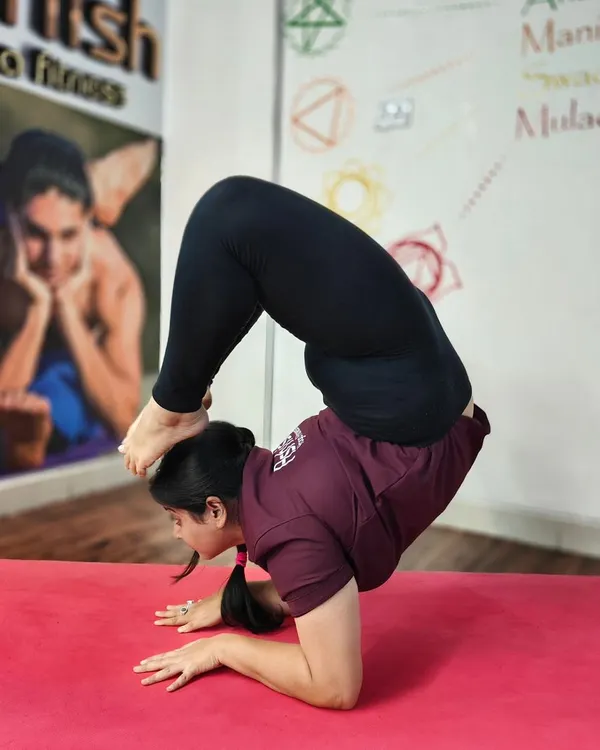
Here is a detailed tutorial for the Forearm Kickover. I guide my student through her first attempt, focusing on dropping the elbows, elevating the shoulders, and using the right amount of momentum. This is how we break down fear and build complex skills safely.
Watch another student's first attempt at a Forearm Kickover. I provide real-time cues on elbow placement, walking the feet forward, and lifting one leg at a time. This hands-on, detailed guidance is what helps students achieve breakthroughs.
A good teacher never compromises on alignment or form, even if it means being a little strict. Here, I'm using blocks and the wall to ensure a safe and deep backbend, focusing on correct technique over just achieving a shape. This is a core principle of my teaching.
Don't just copy others blindly. Learn from their journey, not just their reels. Here I am practicing a supported Pincha Mayurasana, a drill I mastered before teaching it. I only teach what I have lived and understood in my own body.
About The Teacher's Corner: Anatomy & Pose Breakdowns
Focusing on anatomy over ambition is the only way to progress safely. In my classes, we don't just hold poses; we break down muscle engagement, joint mechanics, and safe exits. If you are tired of blindly copying shapes from Instagram and ready to actually understand the why behind your movement, you are in the right place.
Moving Beyond The Shape
Most people think advanced yoga is about how deep the backbend is or how long you can hold a handstand. In my classes, we strip that away. True advancement is knowing exactly which muscle is firing and which joint is bearing the load. Whether it is a Bakasana roll or a Reverse Plank, my focus remains on the biomechanics—agonist versus antagonist muscle groups, joint safety, and deliberate, controlled movement.
The Shashi Method: Technical and Strict
I believe in building a foundation that lasts. This means I won't sugarcoat your progress. If your alignment is off, I will call it out. We use props like blocks and straps not as crutches, but as tools to understand our own limitations and potential. You will learn to identify flexion, extension, and compression, giving you the knowledge to practice without fear of injury.
What You Will Actually Learn
- Anatomical Literacy: Learn the Sanskrit names and the functional purpose of every pose.
- Progressive Drills: We don't jump into peak poses. We build strength through specific, repeatable drills that train your nervous system.
- Safe Transitions: Moving between poses is where most injuries happen. We practice the control needed to flow from one shape to the next.
My goal is to make you your own best teacher. You should leave my class understanding why your body reacts the way it does, empowered to practice anywhere—whether that is in a studio or at home on your own mat.
Similar work from other experts
Browse through Curated picks from other experts on mytribe
 7
7
Master Yoga Alignment: Safe Techniques for Every Pose
In-Depth Yoga Anatomy Training for Teachers
 52
52
Mastering Advanced Asanas and Inversions
Master Yoga Alignment: Pose Guides for Safe Practice
Master Difficult Yoga Poses with Step-by-Step Guides
Mastering Yoga Asanas with Correct Alignment
More from Advanced Yoga Anatomy & Asana Course (Online) by Shashi Prabha Dwivedi
More services by Shashi Prabha Dwivedi