Master Handstands and Arm Balances Safely
Getting upside down isn't about showing off. It’s about building the core strength, balance, and quiet mind that lets you hold your own.
Using a tree for support to work on a handstand variation. Props, whether in nature or the studio, are excellent tools I use in my coaching to help you build confidence and proper alignment in inversions.
A wall-assisted handstand drill, focusing on tucking and extending the legs. Using a wall is a key part of my handstand progression training to build endurance and control before attempting a freestanding hold.
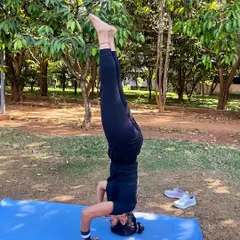
A stable and aligned supported headstand, or Sirsasana. We work on engaging the shoulders and core to take pressure off the neck, making this powerful inversion accessible and safe.
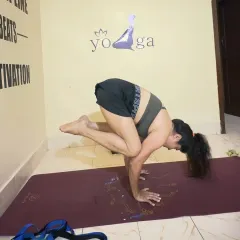
Holding Bakasana, or Crow Pose, a foundational arm balance that builds incredible wrist and core strength. I teach the mechanics of weight distribution to help you find that moment of liftoff.
Practicing an inverted split on the bar, a calisthenics-based exercise that builds active flexibility and core control. This demonstrates how we can blend different disciplines to improve your yoga practice.
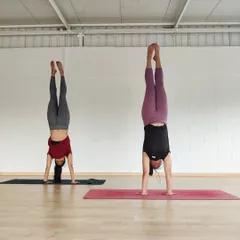
Working on a straddle handstand in a doorway. This drill helps develop the balance and hip flexibility needed for press handstands and other advanced entries.
Combining traditional strength training with a Mugdar and finishing with a headstand. This shows my integrated approach to fitness, where we build functional strength to support our yoga practice.
Finding a moment of peace with a handstand by the river in Leh. The ability to find your balance and hold an inversion in any environment is a true test of mind-body connection.
A headstand flow sequence at Pangong Lake. This video shows variations like eagle legs and straddle splits while inverted, demonstrating how to add dynamic movement once you've mastered the basic hold.
Holding a forearm stand, or Pincha Mayurasana, with the mountains of Ladakh in the background. This inversion requires significant shoulder and back strength, and I provide specific drills to build up to it.
About Inversions & Arm Balances
You don't need to be naturally flexible to start these. I teach you how to fall safely first—because if you aren't afraid of the floor, you'll actually put weight into your hands. We use wall-assisted drills to build the muscle memory so you stop kicking and start balancing.
People think inversions are just about being bendy. They are wrong. They are about physics and grit. Whether you are aiming for your first Crow pose or working on pressing into a handstand, my approach strips away the intimidation.
We start with the exit strategy. Yes, we learn how to fall. Once you know how to tumble out of a pose without getting hurt, your brain stops screaming stop every time your feet leave the ground.
My sessions integrate traditional yoga flows with calisthenics-inspired conditioning. We work on:
- Shoulder stability: Keeping your base locked.
- Wrist conditioning: Preparing your joints for the load.
- Core engagement: Learning where your center of mass actually lives.
If you have been stuck kicking at a wall for months, we will switch up the cues. Sometimes, all you need is a different perspective on alignment to unlock that moment of floating. Let's stop guessing and start training.
Similar work from other experts
Browse through Curated picks from other experts on mytribe
Master Inversions and Arm Balances Safely
Finding Strength Upside Down: Inversions & Arm Balances
Master Inversions and Arm Balances Safely
Mastering Headstands & Arm Balances Step-by-Step
Advanced Yoga Inversions & Skill Building
Build Core Strength & Master Inversions
More from Yoga & Flexibility Coaching by Vaishnavi Jaiswal
More services by Vaishnavi Jaiswal