Discover Precision and Awareness in Iyengar Yoga
Iyengar Yoga is not about replicating a perfect shape; it is about the intelligence of movement. Explore how alignment, specific prop usage, and consistent practice build a deeper, more sustainable connection between your body and mind.
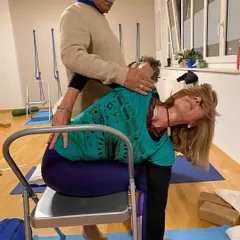
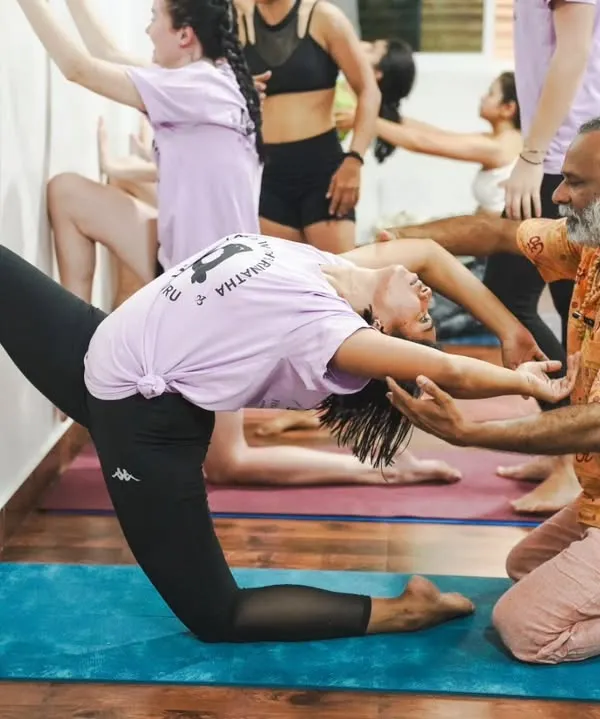
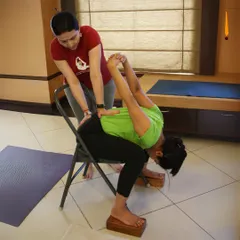
Do you soar when you arch back? Here, we use a chair and bolsters not as a shortcut, but as a tool to understand the mechanics of a deep backbend, allowing the spine to extend and the chest to open safely, creating a feeling of lightness and expansion.
I am proud to have been part of Rohan Bopanna's journey, as featured in The New York Times. This shows how Iyengar yoga can be a powerful tool for professional athletes, helping with performance, recovery, and career longevity through precise, mindful practice.
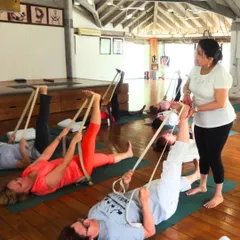
The wall ropes, a signature prop in Iyengar yoga, allow us to explore asanas with a unique sense of lightness and suspension. This practice, known as Yoga Kurunta, helps decompress the spine and access movements that might be challenging on the floor.
A common myth is that headstands are dangerous or cause high blood pressure. With correct technique and alignment, Sirsasana (headstand) can be calming and strengthening. Here, I am providing hands-on assistance to ensure the shoulders are engaged and the neck is safe.
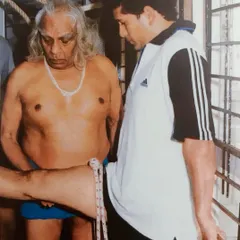
Why are instructions in Iyengar yoga so intricate? Because precision matters. Here, I use the analogy of imaginary chopsticks to explain the subtle but crucial action of aligning the ankle bones, a detail that transforms the foundation of a pose.
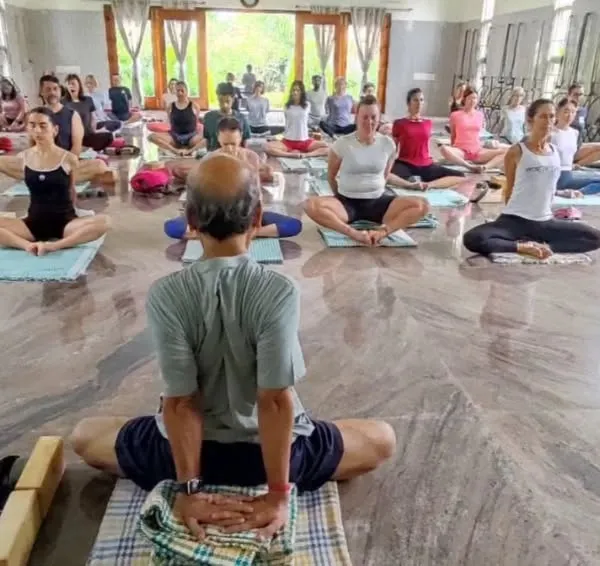
This is a glimpse into one of my international workshops in Bogota, Colombia. The energy of a group class is palpable, creating a shared space for learning, exploration, and connection, whether you are in Bangalore or across the world.
Our studio often feels like a laboratory where we experiment with poses. This is partner work on a specialized backbend bench, showing how we collaborate to safely explore deeper spinal extension and shoulder opening, making the practice interactive and insightful.
I often get asked, "Am I doing this wrong?" My teaching encourages you to move beyond right and wrong, and instead cultivate awareness. This video explores the philosophy that unless an action is causing harm, it is an opportunity for learning, not a mistake.
About Featured
In my studio, we use props—like wall ropes, chairs, and blocks—not as shortcuts, but as tools to decode complex postures. If you have been struggling with a stiff back or are navigating an injury, these supports allow you to find correct skeletal alignment without strain, helping you access deeper layers of the pose safely and with greater understanding.
Why We Approach Yoga as a Laboratory
Many students come to The Practice Room because they feel yoga is merely a sequence of repetitive exercises. My classes are structured differently. I treat the studio as a laboratory where we deconstruct asanas. We investigate the mechanics—how the ankle bones align, how the shoulders engage, and why certain movements are contraindicated for specific conditions. This is the hallmark of the Iyengar method.
The Role of Props
If you see ropes on the wall, chairs, or bolsters, know that these are sophisticated instruments for self-study. They provide the support necessary to hold poses long enough to feel the physiological and psychological shift. Whether you are a total beginner or a seasoned practitioner, props remove the barrier of 'not being flexible enough,' allowing you to focus on the alignment of the body rather than the struggle to touch your toes.
Our Philosophy: Beyond the Right and Wrong
I often ask my students: 'Why are we doing this?' We move away from the binary concept of 'correct' or 'wrong' posture and toward the concept of appropriate action. Unless a movement causes harm, it is a chance to learn. This approach is particularly effective for those seeking therapeutic benefits—whether for wrist pain, shoulder stiffness, or sports recovery. We focus on building a practice that serves your life, not just your performance on the mat.
If you are ready to move beyond basic repetition and dive into the mechanics of your own movement, our Introductory Immersion Course is the place to start. It covers the fundamentals of our methodology, ensuring you have the safety protocols and equipment knowledge needed to progress in our monthly batches.
Similar work from other experts
Browse through Curated picks from other experts on mytribe
Iyengar Yoga: The Art of Alignment
 8
8
Authentic Iyengar Yoga with Arunji
The Science of Asana: Prop-Based Practice
Deepen Your Practice with Certified Iyengar Yoga Workshops
 76
76Hatha & Iyengar-Inspired Yoga: Precision and Alignment
The Iyengar Method: Precision, Props & Practice
More from Iyengar Yoga Classes and Workshops by The Practice Room
More services by The Practice Room