Featured Architectural Projects and Design Philosophy
A showcase of our approach to people-centric, sustainable architecture across educational, healthcare, and public sectors.
At the Sona University Library, we transformed a simple staircase into a dynamic social hub. This tiered wooden seating area encourages spontaneous interactions and collaborative learning, turning a circulation space into the heart of the campus. It is flooded with natural light from a large circular skylight, creating a warm and inviting atmosphere for students to gather, study, and connect.
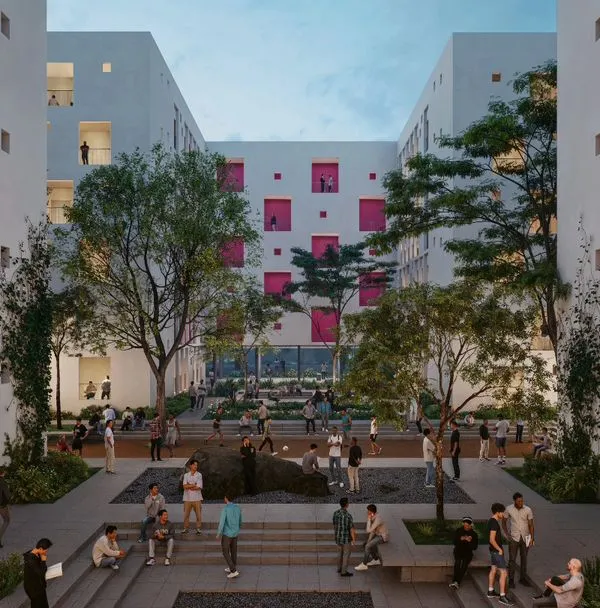
This render of the D.Y. Patil University Rural Health Training Centre illustrates our approach to healing architecture. The central courtyard is designed as a lush, green sanctuary that promotes natural ventilation and daylight, creating a serene environment essential for patient recovery and staff well-being.
Our Principal Architect, Rahul Kadri, shares the personal vision behind the Malabar Hill Forest Walkway. This project reconnects the city with nature through a low-impact elevated path, designed to float above the forest floor to preserve the delicate ecosystem while providing Mumbaikars with a unique space for reflection and recreation.
The facade of JAV Junior College in Bellary showcases our use of rhythmic vertical fins and a sweeping arched entrance. This design is not just aesthetically striking; it is a climate-responsive solution that modulates sunlight and creates a welcoming, modern identity for the institution.
This before-and-after view of the Otters Club in Mumbai, first designed in 1973, demonstrates our philosophy of adaptive reuse. We revitalized the iconic club, respecting its original character while modernizing its facilities to meet contemporary needs, ensuring its legacy continues for a new generation.
This detailed section drawing reveals the science behind our auditorium design. It shows the intricate layering of modular acoustic panels, insulation, and structural supports, illustrating our technical expertise in creating spaces with exceptional auditory and visual performance.
In our healthcare projects, like the MGM Cancer Hospital, green terraces are integral to the design. This video shows how these spaces provide a vital escape for caregivers and a window of hope for patients, demonstrating our belief that healing environments are essential for recovery.
This aerial footage showcases the Sona Institute in Salem, where our new Admin and Library building stands as a modern clock tower and a landmark for the city. The design reflects the institution's growth, combining student-centered spaces with a vision for a sustainable and innovative future.
About Featured
Architecture is not merely about constructing buildings, but about orchestrating the social energy within them. Across our featured work, we prioritize climate-responsive features like vertical fins, deep-set windows, and central courtyards that invite natural interaction. This ensures that every project, whether a library, hospital, or public walkway, functions as a living ecosystem that evolves with its occupants.
Our architectural practice is built on a simple dialogue: how a space interacts with the people who inhabit it and the environment that surrounds it. We treat every project as an opportunity to solve a specific human problem through design.
Educational Campuses as Ecosystems
We move beyond the traditional classroom model to create spaces for connection. In projects like the Sona University Library, we reimagined circulation areas—turning standard staircases into tiered social hubs filled with natural light. By mixing formal learning zones with informal hangouts, we foster environments where knowledge and community overlap.
Healthcare Architecture and Recovery
We believe that healing is influenced by one’s surroundings. Our healthcare projects, such as the MGM Cancer Hospital, are designed to reduce the clinical sterility often associated with these spaces. We integrate green terraces and calming courtyards that offer caregivers a moment of respite and provide patients with a direct connection to nature, supporting mental and physical well-being.
Public Spaces and Ecological Sensitivity
Our public projects reflect a commitment to preserving the context of the site. For the Malabar Hill Forest Walkway, we employed a low-impact design that floats above the forest floor, allowing citizens to engage with nature without disrupting the existing ecosystem. Whether through the adaptive reuse of historical structures or the creation of new urban landmarks, we aim to design environments that encourage collective ownership and respect for the land.
Similar work from other experts
Browse through Curated picks from other experts on mytribe
 7
7
Featured Healthcare and Institutional Design Projects
 9
9
Featured Architectural Projects
 7
7
Featured Architectural Projects and Design Work
 15
15
Architecture and Design That Tells Your Story
 10
10
Featured Institutional & Campus Architecture
 8
8
Featured Architectural Projects & Spatial Design
More from Institutional & Public Architecture by IMK Architects