Architectural Craft: Details, Materials, and Innovation
Precision in material and geometry defines our practice. We explore how indigenous materials and technical innovation, from acoustic engineering to climate-responsive masonry, shape the human experience within a built environment.
This video provides a closer look at the acoustic treatment inside our auditorium designs. It highlights the geometry, layering, and materiality of the modular faceted panels, which work in sync to diffuse sound and create an immersive auditory experience.
A detail shot of the acoustic wall panels, showing the contrast between the perforated white PET board and the warm laminated plywood below. This combination is not just aesthetic; it is engineered for optimal sound absorption and diffusion.
The geometric plan for the interlocking 3D acoustic panels. This drawing illustrates the modular design, which allows for both visual rhythm and precise control over the sound characteristics of the auditorium space.
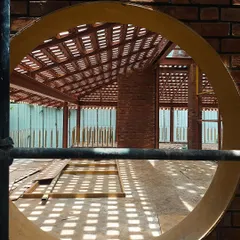
At Sona University, we used jali work in various modules and sizes to create a cohesive design language. This video shows how the perforated screens create playful patterns of light and shadow while providing natural ventilation.
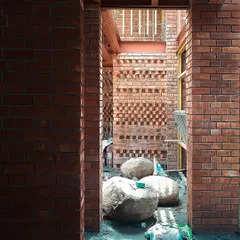
A close-up of a perforated brick wall, demonstrating our use of indigenous materials to enhance facade design. This technique, seen here at the Symbiosis University Hospital, allows for ventilation while creating a textured, rhythmic surface.
The compressed earth block (CEB) facade at the Symbiosis University Hospital and Research Center in Pune. This sustainable material choice not only reduces environmental impact but also gives the building a warm, earthy aesthetic that connects it to its site.
A view through the MS Jaali screens at the Sona University Centre in Salem. These screens provide shade and privacy while framing views of the surrounding landscape, demonstrating a modern interpretation of a traditional architectural element.
Stone takes center stage in many of our projects. This detail from the Otters Club (c. 1973) shows the intricate, textured stonework that defines the building's character and has stood the test of time.
A detail of stone cladding from Ceat Mahal (c. 1974), showcasing decorative motifs carved into the stone. This highlights our long history of integrating artistic and cultural elements directly into the architectural fabric.
The circular window and textured stone wall at Tata Chemicals, Babrala (c. 1996). This composition shows our focus on creating visual interest through the interplay of simple geometric forms and natural material textures.
About Architectural Craft: Details, Materials & Innovation
The structural integrity of a space relies on the specificity of its material choices. We design facade shading, acoustic treatments, and internal circulation elements not merely for aesthetic appeal, but to actively regulate temperature, sound, and movement within a facility.
Architectural excellence lies in the details. We do not view materials as mere finishes, but as active components of a building’s performance. Our use of Compressed Earth Blocks (CEB) at the Symbiosis University Hospital in Pune, for example, provides thermal mass, which significantly reduces the building's heat gain. Similarly, the acoustic treatment at the Sona University auditorium demonstrates our technical methodology. We combine 50mm polyester fibre insulation within a GI mesh framework and layer it with perforated PET boards. This creates a functional sound-absorption shell while maintaining a cohesive aesthetic rhythm. We are committed to preserving local architectural languages, which we interpret through modern construction. At the Nehru Centre in Mumbai, the spiral staircase serves as a study in spatial choreography, demonstrating how movement and structure can be combined to elevate the public experience. Whether integrating laterite stone in vocational centers or utilizing ceramic mosaics to turn seating into functional artwork at Yashraj Studios, our focus remains on material honesty and climate responsiveness.
Similar work from other experts
Browse through Curated picks from other experts on mytribe
Materiality and Detail: The Architectural Craft
 10
10
Architectural Details and Materiality
 9
9
Handcrafted Materials and Architectural Detail
 28
28
Reimagining Materials and Architectural Form
 11
11
Natural Materials and Craftsmanship in Design
 6
6
Architectural Material Detailing and Finish Selection
More from Institutional & Public Architecture by IMK Architects