Hamstring Injury Rehabilitation & Return-to-Sport
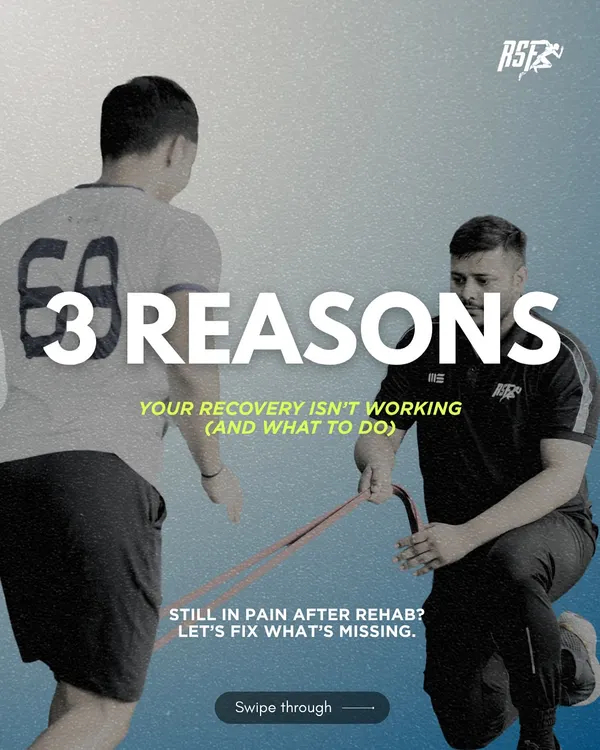
Hamstring strains are often coordination failures rather than just muscle weakness, which is why they tend to return. At RSF, we use sports science and force plate analysis to identify exactly where your system is breaking down, building a rehab plan that moves you from pain back to the field.
This image introduces the hamstring not as one muscle, but as a complex system of three. Understanding the synergy between the biceps femoris, semitendinosus, and semimembranosus is the key to effective rehabilitation and performance.
Your hamstrings are a 3-muscle system responsible for speed, deceleration, and cutting. Injuries happen when these muscles stop working together. We break down the real anatomy to show why this coordination matters for performance.
Here, we detail the three distinct muscles of the hamstring complex. Each has a specific role, from controlling lateral stability in sprinting to stabilizing the medial knee. They must fire as a coordinated unit, not as isolated movers.
This synergy is critical for athletes because hamstrings have dual roles as both hip extensors and knee flexors. They generate propulsion and control deceleration. If one part of the system lags, the entire posterior chain becomes vulnerable.
Recurring hamstring injuries are not about "tightness"; they are coordination failures. This infographic outlines the real causes, such as asymmetry between muscles, poor eccentric control, and weak hip extension.
Our training goes beyond simple hamstring machine curls. We target the specific roles of each muscle with exercises like Nordic curls for the biceps femoris, Romanian deadlifts for the semitendinosus, and single-leg RDLs for the semimembranosus.
Hamstring strains have one of the highest re-injury rates in sport, with up to 50% of athletes experiencing a recurrence within a year. This happens because conventional rehab often fails to prepare the muscle for the demands of high-speed sport.
Hamstring injuries are often misdiagnosed as simple strains. In reality, they can involve tendon damage and neuromuscular inhibition. Rehab that only targets pain or range of motion misses the real problem.
Research shows that the most common mechanism for hamstring injury occurs during the terminal swing phase of sprinting. Eccentric strength deficits are the biggest predictor of re-injury, yet most protocols skip these crucial checks.
Strength is not enough to prevent hamstring injuries. Athletes also need a high rate of force development (RFD), precise timing of muscle activation, and fine motor control. You cannot simply lift your way out of a sprint injury.
About Hamstring Injury: Rehab & Resilience
Most rehab protocols fail because they treat the hamstring as a single muscle that merely needs rest. In reality, it is a three-part complex—the biceps femoris, semitendinosus, and semimembranosus—that must work in perfect synergy to handle high-speed deceleration. If your current recovery plan involves only static stretching or light machine curls, you are missing the targeted eccentric loading and rate of force development required to prepare your tissues for the real-world forces of sprinting or changing direction.
Why Traditional Rehab Often Fails
Hamstring injuries have one of the highest recurrence rates in sport because many programs stop as soon as pain subsides. True resilience requires training the posterior chain to handle forces up to six times your body weight during deceleration. When the biceps femoris, semitendinosus, and semimembranosus do not fire in sequence, you experience energy leaks that lead to strain.
The RSF Rehabilitation Methodology
We do not guess; we measure. Our assessment process at our Koramangala and Jayamahal facilities uses handheld dynamometers and jump mats to provide objective data on your force output. This allows us to see exactly where your muscles are failing to cooperate.
Our return-to-sport protocols focus on:
- Eccentric Control: Using Nordic curls and bridge variations to strengthen the muscle while it is lengthening.
- Sprint Integration: We reintroduce sprinting mechanics early in the process, focusing on the terminal swing phase where most injuries occur.
- Terminal Stability: Building the ability to decelerate safely, which is critical for athletes in multi-directional sports.
Beyond The Treatment Table
We don't just treat the injury; we rebuild your capacity. Our sessions combine clinical treatment like manual therapy for pain management with 40 minutes of supervised gym floor training. This ensures that when you return to your sport, you are not just back to play—you are more capable than before the injury occurred.
Similar work from other experts
Browse through Curated picks from other experts on mytribe
 9
9Expert Injury Rehabilitation and Return to Sport
Athlete Recovery & Peak Performance Programs
Safe Injury Recovery and Strength Rehabilitation
Injury Recovery & Resilient Strength Training for Athletes
 11
11


Sports Physiotherapy and Injury Rehabilitation in Bengaluru
Injury Rehabilitation & Recovery Programs
More from Injury Rehabilitation & Physiotherapy by Rapid Sport Fitness
More services by Rapid Sport Fitness