Expert Shoulder Rehabilitation and Rotator Cuff Function
Shoulder pain often stems from systemic imbalances rather than just weak muscles. We use data-driven assessments to pinpoint the root cause of your discomfort, guiding you through structured rehab that restores function, mobility, and strength.
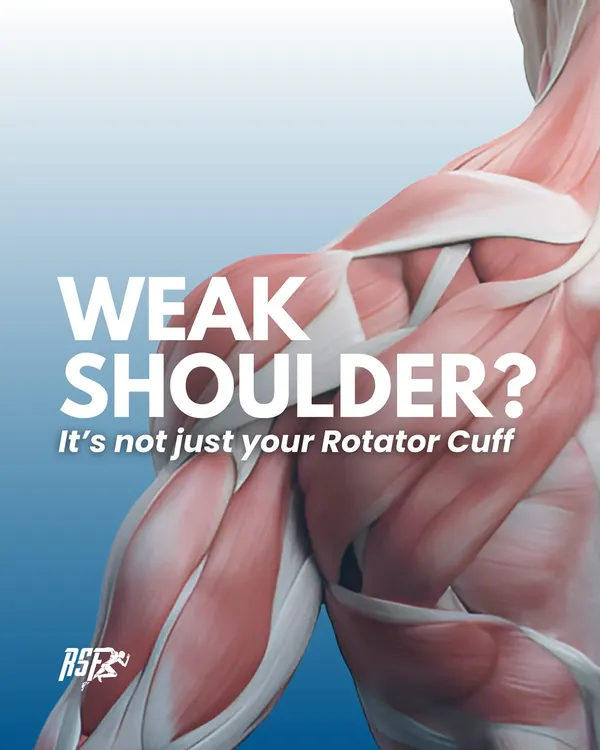
A weak shoulder is rarely just about the rotator cuff. This image introduces the concept that shoulder health depends on a complex system of muscles and joints working in harmony.
The shoulder girdle isn't just one joint. It's a complex of four distinct joints, including the glenohumeral and scapulothoracic joints. For healthy movement, all these parts must coordinate perfectly. If one fails, the entire chain suffers.
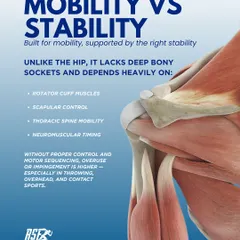
Unlike the hip, the shoulder lacks deep bony sockets and relies heavily on muscles for stability. This infographic explains the critical roles of the rotator cuff, scapular control, and thoracic spine mobility in preventing injury.
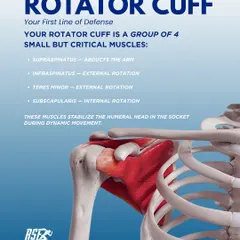
This is your rotator cuff, the first line of defense. This infographic breaks down the four critical muscles: supraspinatus, infraspinatus, teres minor, and subscapularis. Together, they stabilize the humeral head during dynamic movement.
This image highlights common imbalances in athletes that lead to shoulder issues like impingement and rotator cuff tears. These include overuse of pecs and lats, weak external rotators, and poor scapular upward rotation.
What does real stability look like? For athletes, it's dynamic. It means having control through range, strength in rotation, and eccentric control during deceleration. Our exercises progress from isolated movements to integrated, functional patterns.
Your shoulder isn't held together by "a rotator cuff." It's a system of four independent muscles, each with a different job. If even one underperforms, your shoulder loses stability, strength, and control.
The rotator cuff is not one function. This image introduces our deep dive into breaking down shoulder stability across the four distinct movers that make up the cuff.
Meet the four movers. This infographic details the specific anatomy and function of each rotator cuff muscle, from the supraspinatus initiating abduction to the subscapularis providing anterior stability.
The real job of the rotator cuff is dynamic shoulder centration: keeping the humeral head centered in the socket during movement. It is built for fine-tuned control under speed and load, not for brute force.
About Shoulder Health & Rotator Cuff Function
Most shoulder pain isn't just a rotator cuff issue. It is often a failure of the scapular-stabilizing muscles or poor thoracic mobility. During your initial assessment at our Koramangala or Jayamahal centers, we use force plate analysis and dynamometry to measure your actual output. We do not guess at your recovery. We map out a plan based on these metrics to ensure you regain full range of motion and dynamic stability without the risk of recurrence.
Why Standard Shoulder Rehab Fails
Most people attempt to fix shoulder pain by resting or performing generic band exercises. This ignores the root cause. The shoulder is the most mobile joint complex in the body, relying on a delicate, dynamic synergy between four rotator cuff muscles and the scapula. When this synchronization breaks down, you experience impingement, pain, or weakness.
Our Data-Driven Approach
We treat the shoulder as a system, not a single joint. Our process identifies where your 'system' is leaking energy or failing to stabilize:
- Biomechanical Screening: We use video capture to analyze your throwing, lifting, or reaching mechanics to spot energy leaks.
- Objective Measurement: Handheld dynamometers and jump mats provide baseline numbers for your strength and reactive capabilities.
- Integrated Loading: We move quickly from isolated strengthening to integrated, functional patterns. This ensures your rotator cuff can handle the speed and load of your specific sport or daily activity.
Fixing Common Shoulder Issues
We specialize in evidence-based protocols for:
- Shoulder Impingement: Restoring the scapular-humeral rhythm to stop the pinching sensation.
- Rotator Cuff Tendinopathy: Using heavy, slow resistance and isometric loading to rebuild tendon capacity rather than just masking pain.
- Post-Surgical Return: Step-by-step guidance to regain confidence and power after an injury or operation.
Our goal is dynamic centration. We want your shoulder to maintain a centered position in the socket under any load. If you are tired of the cycle of pain and temporary relief, come in for an assessment to see exactly what your shoulder is missing.
Similar work from other experts
Browse through Curated picks from other experts on mytribe
Neck and Shoulder Rehabilitation
Rehab, Mobility, and Movement Therapy
Real Results in Injury Recovery and Corrective Training
 23
23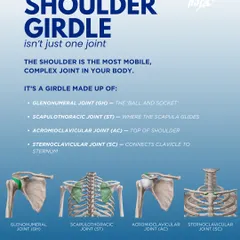
Injury Education for Shoulder, Back, and Ankle Health
Fix Shoulder, Wrist & Upper Back Pain
 10
10


Effective Shoulder, Arm, and Wrist Pain Relief
More from Injury Rehabilitation & Physiotherapy by Rapid Sport Fitness
More services by Rapid Sport Fitness