Institutional Campus Landscape Design and Master Planning
For institutional projects, we prioritize natural topography over excessive grading. By working with the site’s existing contours, we create functional, interconnected campuses that support student life while maintaining ecological integrity.
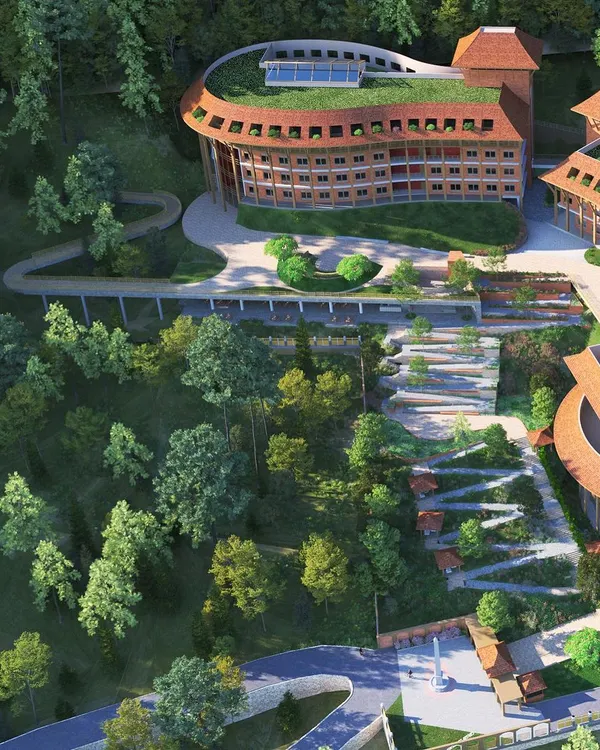
An aerial rendering of the 17-acre Maritime Training Institute campus in Khopoli. The master plan shows how academic buildings, residences, and parade grounds are integrated into the contoured landscape, preserving much of the existing olive grove.
This rendering shows the student plaza at the Maritime Training Institute. The space is designed to be a vibrant hub, connecting different buildings and providing an engaging outdoor area for students, with landscaping that follows the site's natural slope.
Our design for the institute minimized the use of retaining walls by grading the land into rolling mounds. This approach, combined with planting vetiver grass, helps stabilize the soil, manage water runoff, and create a more natural, flowing landscape.
About Institutional Campuses: Designing with the Land
When designing large-scale institutional campuses, the temptation is often to flatten the site entirely. We resist this. At the Maritime Training Institute in Khopoli, for instance, we managed a 17-acre contoured site by grading the land into rolling mounds rather than building intrusive retaining walls. This approach stabilizes the lateritic soil with deep-rooted vetiver grass and creates natural drainage paths that keep the landscape water-positive.
Institutional design demands a rigorous approach to site topography. Our master planning process begins with a detailed sun path analysis and contour study to ensure that student plazas and faculty residences integrate naturally with the existing terrain. By prioritizing minimal excavation, we preserve the site's original drainage patterns, which is critical in regions with high water tables.
We believe that a campus landscape should facilitate movement while offering moments of respite. Our designs often feature central plazas that serve as social hubs, connecting academic buildings and hostels. These plazas are not merely paved surfaces but are integrated into the landforms, using native plantings and local stone to provide a sensory experience that changes with the seasons.
Sustainability is integrated at the technical level through water-sensitive design. Features such as contour trenches and rain gardens manage monsoon runoff, effectively turning a potential drainage problem into a resource that sustains the campus greenery. This technical focus ensures that the landscape remains resilient, requires lower long-term maintenance, and continues to foster local biodiversity long after the construction phase is complete.
Similar work from other experts
Browse through Curated picks from other experts on mytribe
 14
14

Educational and Institutional Campus Master Planning
 8
8
Master Planning for Large-Scale Developments
Institutional and Educational Campus Landscape Design
 5
5


Institutional and Corporate Campus Landscaping
Master Planning and Landscape Urbanism Projects
 14
14
Institutional & Civic Architecture Design
More from Landscape Architecture by Sejpal and Parekh Associates
More services by Sejpal and Parekh Associates