Handcrafted Woodwork: My Tools & Process
I don't just build furniture; I build the tools to build the furniture. Here is a look at how I mix traditional joinery with modern precision to get the job done.
Using a table saw with a specialized jig to cut precise half-lap joints. This joinery technique is fundamental to creating strong, interlocking frames for projects like Kumiko panels.
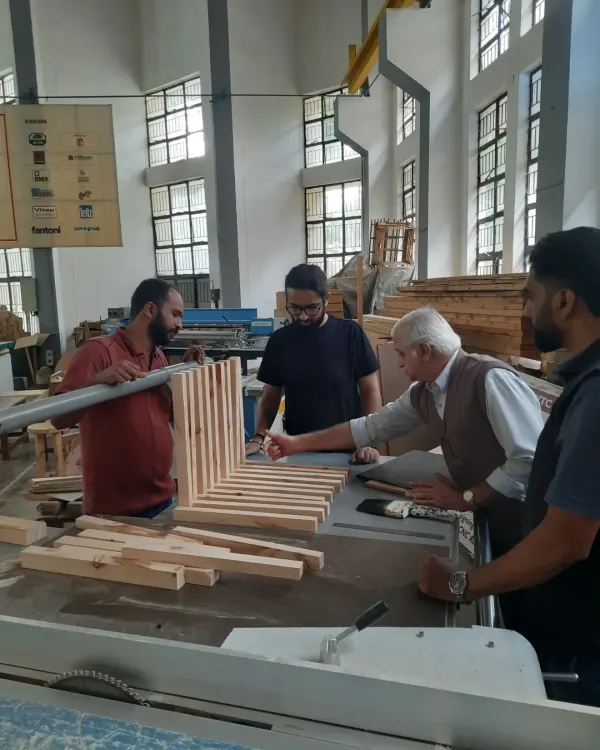
Assembling the Kumiko frames by hand. The half-lap joints allow the thin strips of wood to fit together snugly, forming a perfect grid without any nails or screws.
A pneumatic nail gun and a custom-made nail sorting tray. Having an organized workshop and the right tools, like this power carving tray made with a router, makes every project more efficient.
A cam-based clamping system I built for use with my router. This simple jig holds workpieces securely for precise carving tasks, like making the slots in this nail sorting tray.
A set of custom jigs for making Kumiko infill pieces. These jigs hold the small wooden strips at precise angles (22.5, 45, and 67.5 degrees) for cutting on a disc sander.
The beautiful curls of wood created by a hand plane. There's a certain flow state you achieve with hand tools, where focus and precision are everything.
A typical scene on my workbench: measuring tools, a router, clamps, and safety gear. Every project starts with a clean space and the right equipment.
Upgrading my table saw with a router plate insert. This allows me to use my table saw's fence and dust collection system for routing tasks, increasing accuracy and safety.
The Dongcheng trimmer router mounted underneath the new table saw insert. This setup effectively turns my table saw into a functional router table.
A view from below: the organized chaos of sawdust and wood shavings that collects under the workbench. It's the natural byproduct of a productive day in the shop.
About The Craft: Tools & Process
Most workshops rely solely on power tools, but I prefer building custom jigs for every specific joint. Whether I’m cutting half-lap joints for a Kumiko panel or turning a lathe for a custom box, these jigs are the difference between 'near enough' and 'perfectly flush'. It’s that extra step of preparation that ensures your furniture is not just strong, but structurally sound for the long haul.
Precision in Every Cut
Precision isn't just about using a high-end router; it is about how you control it. In the workshop, I spend as much time designing and creating custom jigs as I do working on the actual furniture pieces. These jigs, often made from scrap MDF or plywood, allow me to achieve repeatable accuracy that standard tools simply cannot offer on their own.
Where Tradition Meets Tech
I believe in the satisfying feel of a hand plane, but I also see the value in upgrading a table saw with a router plate insert. My process is a mix of the old and the new:
- Traditional Joinery: I use Japanese Kumiko techniques, fitting wood pieces together without nails or glue. It requires immense patience and the right angle jigs (22.5, 45, and 67.5 degrees).
- Modern Power: I integrate power tools like trimmers and routers to speed up the repetitive parts of the build, like flattening surfaces or creating precise dado cuts.
- Design & Validation: Before a single expensive piece of hardwood is cut, I often build scale models. This helps in understanding spatial constraints, especially for custom furniture or architectural models.
The Workshop Philosophy
If you have ever been to the workshop in Singasandra, you will notice it is not a pristine showroom. It is an active space filled with sawdust and half-finished projects. That is intentional. True craftsmanship happens in the mess, in the middle of a build, while checking and re-checking the joinery. Whether I am making a custom cat tree or a delicate Kumiko lamp, the process remains the same: measure twice, cut once, and build it to last.
Similar work from other experts
Browse through Curated picks from other experts on mytribe
The Art of Craftsmanship in Woodworking
Behind the Craft: How We Build Your Stories
 8
8

Practical Woodworking and Furniture Design Training
 4
4

The Art of Teak Craftsmanship
From Workshop to Home: Our Custom Furniture Process
 6
6

The Art of Craftsmanship: Architectural Interiors & Site Execution
More from Custom Furniture & Woodworking by Kydo
More services by Kydo