The Science and Philosophy of Iyengar Yoga
Yoga is not just a form of exercise, it is a precise science. Learn to understand your body as a system of alignment, sequencing, and timing to conserve your energy and build a rock-solid mind.
The body is the most mysterious subject, an amalgamation of body, mind, and soul. I explain why only yoga, specifically the Iyengar system, can reach the 'Sukshma Sharir' or subtle body, and how precise alignment prevents the spilling of energy, just like pouring water from a beaker into a glass.
The Indian concept of health is different. A person who appears thin may have no 'Pran Shakti', while a larger person may have a continuous flow of life force. I explain why the latter will heal faster from an injury, challenging the Western concept of fitness.
This student appears slim, but his hands are crooked, his shoulders are closed, and his back is popping out. His life force is only at 25%. This is why the Western parameter of thinness is a flawed measure of true health.
To prepare for Pranayam, you must first open the body. I explain the importance of lifting the side ribs and armpit area to create space for the breath. My classes are structured to prepare the body for each subsequent asana, ensuring a deep and correct practice.
Why should you extend the spine? Because your life force, your 'Pran Shakti', flows through it. I explain that this is not just about breathing, but about the flow of energy through your nerves to every part of the body.
Yoga is an art, a science, and a philosophy. I can look at a single Tadasana and know what issues a person will face. I invite you to my class to taste the most scientific and structured system of yoga and see this difference for yourself.
People often start yoga only when they have health issues. I urge you to start before these problems creep in. Educate yourself about your own body and lead a happy, healthy life, rather than falling into the trap of doctors and therapists.
We often ignore stiffness in our back and shoulders until it becomes a debilitating problem. I explain how to check yourself for these initial signs and the importance of finding a good Iyengar center to work on them before they get worse.
Our modern life with gadgets is giving us stiffness in the neck, shoulder, and back. I explain how Iyengar yoga can give you the tools to work on yourself, correct your posture, and lead a beautiful, healthy life.
In a world of gadgets, we need a subject that gives us access to our inner world. That subject is yoga. I sincerely suggest you practice Iyengar yoga to counter the effects of a modern lifestyle and find mental and physical balance.
About My Philosophy: The Science of Iyengar Yoga
Most people view alignment as merely aesthetic, but in my class, it is a biological necessity. When your body is misaligned—whether from slouching at a desk or incorrect posture—it creates a literal 'traffic jam' in your nervous system. This causes energy leakage, where your body wastes effort just to stay upright, leading to chronic stiffness and fatigue. We do not just 'stretch'; we use specific props to place your joints back into their correct cupboard, ensuring your life force can flow unobstructed.
The Science of Alignment
In the Iyengar system, we treat the body like a complex machine. If the alignment goes haywire, the 'water'—your life force or Pran Shakti—cannot reach the glass. This is why we focus so heavily on the precision of each asana. When you hold a pose for an extended period, it is not just for flexibility; it is a gestation period for the body, similar to how a child develops in the womb.
Why Props Are Not Shortcuts
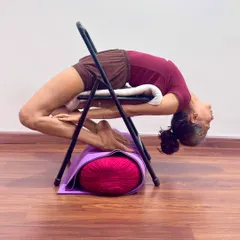
I often see students treat chairs, ropes, and blocks as crutches. In my classes, these are scientific tools. They are designed to help you access the pose precisely, regardless of your current stiffness or injury. If you have a slipped disc or sciatica, the prop provides the support your spine needs to lengthen without the risk of further injury.
Breaking Emotional Blockages
Your physical body is the mirror of your Sukshma Sharir (subtle body). Chronic tension in the neck, shoulders, and lower back is often where we store our emotional baggage. By opening the chest and releasing the hips, we do not just improve your posture; we release those stuck emotions. This is how we move from a state of limitation—where you feel you 'cannot do it'—to a state of limitless potential.
The Need for Structure
Many students come to me after years of practicing yoga elsewhere, wondering why they haven't made progress. The answer is usually a lack of structure. Yoga is an ancient, structured science. Without a disciplined sequence and a clear understanding of the yamas and niyamas, you are only scratching the surface. I invite you to join our clinical batches where we don't guess—we teach you to check yourself, understand your unique anatomy, and build a future with no pain.
Similar work from other experts
Browse through Curated picks from other experts on mytribe
The Science & Soul of Yoga: Anatomy & Alignment
 4
4

My Yoga Journey and Philosophy

Understanding Yoga Philosophy and Core Principles
My Yoga Philosophy & Approach
Iyengar Yoga Classes: Precision, Alignment, and Therapeutic Practice
The Philosophy of Yoga: Aligning Mind and Body
More from Yoga Therapy for Pain & Injury Management by Nivedita Joshi
More services by Nivedita Joshi