Himalayan Landscapes and Culture Photography
My travels through the high-altitude terrain of Ladakh and Nepal, capturing the silence of frozen lakes and the rhythm of monastic life.
The Karsha Monastery in Zanskar Valley, appearing like a fortress clinging to the mountainside. This shot captures the scale and isolation of this incredible Buddhist gompa.
The stunning landscape of Tso Moriri in Ladakh, with snow-capped peaks reflecting in the deep blue waters under a partly cloudy sky.
A moody, atmospheric shot of Pangong Lake, with low clouds shrouding the colorful, mineral-rich mountains.
The stark beauty of the Ladakhi landscape near Tso Moriri, where the barren brown mountains meet the deep blue of the lake.
A lone vehicle stands on the barren shore of Tso Moriri, providing a sense of scale to the vast, empty landscape.
Stakna Monastery, perched on a hilltop overlooking the Indus River in Ladakh. The lush green trees provide a vibrant contrast to the arid landscape.
The sacred mountain of Gumbok Rangan in the Zanskar region, its golden peak standing out against the valley.
The incredible Phugtal Monastery, built into the mouth of a cave in the remote Zanskar Valley. A testament to faith and engineering.
A video showing the Rezang La War Memorial in Chushul, Ladakh, with the Indian flag flying high at 16,400 ft. A tribute to the soldiers of the 1962 war.
A poignant portrait of a young monk in Ladakh, his innocent eyes and sun-kissed cheeks telling a story of life in the high Himalayas.
About Himalayan Journeys: Ladakh & Nepal
These frames are not just pretty views. Getting to remote gompas like Phugtal in Zanskar takes days of travel, and I usually wait until the light hits the valley just right to get the shot. I use Fujifilm prime lenses for these landscapes because they keep the textures of the mountains and the monks' red robes looking natural, without relying on heavy filters that distort the reality of the altitude.
The Himalayas hold a silence that you can only capture when you spend time there. When I am in Ladakh or Nepal, I do not just look for the grand peaks. I look for the life that happens beneath them. Whether it is a young monk running down a stone staircase in Karsha or the reflective surface of Tso Moriri at dawn, my goal is to frame the scale of the environment against the smallness of our daily existence.
My process involves balancing ground-level portraits with aerial drone shots. A wide shot of a monastery like Karsha shows its isolation, but a close-up of a monk's face tells you about the life inside those walls. I bring my Fujifilm X-Series gear and a licensed drone to these locations, ensuring that the final images have a gritty, documentary look rather than a commercial polish. Every image here is manually culled to make sure the narrative flows, capturing the grit and the grandeur of these regions.
If you are planning a project in these areas, or if you need someone to document a journey with a lens that respects the terrain and the local culture, I am ready to travel. I treat these assignments as stories to be told, not just photos to be filed.
Similar work from other experts
Browse through Curated picks from other experts on mytribe
 41
41
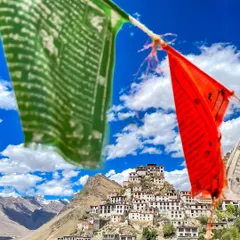
Capturing the Soul of the Himalayas: Ladakh to Uttarakhand
 10
10
Himalayan Vistas: Mountain Landscape Photography
 26
26
The Mighty Himalayas: Aerial Drone Cinematography
 13
13
Himalayan Photography Tours in Ladakh & Zanskar
 9
9Capturing Your Himalayan Adventure in Cinematic Style
 8
8
Cinematic Documentary & Travel Photography
More from Travel & Documentary Photography / Videography by Akshansh Kumar
More services by Akshansh Kumar