Mastering the Tennis Serve in Noida
A powerful serve isn't just about raw strength; it's about rhythm, toss consistency, and a proper kinetic chain. Here is how we break down the mechanics to make your serve a reliable weapon.
A young player practices his serve motion. We start with the basics of the toss and racket drop to build a strong foundation.
This player is working on getting height and extension on his serve, a key component for power and angle.
A demonstration of a wide-angle second serve. We teach players how to use spin to pull their opponents off the court.
A player practices his serve during a morning session. The text overlay reminds you that we offer free trial classes from Tuesday to Friday.
A player tossing the ball for a serve. A consistent toss is the first step to a reliable serve, and we drill it relentlessly.
A player hits a serve right on the line. We work on precision and placement to make the serve a true weapon.
This video shows the full motion of a serve, from the initial stance to the follow-through.
A player hits a clean serve during a morning practice. You can hear me say "Good shot, yaar!" in the background.
I am giving instructions on how to add a little jump and spin to the serve. "Halka sa jump add karo," I tell the student to help him generate more racket head speed.
A demonstration of a big, powerful flat serve. This is a result of proper technique and timing.
About Mastering the Serve
On our clay courts in Sector 75, I don't just feed you balls to swing at blindly. We start by fixing your toss—if your toss is inconsistent, your serve will never be reliable. I will show you how to drop the racket head properly to generate natural spin and power, rather than just forcing it with your arm.
A strong serve is a sequence of movements, not just one single hit. At Tennisious Sports Academy, we focus on the kinetic chain: your legs push up, your core rotates, and your arm acts as the whip.
Why Clay Courts Matter
We train on red clay, which is softer on your joints but demands better footwork. It gives you more time to set up your stance, making it the perfect surface to refine your serve motion without the jarring impact of hard courts.
The Correction Process
Whether we are in a group session or a 1-on-1, my goal is to get you serving with natural rhythm. I often see players tighten up their shoulders under pressure—I tell them, 'Relax, arm loose rakho.' When you stop fighting the racket and start letting it accelerate, the ball speed increases naturally.
Building Muscle Memory
We use high-volume ball feeding. You will hit hundreds of serves in a session until the toss and follow-through feel like muscle memory. We also introduce match scenarios—learning where to place the ball to open up the court, rather than just hitting it hard. If you are struggling with a specific technical issue like hitting the net or losing your balance, we use video analysis to break down the frame-by-frame movement so you can see exactly where the rhythm breaks. Let’s get your serve consistent.
Similar work from other experts
Browse through Curated picks from other experts on mytribe
Master Your Serve with Expert Biomechanical Analysis
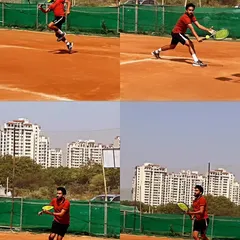
Tennis Technique and Match Play Coaching in Noida
Tennis Technique Masterclass: Drills for Every Shot
On-Court Tennis Coaching: Mastering the Basics
Master Your Tennis Strokes with Intense On-Court Drills in Dwarka
Professional Tennis Coaching Drills for Competitive Players
More from Tennis Coaching by Bheem Khatana