Hands-On Learning with the Montessori Method
At Hastam, we believe the mind remembers what the hands have done. Step into a space where children lead their own discovery through purposeful, hands-on activity.
This video shows our children deeply engaged in their work. You'll see them tracing shapes to develop pre-writing skills, mastering the knobbed cylinders for visual discrimination, and interacting with peers.
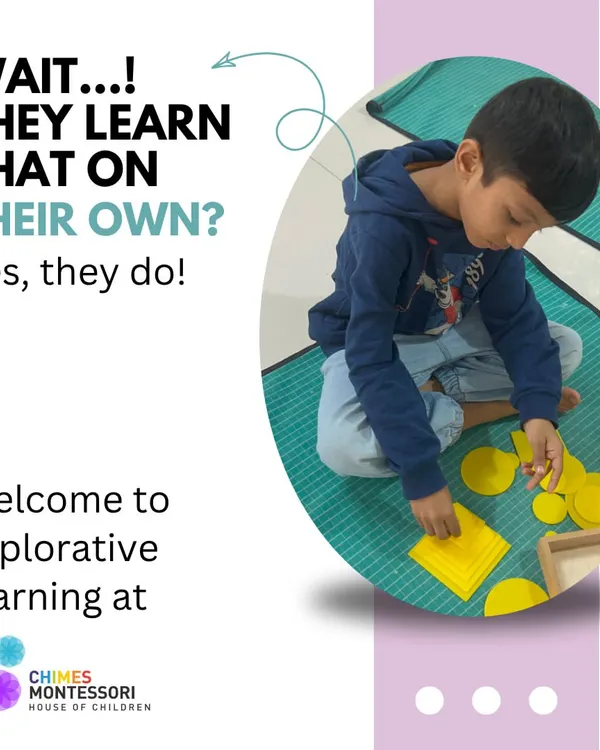
A young child explores constructive triangles, learning about geometric shapes and how they can be combined to create new forms. This hands-on geometry work lays a foundation for later mathematical understanding.
A group of children works together with the movable alphabet. This classic Montessori language material allows them to physically build words before they can even hold a pencil, making the process of learning to read and write intuitive.
A child proudly holds up a piece from a wooden puzzle. Puzzles like these help develop problem-solving skills, shape recognition, and fine motor control.
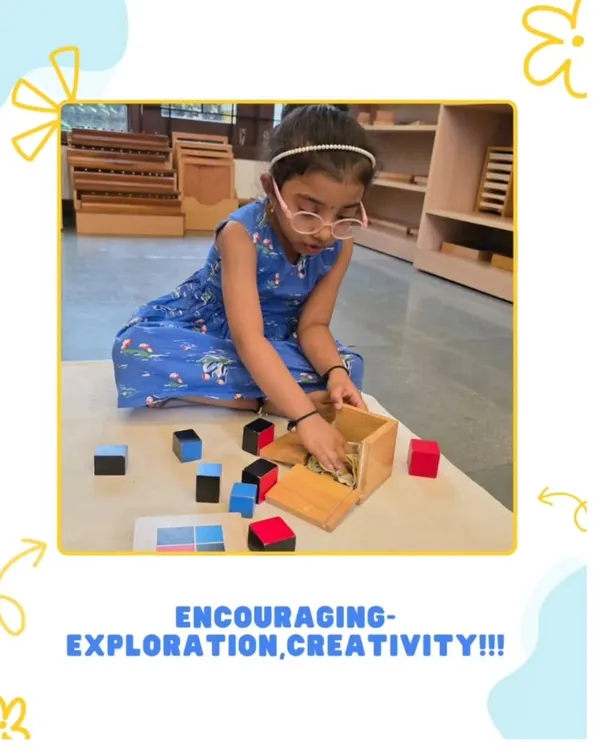
A teacher guides a child as she works with the trinomial cube, a sensorial material that provides a tangible, three-dimensional representation of the algebraic formula (a+b+c)³.
A child works on the Decanomial Square, a sensorial math material that visually represents the multiplication tables from 1 to 10. This hands-on approach makes abstract concepts concrete and understandable.
A blindfolded child uses her sense of touch to identify different materials. This stereognostic exercise isolates and refines the tactile sense, a key part of our sensory curriculum.
A child uses a small rolling pin, an activity that strengthens hand muscles and coordination. This is part of our practical life curriculum, where children learn real-world skills and gain independence.
A child carefully stacks wooden balancing blocks, an open-ended material that encourages concentration, creativity, and an intuitive understanding of physics and balance.
This child is fascinated by the Little Lock Box. By figuring out how to open each different latch and lock, she is developing fine motor skills, hand-eye coordination, and persistence.
About Hands-On Learning: The Montessori Method in Action
You might see your child fascinated by something as simple as a 'Little Lock Box' in our classroom. It looks like play, but they are actually building fine motor skills, patience, and logic as they figure out the mechanics. We do not rush them to finish; we let them explore the materials until they understand them themselves. This kind of deep focus is what we mean by hands-on learning—where the child is the teacher, and our role is simply to provide the right environment for that learning to stick.
A Prepared Environment for Discovery
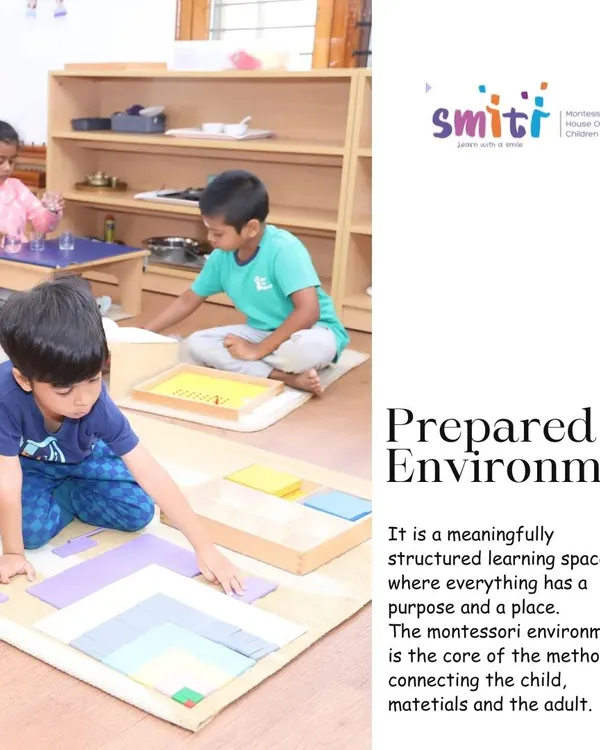
In our Talaghattapura campus, the environment is intentionally designed to be at a child’s height. Everything from our Pink Towers to the Sandpaper Letters is placed where a child can reach, choose, and return it independently. This freedom of choice is the core of our Montessori practice.
Why the Hands Matter
We often see children completely absorbed in their work, whether they are using the Decanomial Square to visualize complex math or tracing shapes for pre-writing skills. Because they are using their hands to manipulate physical objects, they grasp abstract concepts like geometry, arithmetic, and phonics far more intuitively than if they were just sitting and listening to a lecture.
Our Practical Life Curriculum
It is not just about academic materials. A huge part of our day involves what we call 'Practical Life' skills. When a child pours water, cleans a spill, or practices using a rolling pin, they are developing:
- Independence: Learning to care for themselves and their space.
- Coordination: Refining their fine motor control and concentration.
- Confidence: The joy of saying, 'I did it myself.'
We keep our class sizes intimate and our approach gentle, ensuring that every child feels safe enough to be messy, curious, and creative. If you are looking for a place where your child learns through genuine interaction rather than rote memorization, you will likely find a home here with us.
Similar work from other experts
Browse through Curated picks from other experts on mytribe
 66
66
Learning by Doing: The Montessori Way
 59
59
Hands-On Montessori Learning: How Children Build Real Skills
 54
54
The Montessori Method in Action
 22
22
Montessori in Action: Hands-On Learning
 14
14
The Montessori Method in Action
The Montessori Method in Action
More from Montessori Preschool Program by Hastam Montessori
More services by Hastam Montessori