Yoga with Props: Deeper Stretches & Better Alignment
Using props like blocks, straps, and rope walls isn't just for beginners—it is the best way to safely deepen your stretches and correct your alignment. Discover how these tools help you hold poses longer and find real comfort in your practice.
In this class, students are using yoga straps to assist with Dhanurasana (Bow Pose). The strap helps to get a better lift and a deeper opening in the chest and shoulders, making the pose more accessible.
Here, students use a yoga block for support in Setu Bandhasana (Bridge Pose). The block ensures correct posture by preventing the hips from dropping and allows for a longer, more restorative hold.
This collage shows the versatility of props in my class. You can see students using blocks for supported bridge pose and straps for poses like Natarajasana, demonstrating how we achieve stability and depth.
Students using yoga straps for Supta Padangusthasana (Reclining Hand-to-Big-Toe Pose). This is a fantastic way to safely stretch the hamstrings and open the hips without straining the lower back.
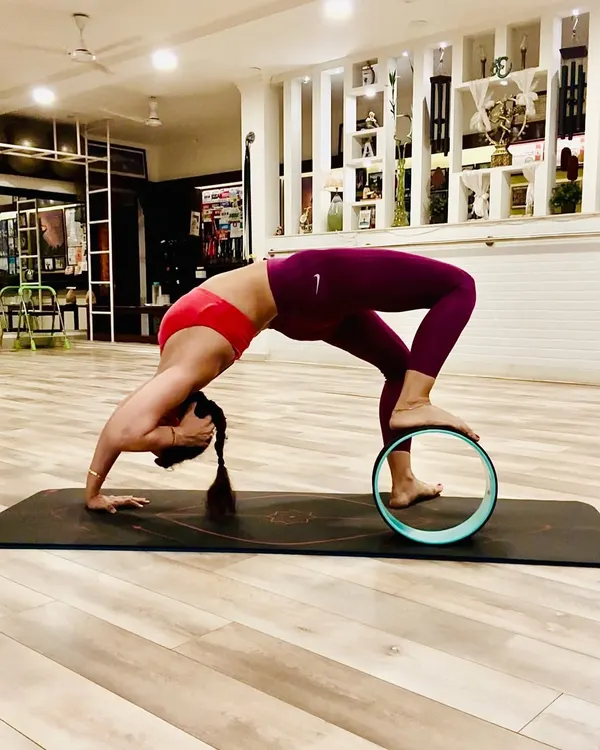
My personal practice often includes a yoga wheel to work on spinal flexibility. Here, I am in a deep backbend, using the wheel to support my spine and open my chest for a healthy, youthful back.
A wide view of the studio during Dhanurasana (Bow Pose) practice. You can see students at different levels of flexibility working on this powerful backbend.
About Yoga with Props: Deeper Stretches & Better Alignment
Using a strap or block is not a sign that you aren't flexible enough—it is actually the smartest way to advance your practice. In our Kaggadasapura studio, we use Iyengar-style rope walls and yoga wheels to bridge the gap between where your body is today and where you want it to be. This ensures you are holding poses with the right muscular engagement, allowing you to sustain the 'Sthiram Sukham Asanam' (steadiness and comfort) without overstraining.
Many people hesitate to use props because they feel it implies they are 'cheating' or 'not doing real yoga.' My sessions at Swasthya Yoga Academy focus on exactly the opposite. Props are instruments of precision.
How We Use Props
- Straps for Alignment: When working on poses like Dhanurasana (Bow Pose) or Supta Padangusthasana, a strap acts as an extension of your arm. It prevents you from hunching or straining your lower back, allowing you to focus on the chest opening and shoulder alignment.
- Blocks for Stability: Using a block in Setu Bandhasana (Bridge Pose) prevents your hips from dropping and ensures your spine stays in a neutral, supported position. It allows you to hold the pose longer, which is essential for reaping the restorative benefits.
- Rope Walls: We utilize Iyengar-style rope walls to decompress the spine. This is particularly effective for those with limited mobility or chronic tightness, as it uses gravity to aid the stretch rather than forcing the body.
Why This Approach Works
My background as an M.Sc certified Yoga Therapy instructor means that every prop I introduce serves a physiological purpose. We aren't just stretching; we are working on the geometry of the body. By reducing the physical effort required to hold an awkward position, we allow the nervous system to relax. When you are relaxed, your muscles stop fighting back, and you can achieve a deeper, safer range of motion. Whether you are recovering from an injury or trying to master a challenging backbend, these tools make the journey sustainable and far more effective.
Similar work from other experts
Browse through Curated picks from other experts on mytribe
 8
8
Yoga with Props: Find Alignment and Stability
Prop-Based Yoga for Better Alignment & Flexibility
Yoga with Props: Deepen Your Practice and Alignment
 22
22
Master Difficult Yoga Poses with Essential Props
Deepen Your Yoga Practice with Props
Deepen Your Yoga Practice With Props
More from Yoga Classes by Anjali Verma Kushwaha
More services by Anjali Verma Kushwaha