Advanced Calisthenics and Skill Progressions
Advanced calisthenics is less about brute force and more about understanding leverage, balance, and control. We move away from generic circuits and focus on precise progressions that help you unlock skills like planches and levers without the injuries.
Working on tuck planche progressions on parallettes. This exercise builds incredible straight-arm strength and shoulder stability, which are foundational for the full planche.
This is a band-assisted planche lean on parallettes. The band helps support some bodyweight, allowing me to focus on protracting my scapula and leaning forward with good form.
Practicing tuck planche holds on a box. Elevating the feet changes the leverage and helps build the specific strength needed to hold the position without support.
This is a pseudo planche pushup with feet elevated. This variation increases the load on the shoulders and chest, making it a great progression towards a full planche pushup.
Another variation of a band-assisted planche. The goal is to gradually reduce the band assistance over time as your strength increases.
A band-assisted front lever hold. This skill requires a huge amount of pulling strength and core stability. The band helps me accumulate time in the correct position.
A new personal best on the straddle planche with red band assistance. Weeks of work often come down to a few seconds of holding a position. That's the nature of this training.
Another shot of the band-assisted straddle planche. The parallettes allow for a neutral wrist position, which can be more comfortable for this demanding skill.
This clip shows a mix of strength work, including dumbbell presses and front lever progressions. A well-rounded program includes both bodyweight skills and traditional strength training.
Life lately has been a lot of this: grinding away at front lever progressions. This is a one-leg front lever variation, which is a step towards the full movement.
About Advanced Calisthenics
Most people try to jump straight to a full planche and end up with wrist or shoulder pain. Here, we reverse-engineer the move. We start with specific scapular protraction on the floor and progress to band-assisted holds on parallettes, ensuring your joints are strong enough to handle the leverage before you ever try to hold your own body weight unsupported.
Progression in calisthenics isn't linear. You will have days where a tuck planche feels heavy and others where the mechanics just click. My goal at Troop HQ is to help you navigate those fluctuations. We focus on 'straight-arm' strength and joint preparation, which are often the missing pieces for anyone stuck on the same plateau for months.
The Method
We don't just throw you on the rings or parallettes. We spend time on wrist preparation and scapular stability. If your foundation is weak, your advanced skills will be inconsistent.
- Tactile Feedback: In our semi-private sessions, I use manual spotting to help you understand the hip and shoulder alignment required for levers and planches.
- Progressive Overload: We use resistance bands and micro-loading to reduce the intensity of a movement until your body is ready to hold the full weight.
- Video Analysis: For 1:1 sessions, we use frame-by-frame analysis to identify exactly where your form breaks down, whether it's lumbar arching or improper scapula position.
Why Longevity Matters
I have dealt with tennis elbow and shoulder strains in the past. These injuries taught me that training smart is more important than training hard. If you are training for a front lever or a muscle-up, you have to prioritize the health of your tendons. We swap explosive, high-impact movements for isometric holds and controlled eccentrics whenever necessary. This keeps you in the game for the long haul, not just for a few months until your joints give out. You are not just building a skill; you are building a body that can actually move well for years to come.
Similar work from other experts
Browse through Curated picks from other experts on mytribe
Master Calisthenics Skills with Expert Bodyweight Coaching
Advanced Movement & Calisthenics Skills
Master Your Bodyweight: Calisthenics & Gymnastics
Master Calisthenics Skills in Namma Bengaluru
Advanced Calisthenics & Strength Training
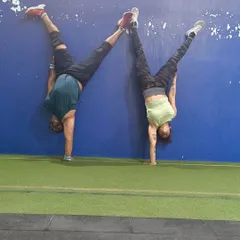
Master Your Bodyweight: Gymnastics & Skill Training in Yemalur
More from Gymnastics & Calisthenics Training by The Troop Fit
More services by The Troop Fit