Your Amazing Pregnant Body & Baby: Understanding Your Anatomy and Movement
Pregnancy is a powerful physiological process, not a medical condition. Learn to decode your body's signals, understand your changing anatomy, and master the art of monitoring your baby's well-being.
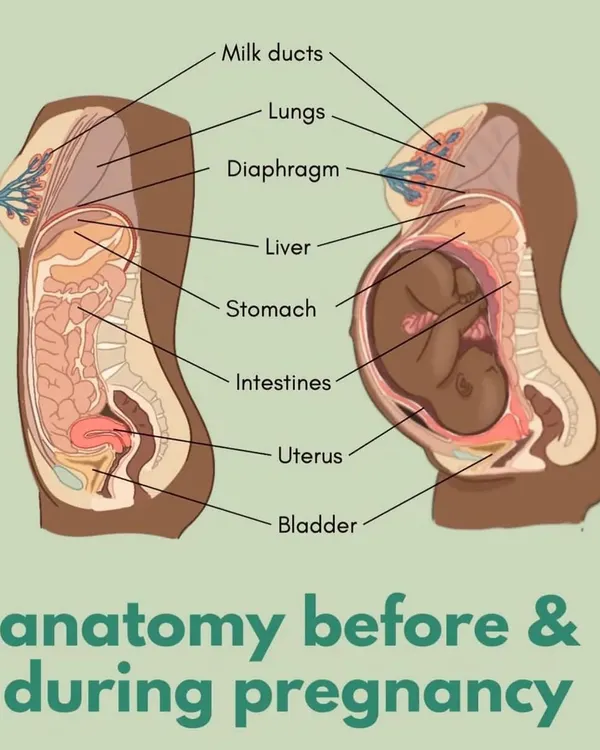
This anatomical illustration shows how your uterus, supported by ligaments, expands dramatically during pregnancy. Your internal organs, like the intestines and diaphragm, shift upwards to make room for your growing baby.
An illustration showing your baby nestled inside the uterus. The uterus is an incredible muscle that grows from the size of a pear to an organ capable of holding a full-term baby, placenta, and amniotic fluid.
Experiencing sharp, jabbing pains when you move suddenly? That's likely round ligament pain. These ligaments act like support cables for your uterus, and they stretch significantly as your belly grows.
This simple drawing shows a baby in the occiput posterior (OP) or "sunny-side up" position. Lying on your back can encourage this position, which may lead to back labor. I teach upright and forward-leaning positions to help baby get into an optimal alignment.
The placenta, or "tree of life," is an amazing organ you grow just for your baby. This collage celebrates the uniqueness of each placenta, which nourishes, protects, and provides everything your baby needs to thrive in the womb.
"Mindfetalness" is a practice of getting to know your baby's unique movement patterns. By paying mindful attention each day, you can establish a baseline for what's normal for your baby.
To practice Mindfetalness, spend about 15 minutes daily focusing on your baby's movements. Ask yourself if the movements feel distinct and have the same intensity and frequency as usual. Movements can be anything from a flutter to a kick or roll.
Why is monitoring movement so important? A change in fetal movement can be the earliest sign of distress. Unfortunately, many women are not told to monitor movements, so empowering yourself with this knowledge is key.
Has this happened to you? The moment you want your partner to feel the baby kick, they stop! Patience is key. Learning your baby's active periods helps you and your partner connect and monitor their well-being.
About Your Amazing Pregnant Body & Baby
When you feel that sharp, jabbing sensation during a sudden movement, it is often just round ligament pain—a signal that your body is stretching to accommodate your baby. I teach you how to adjust your posture and use specific stretches, like lunges or deep squats, to relieve this pressure instead of rushing to a doctor out of fear.
Understanding Your Changing Anatomy
Your body is doing incredible work right now. The uterus, which starts as a tiny, pear-sized organ, grows to support a full-term baby, placenta, and amniotic fluid. This shift changes your center of gravity and places strain on your ligaments and spine. Many mothers I work with are surprised to learn that what they perceive as 'problems' are often just normal physical adaptations. Understanding how your organs shift and how ligaments support your uterus can change how you view your pregnancy. Instead of seeing these changes as symptoms to be treated, we work on comfort measures, posture, and active movement to help your body flow through the process.
Mindfetalness: Connecting Before Birth
One of the most important habits I teach is 'Mindfetalness.' This isn't just about counting kicks; it's about intentional connection. By spending 15 minutes a day with your baby, you learn their unique patterns of intensity and frequency. Many women are told that babies move less toward the end of pregnancy, which is false and potentially dangerous advice. If you know what is 'normal' for your specific baby, you gain the confidence to act quickly if something feels off. This daily practice is about intuition as much as it is about observation, turning monitoring into a bonding experience rather than a medical chore.
Beyond Fear
We often fall into the trap of lying on our backs, which can encourage the baby into an occiput posterior (sunny-side up) position—leading to back labor. By learning to keep your knees below your hips and understanding how to tilt your belly, you actively create space for your baby to rotate into an optimal position. My goal is to move you away from the 'wait and see' approach and into an active role where you feel capable, prepared, and deeply connected to your baby.
Similar work from other experts
Browse through Curated picks from other experts on mytribe
Understanding Your Body & Baby During Pregnancy


Understanding the Science of Conception
 4
4

Your Pregnancy Journey: Trimester by Trimester Care
Prenatal Fitness Classes for a Stronger, Active Birth
 43
43
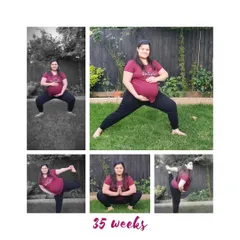
Your Pregnancy Yoga Journey at Home
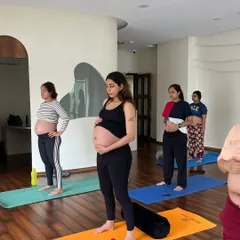

Prenatal and Postnatal Yoga Journey
More from Childbirth Education & Labor Preparation by Pujitha Shetty
More services by Pujitha Shetty