Yoga with Props: Precision and Safety in Your Practice
Alignment is not about how a pose looks; it is about how it feels in your body. We use props like the rope wall and blocks to bring ease and depth to your asana practice.
This poster for our Yoga Kurunta Workshop showcases the transformative practice of using ropes. This method enhances flexibility, strength, and alignment, allowing for deeper backbends and supported inversions.
Students in our Kurunta workshop using ropes and bolsters to find length and release in their spines. The ropes provide unique support that allows the body to open up in ways that are not possible on the mat alone.
A closer look at students exploring different supported poses on the rope wall. This practice is beneficial for all levels, helping to build awareness and decompress the spine.
Here I am adjusting a student in a supported inversion on the Yoga Kurunta. This hands-on guidance ensures safety and helps the student experience the full therapeutic benefits of the pose.
A line of students enjoying the feeling of lightness and freedom in a hanging inversion during our rope yoga workshop. This practice is both challenging and deeply restorative.
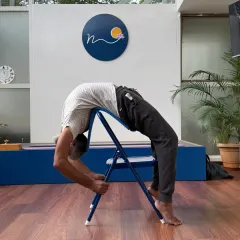
Students using ropes and blankets to practice a supported backbend. Props make challenging poses like this safer and more accessible, allowing for a deeper release in the thoracic spine.
In our Kurunta workshop, students learn to use the ropes to assist with standing poses like Trikonasana, helping to refine alignment and deepen the stretch.
Students using the rope wall for a supported version of Adho Mukha Svanasana (Downward-Facing Dog). This variation helps to open the shoulders and lengthen the spine without putting pressure on the wrists.
Wooden blocks are another essential prop we use to support proper alignment. Here, students use blocks in a forward bend to ensure they are lengthening from the hips rather than rounding the back.
A group photo of the happy participants from our Yoga Kurunta workshop, holding their certificates. These specialized workshops are a great way to dive deeper into specific aspects of the yoga practice.
About Yoga with Props: Deepen Your Practice
Many students view props as crutches for beginners, but in my studio, they are tools for deeper understanding. When I use the Yoga Kurunta (rope wall) or wooden blocks, I am not trying to make a pose easier; I am providing the skeletal support your body needs to align correctly. This support allows you to hold postures longer and safely explore therapeutic benefits that simple floor work cannot offer.
Why We Use Props
Yoga is a logical process, but the human body often has limitations—tight hamstrings, a stiff thoracic spine, or previous injuries—that prevent standard poses from being effective. Using props is not a shortcut. It is a precise way to modify the intensity of an asana so that you can work within your body's current capabilities rather than straining against them.
The Yoga Kurunta (Rope Wall)
Our studio at Chandra Layout is equipped with a traditional Yoga Kurunta system. These ropes allow for traction and spinal decompression that are nearly impossible to achieve on a flat mat. Whether you are using them to hold a supported backbend or to safely invert, the ropes provide a stable anchor. This allows your nervous system to relax into the pose, shifting the focus from 'holding' to 'experiencing' the alignment.
Precision in Every Session
Beyond ropes, we utilize wooden bricks, chairs, and bolsters. In our alignment-focused Hatha sessions, props serve two primary functions:
- Isolation: They allow us to target specific muscle groups without overloading the joints.
- Education: By using a block to extend your reach, you learn the mechanics of a pose, such as lengthening from the hips rather than rounding the spine.
This approach is essential for students recovering from injuries, those looking to deepen their practice, or individuals wanting to ensure their asana technique is sustainable for years to come. Whether you join us in-studio or online, the goal remains the same: using tools to unlock the true potential of your practice.
Similar work from other experts
Browse through Curated picks from other experts on mytribe
Yoga with Props: Deepen Your Asana Practice in Koramangala
The Art of Alignment: Precision Yoga with Props
Yoga with Props: Deepen Your Practice and Alignment
Yoga with Props: Precision for Deeper Alignment
The Science of Asana: Prop-Based Practice
Yoga with Props: The Wall, Ropes & More
More from Yoga Classes & Therapy by Yogavijnana
More services by Yogavijnana