The Art of Asana: Practice and Alignment
True practice goes beyond the physical. Discover the Sivananda method of stability, breath, and alignment at our ashram in the hills of Amboli.
Guiding a student into a stable Sirsasana (Headstand). Proper alignment is key to receiving the full benefits of this master asana.
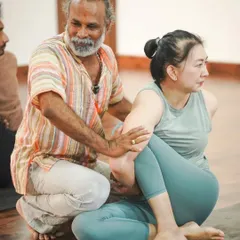
Assisting a student in Paschimottanasana (Seated Forward Bend). Gentle adjustments help release tension in the back and deepen the stretch.
With careful guidance, students learn to surrender into forward folds, releasing the ego along with physical tension.
I provide support to help a student find more length in their spine during a forward bend, an essential practice for flexibility and calm.
Helping students in Ananda Balasana (Happy Baby Pose). This posture helps to release the lower back and hips, promoting relaxation.
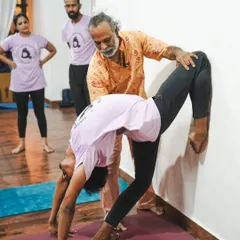
A demonstration of partner work to deepen asana practice. Working together allows students to explore new possibilities in their postures with support.
With trust and proper technique, students can assist each other in complex poses like this variation of headstand and arm balance.
Observing students in a forward bend during a masterclass. Correct form in foundational poses is crucial before moving to more advanced asanas.
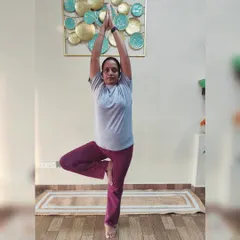
Leading a class in Vrikshasana (Tree Pose). This balance pose cultivates focus and stability, reflecting the balance we seek in life.
A group of students practicing a standing balance pose in a beautiful hall. The collective energy of a group class enhances individual concentration.
About The Art of Asana: Practice and Alignment
Many students arrive seeking flexibility, yet the true benefit of Asana lies in stability and the steady breath. Whether you are struggling to hold Sirsasana (headstand) or finding your center in Vrikshasana (tree pose), I provide hands-on adjustments to ensure your alignment is safe and intentional. We work with the body as a tool to calm the mind, not simply to achieve a posture.
In the Sivananda tradition, Asana is one of the five points of yoga, serving as a preparation for meditation rather than a goal in itself. My teaching approach focuses on the 12 basic postures, which are designed to systematically open the body's energy channels.
Why Alignment Matters
Correct alignment is not about aesthetics. When the body is positioned according to traditional principles, the flow of Prana (life energy) is optimized. In my classes, we prioritize:
- Conscious Entry: Moving into the pose with awareness, not momentum.
- Stillness: Holding the pose to build endurance and mental focus.
- Conscious Exit: Returning to a neutral state, allowing the body to integrate the benefits.
The Role of Savasana
No practice is complete without Savasana (corpse pose). This is where the physical effort is released, allowing the heart rate to normalize and the nervous system to settle. Beginners often rush this stage, but I guide students to understand that relaxation is an active part of the practice—you must learn to consciously let go.
Training in an Ashram Setting
Practicing in Amboli offers a distraction-free environment. Far from city noise, you can focus entirely on your Sadhana. Our residential courses provide the continuity needed to see real progress, as you are not just practicing for an hour a day, but living a yogic lifestyle, including sattvic diet and daily satsang.
Similar work from other experts
Browse through Curated picks from other experts on mytribe
Yoga Alignment and Hands-On Adjustments
 58
58The Art of Asana: Alignment, Props, and Practice
Foundational Yoga Asanas for Real Strength and Stability
Expert Yoga Asana and Alignment Practice
 28
28
Traditional Hatha Yoga: Correct Form & Alignment
Foundational Hatha & Ashtanga Yoga Teacher Training in Mysore
More from Yoga Teacher Training by Govindananda Saraswati
More services by Govindananda Saraswati