Eco-Sensitive & Wildlife Architecture
We design low-impact structures that listen to the land, allowing nature to set the pace for every form and space we create.
The interior of the Elephant Pavilion is designed for multiple users, from forest guards to school groups. Movement is continuous, with rammed earth volumes expanding and contracting to create places to sit, observe, and interact without the need for traditional rooms.
At the Elephant Pavilion, every detail is tied to performance. The construction follows a logic of necessity, where the spacing of timber slats and the joinery of rammed earth walls are determined by thermal comfort, structural need, and ease of use.
The Elephant Pavilion is shaped by its site. The building's form is neither sunken nor elevated; it sits with the land, and the entry is a slow transition where the built mass blends into the rising terrain.
Another view of the Elephant Pavilion, where the structure is embedded in the landscape. The roofline undulates gently, and in some areas, earth continues over the built volume, adding thermal insulation and visual continuity.
At the foothills of Anamalai, a roof becomes the landscape. This video shows early conceptual sketches for the Serenity resort, where we explored a canopy-like roofscape to connect rooms and frame views without altering the existing footprint.
The 'Machan' or canopy at the Serenity resort was designed to reorganize the site without overwhelming it. This rendering shows how the structure becomes a roof, bridge, and perch, unlocking vistas toward wildlife trails.
This sectional drawing of the Serenity resort shows how the roof structure creates varied experiences, offering shelter in some places and an elevated perch in others, all while maintaining a cohesive architectural gesture.
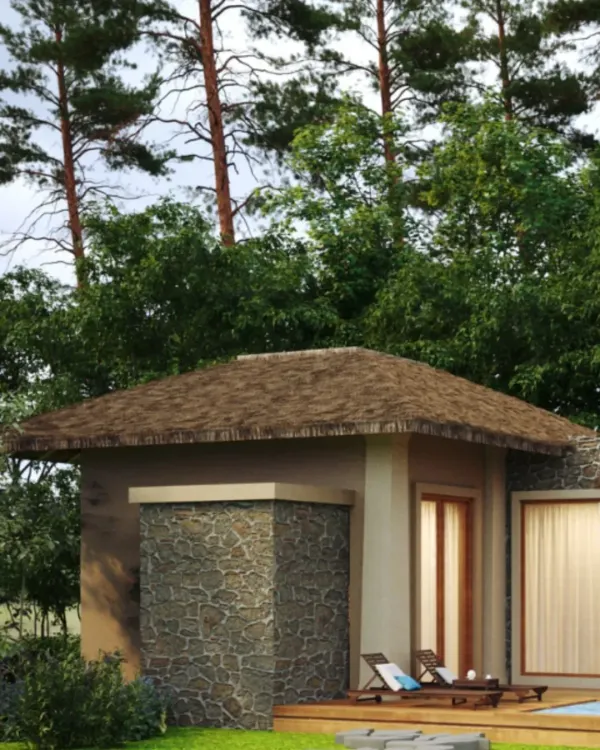
A rendering of the Serenity resort, where the synthetic thatch roof mirrors the gentle slopes of the surrounding landscape. The architecture remains simple, but the experience of being in nature is deepened.
Another view of the Serenity guesthouse renovation, showing how the new roofscape connects previously separate volumes into a single, flowing structure.
A close-up rendering of the Serenity resort, highlighting the use of local stone for boundary walls and bamboo screens for privacy, blending the structure into its natural setting.
About Eco-Sensitive & Wildlife Architecture
Our approach to wildlife architecture prioritizes structural performance over mere aesthetics. In projects like the Elephant Pavilion, we utilize rammed earth and exposed timber not just for their natural finish, but for their ability to passively regulate temperature, ensuring a comfortable environment for users while remaining deeply integrated with the surrounding forest landscape.
Architecture as a Dialogue
When we step into a natural setting, we do not come to impose. We come to listen. Wildlife architecture demands a specific cadence—it requires us to understand how water moves across a site, where the sun sits during the hottest months, and how a structure can exist without disrupting the daily paths of local fauna.
Materiality and Performance
- Rammed Earth: We often turn to rammed earth for its thermal mass. It breathes, it regulates humidity, and it ages gracefully, eventually becoming indistinguishable from the earth around it.
- The Roof as Landscape: As seen in our Serenity project, we treat the roof not as a topper, but as a secondary layer of the ground. By using thatch or organic profiles, we create canopy-like interventions that offer shelter while unlocking vistas toward wildlife corridors.
- Structural Necessity: Every element has a reason. Joinery, timber slats, and stone boundary walls are calculated for their performance. If a wall is built, it is because it provides shade, privacy, or structural stability. We avoid decorative fluff because, in a forest or a remote retreat, beauty is found in the raw, functional truth of the building.
The Process
- Site Analysis: We observe the terrain's slope and the existing flora before a single line is drawn.
- Conceptual Mapping: We sketch how the building will 'sit' with the land, ensuring it is neither sunken nor overbearing.
- Integration: Our interiors are designed for sustained, everyday use—meant to serve forest guards, researchers, and visitors with the same ease.
Whether you are planning a wildlife retreat or a home that demands a deep connection to its wild surroundings, we approach the project as a collaboration between nature and design.
Similar work from other experts
Browse through Curated picks from other experts on mytribe
 5
5
Eco-Retreats and Sustainable Residences
Architecture in Nature's Embrace: Design That Resonates
 12
12
Resort Architecture and Retreat Design
 4
4
Boutique and Nature Resort Architecture
 7
7
Hospitality & Nature Retreats Design
 18
18
Designing Sustainable Nature Retreats
More from Facade Design & Material Innovation by SIAN Architects
More services by SIAN Architects