Functional Asana: Anatomy and Biomechanics
Move beyond picture-perfect poses. We teach you to understand your unique skeletal structure and biomechanics, using props to make your asana practice truly stable and comfortable.
Why do these practitioners look different in the same backbend? Because of their unique hip joints and body proportions. We teach you to use yoga poses to travel inwards, rather than pushing for a picture-perfect shape.
There is no 'one size fits all' alignment in asana. Here, we explore different hand grips in Adho Mukha Svanasana. A functional approach is about finding what works for your unique skeletal structure to mobilize prana.
Your feet are the roots of your stability, just like the roots of a tree. We teach the principles of the kinetic chain, emphasizing firm grounding in asanas to create a stable foundation for your entire posture.
A balanced asana practice incorporates movements in all three planes: sagittal (forward/backward), transverse (rotational), and frontal (side-to-side). We teach you how to sequence your practice anatomically for optimal health.
Our alignment sessions focus on understanding your body's unique skeletal variations. We teach you to use props and modify poses to stay 'Sthira' (stable) and 'Sukham' (comfortable) in every asana.
We bust common yoga myths with science. Does Sirsasana (headstand) increase blood flow to the brain? Physiology shows our brain auto-regulates blood flow. We teach asanas based on evidence, not dogmatic assertions.
Preparing for arm-loading asanas like Chaturanga requires understanding your anatomy and identifying red flag areas. We guide you through the preparations and adjustments needed for a safe and strong practice.
An article featuring our insights on managing arthritis with a holistic yoga practice. We explain how asanas, modified with props, combined with pranayama and meditation, can be a powerful tool for joint health.
Using a strap in Baddha Virabhadrasana III demonstrates the principle of 'Sthira Sukham Asanam'. Props are not a crutch; they are intelligent tools to make poses accessible and help you find stability and comfort.
Using blocks in Trikonasana is a perfect example of accessible yoga. We encourage the use of props to elevate the floor and adapt the pose to your body, honoring your unique structure.
About Functional Asana: Anatomy & Biomechanics
Why force your body into a rigid pose when your skeletal structure isn't designed for it? In our functional asana sessions, we help you understand your unique bone structure and joint orientation. We move past the 'one size fits all' dogma to explore how you can use props and adjustments to target specific muscle groups without risking injury. You will learn to feel the difference between healthy muscle tension and bone-on-bone compression, making your practice steady and comfortable.
Our approach is rooted in the principle of Sthira Sukham Asanam, the idea that a pose should be both stable and comfortable. Many modern practices focus on achieving an aesthetic shape, but we teach you to analyze the 'why' behind every movement.
We utilize the 14-10-7 rule in our workshops, understanding how 14 skeletal segments and 10 muscle groups combine to form the 7 archetype poses. Whether you are struggling to find depth in a backbend or feeling strain in your knees during Warrior 1, we help you identify the anatomical limitations involved.
We do not just tell you to reach further. We look at the orientation of your hip socket, your limb proportions, and your range of motion to determine if you need a block, a strap, or a completely different variation. This is about ahimsa, or non-violence, toward your own body.
Whether you are joining our in-studio sessions in Ghatkopar, Mumbai, or participating in our online teacher training programs, you get access to:
- Evidence-based Anatomy: Bypassing myths to focus on biomechanics.
- Individualized Alignment: Practical assessments of skeletal variations.
- Scientific Sequencing: Understanding how to build a class that respects the body's natural mechanics.
You bring the commitment to deepen your understanding, and we will provide the tools, manual adjustments, and philosophical context to make your yoga practice sustainable for a lifetime.
Similar work from other experts
Browse through Curated picks from other experts on mytribe
 58
58The Art of Asana: Alignment, Props, and Practice
Expert Yoga Asana and Alignment Practice
Refining Your Asana Practice with Props
Master Yoga Alignment: Pose Guides for Safe Practice
 5
5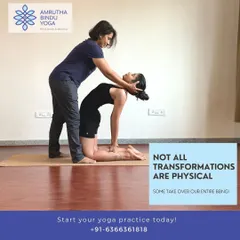
Yoga Practice and Alignment in JP Nagar
Master Advanced Yoga Through Anatomy and Proper Technique
More from Yoga Sadhana (Guided Practice Programs) by Sayujya Yoga
More services by Sayujya Yoga