The Art of Teaching Classical Pilates
Mastery is about more than performing exercises. It is about understanding the mechanics, refining your eye for detail, and learning to guide others with clarity.
Progress is not just about mastering choreography. It is about developing an eye for detail and the ability to guide others with precision and care. My internship hours ensure trainees hone these essential teaching skills.
Your spine has superpowers, and Pilates helps unlock them. Every exercise is designed to work with its natural curves, strengthening support muscles, improving mobility, and enhancing posture.
Your spine is designed to move in flexion, extension, lateral flexion, and rotation. Pilates works the spine in every direction to keep it strong, supple, and healthy.
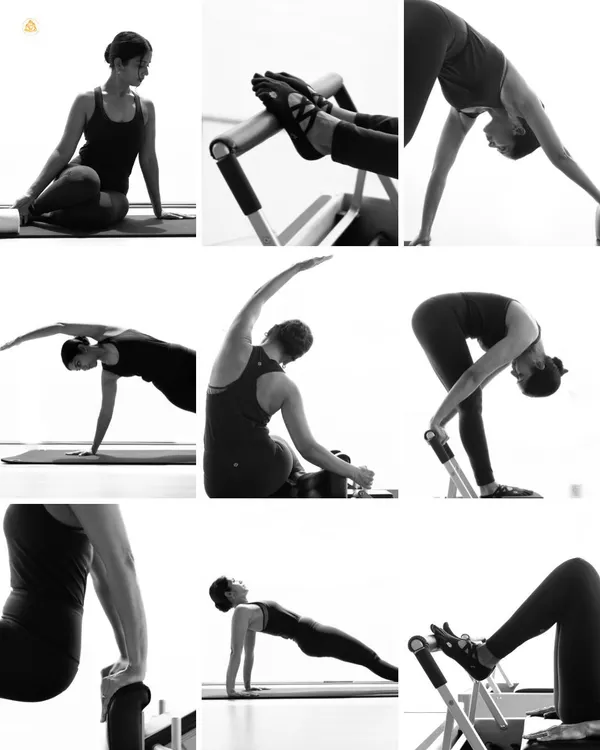
Here is how to ace the Cat on the Wunda Chair. This post breaks down the key tips for mastering spinal articulation, core control, and fluidity in this powerful exercise.
This video demonstrates the Cat on the Wunda Chair. Notice the focus on spinal articulation and deep core engagement, which are key to executing the movement with control.
The Spine Stretch on the Wunda Chair, demonstrated here, uses spring resistance to support spinal flexion. On the Mat, the core must work harder. Both versions promote a stronger, more flexible spine.
In Classical Pilates, mindful lateral breathing is essential. I use various techniques, including props like the theraband, to help students deepen their breathwork and refine their movement.
Here is a Pilates teacher tip of the day. Focus on cueing rather than correcting. Giving verbal and visual cues empowers students to find their own alignment and body awareness.
This is a sneak peek into a trainee duet lesson. I am guiding Sangeeta and Suman through the long stretch series, providing cues to help them refine their form and deepen their understanding.
This graphic outlines the six key principles of Pilates: Breathing, Concentration, Control, Centering, Flow, and Precision. These principles will guide you to a purposeful workout.
About The Art of Teaching: Technique & Principles
The shift from practitioner to teacher happens the moment you stop simply performing exercises and start understanding the biomechanics behind them. In my training, we focus on developing your eye—learning to spot an alignment issue and using verbal or visual cues to guide a client toward the right sensation. It is not about correcting the student; it is about providing the precise instruction that allows them to find the alignment themselves.
Beyond Choreography: Mastering Contrology
Many think Pilates is just a collection of exercises. This is a common misconception. When you dive into the Classical method, you realize it is a complete system. Joseph Pilates called it 'Contrology' because it demands total command of the mind over the body. To teach this effectively, you must understand the 'why' before the 'what'.
The Spine: Your Focal Point
Almost every exercise we teach revolves around the spine. We don't just focus on strength; we focus on articulation. Whether you are working on the Reformer, Cadillac, or Wunda Chair, the goal remains the same: to move the spine in every direction—flexion, extension, lateral flexion, and rotation. If you cannot explain why a client is articulating their spine in a specific way, you are just showing them a move, not teaching them a method.
The Power of Cueing
Effective teaching is rooted in communication. I train my instructors to move away from generic corrections. Instead, we use specific, tactical cues. How do you describe the engagement of the deep abdominals without just saying 'pull your stomach in'? How do you use the spring resistance on the apparatus to facilitate a movement rather than fight it? You will learn to use voice modulation, tactile cues, and visual imagery to help students embody the movement.
Why This Training Matters
This is not a quick certificate. It is a deep dive. Over 450 hours of training, you will shadow me, observe real-time corrections, and eventually lead sessions yourself. You will learn to work with diverse bodies—from athletes to those recovering from injury—ensuring you graduate with the confidence to handle any client who walks into your studio.
Similar work from other experts
Browse through Curated picks from other experts on mytribe
 63
63
The Classical Pilates Method in Motion
Pilates Teacher Training and Certification in Mumbai

Mastering the Fletcher Pilates Matwork Series
Become a Certified Pilates Instructor
 21
21
The Pilates Method: Form & Technique
Classical Pilates Training: Reformer Drills & Contrology
More from Pilates Teacher Training by Kavita Prakash
More services by Kavita Prakash