The Iyengar Method: Intelligent Use of Props
Props are not crutches. They are architectural tools designed to reveal the mechanics of your body. In this gallery, we explore how chairs, wall ropes, and blocks help you refine your alignment and access deeper stages of asana practice.
Props can be used to both support and intensify a pose. Here, a chair is used in Virabhadrasana I (Warrior I) to challenge the student to descend deeper while maintaining the correct alignment of the back leg and pelvis.
In this Virabhadrasana II (Warrior II) variation, the chair helps hold the thigh back, allowing the student to focus on revolving the abdomen and hovering just above the seat. This builds immense strength and stability in the legs and core.
This dynamic sequence uses a chair as a target for the hand in the transition from Trikonasana (Triangle Pose) to Ardha Chandrasana (Half Moon Pose). This builds agility, power, and spatial awareness.
Props make asanas accessible, but the experience of a pose without props is often quite different. This clip on Vasisthasana (Side Plank) highlights how removing the support of a chair requires the body to reconfigure itself to both bear weight and balance.
This clip shows two related but different poses. The first uses ropes to assist in a variation of Virabhadrasana II, while the second, its 'evil cousin', prepares the body for a challenging arm balance. Notice the connection in the shoulder and hip actions.
This is another interpretation of Virabhadrasana II, this time using ropes to prepare for the arm balance Vasisthasana. The rope supports the leg, allowing the student to focus on lifting the hips and strengthening the supporting arm.
This image asks if there is a better way than the rope-assisted Virabhadrasana II. It prompts the student to think about progression and how props can be a stepping stone towards the final, unassisted expression of a pose.
Here is a new twist on an old favorite. This is Virabhadrasana II practiced on the floor against a wall. This variation removes the challenge of gravity, allowing for a deep, passive opening of the hips and groins.
If you have a corner at home, try this seated Upavistha Konasana (Wide-Angled Seated Forward Bend). Pressing the inner thighs into the corner helps to awaken and strengthen these often-neglected muscles, which is key for many standing and seated poses.
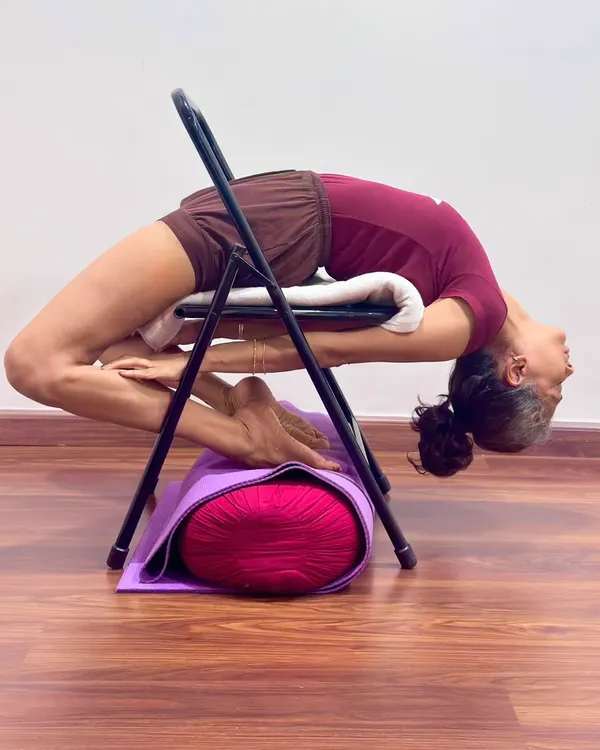
This image demonstrates how a chair can be used for abdominal firming work. This variation of Navasana (Boat Pose) uses the chair for support, allowing for a sustained hold that builds deep core strength.
About The Iyengar Method: Intelligent Use of Props
A chair is never just a chair in this practice. When we use it for a pose like Virabhadrasana II, it does not make the work easier. Instead, it anchors your thigh, allowing you to stop worrying about balance and start focusing on the rotation of your abdomen and the specific engagement of your core. This is how props translate complex alignments into physical reality.
Why do we use props? Beginners often assume they are for those who cannot do the 'real' pose, but that is a misunderstanding of yoga mechanics. In the Iyengar method, props are precise instruments for learning.
The Anatomy of Support
When you use a block under your hand in Trikonasana, you aren't 'cheating' by reaching the floor. You are creating the necessary space to open your chest and align your spine vertically, rather than collapsing into the side you are trying to stretch. We use these tools to teach the brain where the body is in space.
Wall Ropes and Decompression
Our use of wall ropes, visible in several of our gallery clips, serves a different purpose. They provide traction. In inversions or standing poses, they allow for a cooling fluidity, helping to decompress the spine and create space in the joints that active effort alone cannot reach.
Finding the 'Why'
Whether you are using a chair for abdominal firming or a rope for Parsva Halasana, the goal remains the same: clarity. Props act as a feedback loop. They force you to engage the muscles you might otherwise ignore. For students in our Bangalore classes and those following our digital library, this is the fundamental shift—moving from blindly copying a shape to understanding the architecture of the pose.
If you have been practicing for years and feel stuck, or if you are just starting and feel rigid, these tools are your best teachers. They provide the support required to stop struggling and start observing.
Similar work from other experts
Browse through Curated picks from other experts on mytribe
The Iyengar Method: Using Props for Precision
The Iyengar Method: Using Props for Deep Alignment
The Science of Asana: Prop-Based Practice
Precision in Practice: Iyengar-Inspired Prop Yoga
 22
22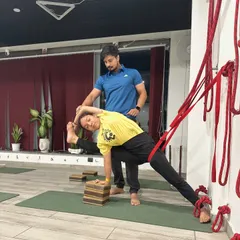
Iyengar Yoga with Props: Precision and Alignment
 26
26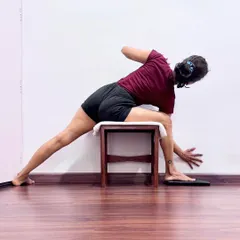
The Iyengar Method: Precision with Props
More from Advanced Yoga Studies by The Practice Room
More services by The Practice Room