Bharatanatyam as Inquiry: Weaving History, Philosophy, and Dance
Dance is more than movement for me. Here, I share my journey of using Bharatanatyam to explore history, mythology, and the stories that define us.
Under a banyan tree, I explore the concept of time and history through movement. The tree, with its interconnected roots and branches, serves as a metaphor for how the past and present are intertwined in our lives and in the evolution of Bharatanatyam itself.
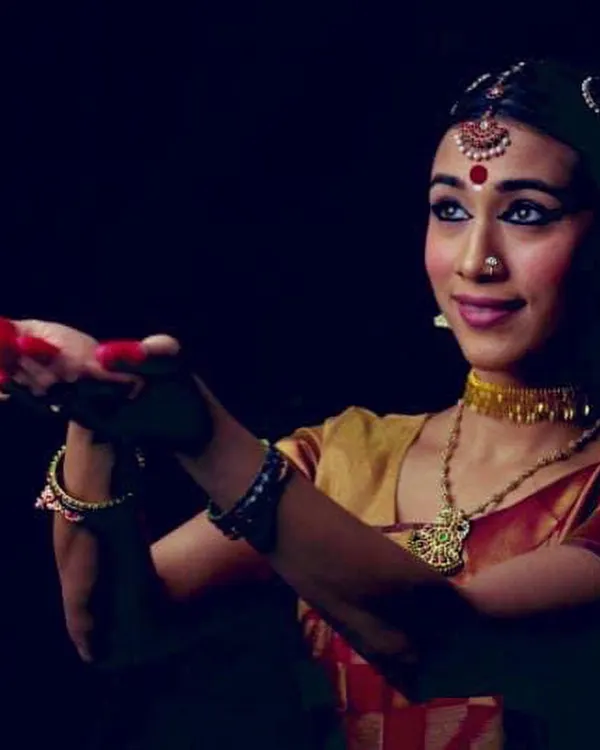
This is the 'padmakosha' hasta, or lotus bud hand gesture, a fundamental element of Bharatanatyam's vocabulary. This image is part of a series exploring 'aharya' (adornment) and how it shapes a dancer's identity, a concept discussed in the ancient text, the Natya Shastra.
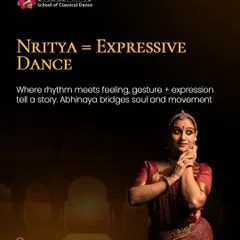
Through 'abhinaya' or expression, I narrate the story of Krishna and Radha, one of the popular legends behind the festival of Holi. My teaching emphasizes storytelling, showing students how to convey emotions and narratives using facial expressions and gestures.
Here, I recreate a pose from a Mughal miniature painting depicting the celebration of Holi. This exploration shows the beautiful syncretic culture of India, where traditions evolved and were shared across communities, a theme I often discuss in my classes.
A moment from a collaborative choreography with a fellow artist, based on the works of Rabindranath Tagore. Such partnerships are a wonderful way to engage in deep artistic discussion and create work that interprets profound literary ideas through dance.
While traveling for a workshop, I came across this temple adorned with beautiful dancing sculptures. I couldn't resist trying to mirror their ancient postures, connecting my contemporary practice to the timeless forms carved in stone centuries ago.
This short piece depicts Kamadeva, the god of love, whose story is tied to the arrival of spring. Using verses from the Soundarya Lahari, I explore how mythology and poetry provide a rich source for choreographic and expressive work in Bharatanatyam.
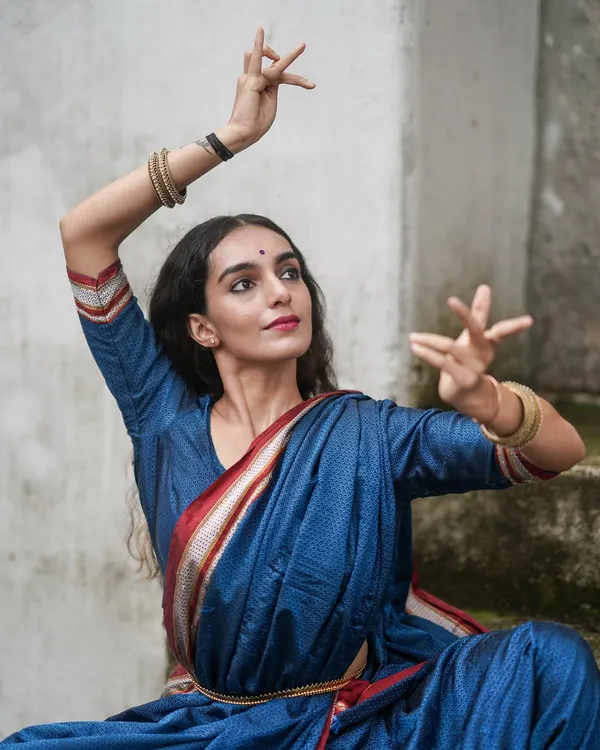
A close-up of the 'mukula' hasta, another hand gesture from the rich vocabulary of Bharatanatyam. This photo contemplates the dancer's identity and whether it is the costume that creates the character or if the dance is already an intrinsic part of who we are.
A quiet, introspective pose from a photo series discussing the role of 'aharya' or costume. Even with minimal adornment, the essence of the dancer remains. This reflects my teaching philosophy of focusing on the internal understanding of the art form, not just the external presentation.
About Dance as Inquiry: Connecting Art, History, and Ideas
I don’t teach just steps. If you join my classes, expect to spend time discussing the Natya Shastra, breaking down the poetry behind a Jathi, or questioning why a 2,000-year-old gesture still feels relevant today. It is a partnership where you bring your curiosity, and we use Bharatanatyam to find the answers together.
This cluster represents my studio as a space of constant questioning. Whether we are in the middle of a rigorous session of adavus or breaking down a verse from the Soundarya Lahari, the focus is always on connecting the physical movement to the intellectual root.
When I dance, I am not just recreating history, I am trying to understand the 'why' behind it. Like in my collaboration exploring Rabindranath Tagore’s work, we spent hours moving beyond the literal text to grasp the emotional and philosophical weight of his verses. My process involves deep research, from studying Mughal miniature paintings to understand the syncretic history of festivals like Holi, to reading Adya Rangacharya’s analysis of the Natya Shastra to ponder if the dancer’s identity changes with the aharya (costume) they wear.
My students, from beginners to advanced practitioners, often ask: can we keep the form traditional while making it relevant to our modern lives? The answer, I believe, lies in the inquiry. We treat every mudra (hand gesture) not as a static pose, but as a dynamic tool for communication. My classes are a space where we dismantle these movements to build them back up with intention. If you are looking for a place where you can refine your technique while deeply engaging with the literature and philosophy of India, you have found the right corner.
Similar work from other experts
Browse through Curated picks from other experts on mytribe
Mastering Abhinaya: The Heart of Bharatanatyam Storytelling
 8
8My Bharatanatyam Performances and Artistic Journey
 10
10
Rooted in Tradition: Yoga and Bharatanatyam Fusion
The Art of Abhinaya: Expressions & Storytelling
 50
50
Understanding Bharatanatyam: A Journey into Classical Dance
Semi-Classical Dance & Storytelling: Expressing Through Movement
More from Classical Dance Education by Tanya Saxena
More services by Tanya Saxena