The Ecological Method: Martial Arts Skills, Not Drills
I don't believe in endless, static drills. My training approach uses ecological dynamics to build fighters who can solve problems in real-time, whether you are a complete beginner or a seasoned competitor.
Here I demonstrate how to use jiu-jitsu principles to set up situations. Instead of drilling a move, we focus on destabilizing the opponent and creating openings for sweeps and submissions in a live, reactive context.
If there's one skill I prioritize, it's recognizing connections. This video breaks down how to identify, break, and establish connections from top and bottom positions to control the fight and progress your game.
This is my Guard Passing 101. I break down the process into four key steps, focusing on principles like passing the foot line, controlling the knee line, and pinning the hips, all of which are trained in live scenarios.
Are you a smaller person getting smashed by bigger opponents? Here are two key principles to focus on: using your knees and feet to manage distance and using frames to disrupt your opponent's connections.
Here's a real-time problem-solving session for one of my students struggling with mount maintenance. We use constrained games to help her develop the skill to counter bridges and break connections, rather than just drilling a technique.
Here are three wrestling games we use to develop takedown skills. We focus on destabilizing the opponent from an over-under position and using foot sweeps to break their base, all with live resistance.
This week we are working on hand-fighting and wrestle-up games from a seated guard. The goal is to create openings, enter a guard like De La Riva or shin-on-shin, and then work to a dominant position.
Here are three games for developing destabilization and reversals. We use constraints to focus on specific skills like hand fighting, achieving chest-to-chest connection, and escaping pins to reverse the position.
A glimpse into our training rounds using the ecological approach. We focus on repetition without repetition, allowing fighters to find realistic outcomes by breaking connections, controlling pins, and hunting for submissions in a live environment.
How do you learn submission escapes? We focus on reverse engineering the submission. By understanding the core concepts that make a submission work, you can learn to dismantle it in a live roll.
About The Ecological Method: Skills, Not Drills
Most gyms teach moves. I teach you to understand the fight. In my classes, we do not memorize sequences that fall apart the moment an opponent resists. Instead, we use live, situational sparring games that force you to adapt, manage distance, and find your own solutions. If you want to get fit while developing genuine, pressure-tested skills, you are in the right place.
Conventional training relies on the repetition of static moves. The problem is that a fight is fluid, not a pre-choreographed dance. When you train with us at Reign MMA in HBR Layout, we use the Constraints-Led Approach. This means I set up specific games with rules that guide you toward effective movement patterns naturally.
Whether we are working on Guard Passing 101 or escape mechanics from the bottom, you will not find me standing around showing you a move for ten minutes while you copy it. You will be rolling from the start. You will learn to identify connections and levers, understanding the why behind every grip and posture. This method removes the ego from the equation because the focus is on constant problem-solving rather than 'winning' a practice round.
For those in Bengaluru looking for serious grappling or MMA training, this methodology is designed to accelerate your growth. A white belt who understands principles will always out-skill someone who only memorized techniques. We focus on reality-based training for kickboxing, Muay Thai, and BJJ. If you are tired of training environments driven by ego and want to learn where the culture is built on hard work and honest problem-solving, this is your home.
Similar work from other experts
Browse through Curated picks from other experts on mytribe
Constraints-Led Jiu-Jitsu Training in Bengaluru
Practical MMA and Combat Sports Coaching in Mumbai
Martial Arts Technique Breakdowns and Fundamentals
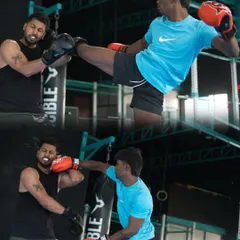
Sparring & Drills: Real-World Combat Training
Combat Philosophy & Technical Training
Real-World Self-Defense & Combat Techniques
More from Mixed Martial Arts (MMA) Training by Vighnesh Nathan
More services by Vighnesh Nathan