Eco-Friendly School and Educational Campus Design
We design learning spaces that breathe, using natural light and reclaimed materials to create environments where children feel connected to their surroundings.
The vibrant facade of the Mathru Centre for Developmental Disabilities in Bengaluru, made entirely from reclaimed windows painted bright yellow. The design creates a cheerful and welcoming landmark while demonstrating our commitment to resource circularity.
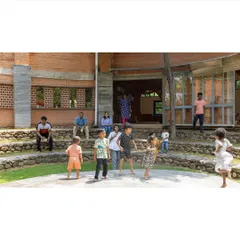
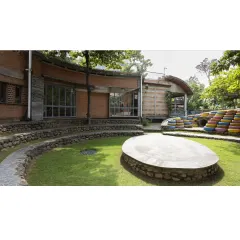
The Buddhi School in Bengaluru is designed around a large, shaded courtyard that serves as the heart of the campus. The building's orientation and use of earth blocks create a comfortable, passive-cooled environment for outdoor activities and learning.
The central courtyard at Sai Kirupa Special School in Tiruppur, featuring a sensory room and shaded gathering spaces under a tensile fabric roof. The architecture is designed to be a therapeutic and engaging environment for children with special needs.
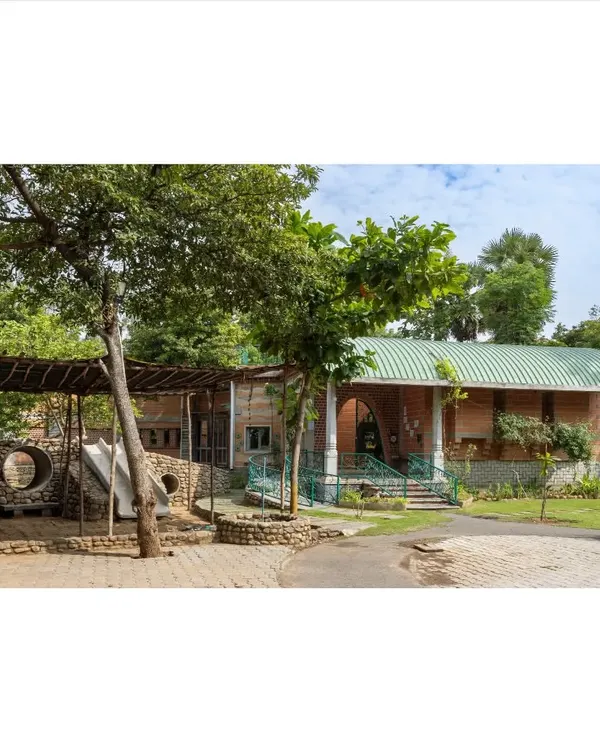
Originally a bus shelter, this arts classroom for the Spastic Society of Karnataka was built in just five weeks on a tight budget. Now standing for decades, its playful brickwork and accessible design show that thoughtful architecture can be both temporary and timeless.
The Eklavya campus in Bhopal, where the building's design actively integrates with nature. The facade provides nesting spaces for birds, and the grounds are lush with plants, creating a living, breathing learning environment.
An informal performance space at Buddhi School, where students can gather, share, and learn from each other. The stage is decorated with broken tiles, another example of creatively reusing materials.
A therapy and play area at the Mathru Centre, featuring equipment for physical development under a skylight. The space is designed to be both functional for therapy and joyful for children.
Playful cutouts in the brick walls of the Spastic Society classroom, shaped like animals. These small details spark imagination and bring a sense of delight to the learning space.
A collage from the Atelier School, showing children interacting with a water play area and moving through partitions made of paper tubes. The design encourages hands-on exploration and can be disassembled and reused in the future.
A view of the Promise Center Montessori from the late 90s, showing a child-scaled kitchenette and a spiral staircase. The design thoughtfully considers the perspective and needs of its youngest users.
About Schools & Learning Environments
In our school projects, we prioritize passive climate engineering to ensure classrooms remain cool and naturally lit throughout the day without heavy reliance on electrical cooling. From the reclaimed window facades at the Mathru Centre to the simple, child-scaled kitchenettes in our early Montessori work, we build environments that invite children to touch, explore, and learn.
Educational spaces require more than just four walls; they need to foster curiosity and handle the rigors of daily use. We apply our philosophy of circularity and resource efficiency to every campus we design. This means we treat the building as a living, learning tool.
Design for Disassembly
We approach school buildings with an eye on their entire lifecycle. At the Atelier School, we utilized bolted steel and paper tube partitions, making the structure adaptable for future needs. This 'design for disassembly' mindset ensures that the building can evolve alongside the educational curriculum, reducing long-term waste and environmental impact.
Inclusive and Sensory Architecture
Inclusive education is at the heart of our practice. Whether it is the Spastic Society classroom, which we converted from a bus shelter, or the Buddhi School, our designs emphasize accessibility. We focus on child-centric details: low brick walls that create distinct zones, sensory rooms for developmental therapy, and materials that offer tactile experiences. By scaling our design to the perspective of the child, we create spaces that feel safe, welcoming, and empowering.
Passive Climate Engineering
We believe in creating a comfortable indoor climate through architecture rather than machinery. By analyzing wind patterns and sun paths, we orient classrooms to maximize cross-ventilation and diffused natural light. This reduces the energy footprint while providing a calm, stable atmosphere for reading and play. Our use of earth blocks and local materials helps maintain thermal comfort throughout the year, keeping interiors temperate even during the peak of summer. We engage local communities, artisans, and teachers in this process, ensuring the final campus reflects the local culture and the specific aspirations of the school management.
Similar work from other experts
Browse through Curated picks from other experts on mytribe
 17
17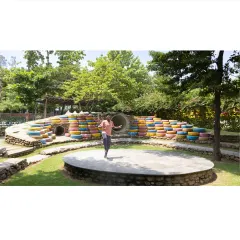
Eco-Friendly School and Learning Center Design
 21
21
Educational Institutions: Designing Functional Learning Spaces
 7
7
Sustainable Architectural Design for Learning Spaces
 14
14
Educational & Institutional Architecture Design in Bangalore
 15
15
Sustainable Institutional Campus Architecture Design
Climate-Responsive School Architecture
More from Community-Led Design & Development by Biome Environmental Solutions
More services by Biome Environmental Solutions