Featured Ecological Architecture Projects
A selection of our work where design, community, and ecology intersect to create living spaces that honor the land they occupy.
This vernacular homestay in rural Madhya Pradesh is the result of a deep collaboration with the local community. The space is built with earth, shaped by local hands, and decorated with murals that tell the stories of the families who live here, offering a truly authentic and sustainable travel experience.
At the Atelier School in Bangalore, learning happens everywhere. This collage shows how we designed spaces that are as much a part of the education as the curriculum, using playful elements like a water channel and partitions made from reusable paper tubes, all inspired by the Reggio Emilia philosophy.
The ASA Office in Bhopal stands as a testament to ecological design on an institutional scale. This building, raised on stilts to create a natural wetland below, is powered by solar energy and built with locally made composite blocks, showcasing how modern workspaces can be both functional and deeply connected to nature.
The heart of our process is in the hands of the community. Here, a woman from a village in Madhya Pradesh makes adobe bricks from the local soil. This image captures the essence of participatory design, where local skills and materials are not just used, but celebrated.
We believe architecture should be playful and invite interaction. At the Sai Kirupa Special School in Tiruppur, a student finds a moment of rest in an inverted arch, a feature that has become one of the most loved elements of the campus, showing how design can create moments of joy and belonging.
Our design process begins with understanding the place and its people. This animated sketch shows the evolution of the amphitheater roof for the Jhamtse Gatsal Community Centre in Arunachal Pradesh, a design choice that gives a large, usable open space back to the children on a narrow mountain ridge.
A building should live and breathe with its environment. The facade of the Eklavya campus in Bhopal, made from reclaimed railway windows, has become a vertical garden, with creepers weaving through and providing nesting spaces for birds, as its reflection shimmers in the collected rainwater below.
We design spaces that feel like home because they are born from the local culture. This bedroom in a Madhya Pradesh homestay features walls adorned with traditional patterns, simple wooden furniture, and textiles made by local artisans, creating a warm and welcoming retreat.
About Featured
Our approach is not just about the structure, but the full lifecycle of materials. Whether it is sourcing reclaimed railway windows for an office in Bhopal or training local artisans to build mud homestays in Madhya Pradesh, our focus remains on creating buildings that leave a positive footprint. We believe a space should tell a story about the land it occupies, rather than just filling space on a plot.
Architecture is, for us, a conversation with the environment and the people who inhabit it. We move away from the idea that a building is a static, finished product. Instead, we design for longevity and adaptability, considering how a structure can evolve or be deconstructed decades later.
Our portfolio reflects this commitment through:
-
Circularity in Practice: We look at 'perceived waste' as a primary resource. At the Atelier School, we utilized bolted steel and paper tubes specifically so the structure could be disassembled and reused. In our campus designs, reclaimed railway windows act as nesting spaces for birds, proving that materials can find new utility long after their first life ends.
-
Participatory Design: We build with, not just for, communities. Our work on vernacular homestays across Madhya Pradesh was not a top-down mandate but a collaboration with local elders, youth, and artisans. By integrating their traditional knowledge—such as mud, cob, and adobe construction—we ensure the final space is deeply rooted in local culture and easier for the community to maintain.
-
Passive Climate Engineering: Sustainability is not an aesthetic choice; it is a functional necessity. Projects like the ASA Office in Bhopal demonstrate this by using water-sensitive design to mitigate flooding, turning a drainage challenge into a wetland that recharges the local aquifer.
We focus on these vernacular techniques and ecological sensitivity to ensure our buildings are not just structures, but hubs that support biodiversity, generate local jobs, and respect the ecosystem.
Similar work from other experts
Browse through Curated picks from other experts on mytribe
 8
8
Sustainable Architecture and Contextual Design Portfolio
 8
8
Architecture Rooted in Context and Human Experience
 8
8
Featured Eco-Friendly Architectural Designs
 6
6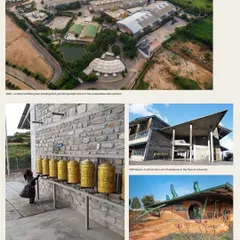
Creating spaces where nature and architecture meet
 15
15
Architecture and Design That Tells Your Story
 8
8
Architectural Work Rooted in Context and Nature
More from Community-Led Design & Development by Biome Environmental Solutions
More services by Biome Environmental Solutions