Board and Train for Reactive Dogs
Real change happens when we stop controlling behavior and start understanding it. My residency programs focus on building trust, confidence, and comfort for dogs struggling with anxiety and reactivity.
This is a training session for Cooper, who has fear-based reactivity towards other dogs. To help him feel safe, we started with controlled exposure using a fake dog. This allows us to manage the distance and intensity, building his confidence before introducing him to a real, calm dog.
Panda came to me with fear-based reactivity. Working with a professional helps set proper expectations and find the right threshold for your dog. Here, we are using pattern games and decompression techniques to make him feel safer on walks. It's a journey, not a quick fix.
This is the case of Tyson, who would bite people in his home without a clear trigger. During his board and train, we discovered he had pain in his hind legs. Once his pain was managed, the biting behavior completely stopped. It's a powerful reminder that behavior is often communication about physical discomfort.
Giving a dog the ability to choose is incredibly powerful. Piku was terrified of going on walks, and a previous trainer suggested pulling him. Instead, I recommended removing the slip lead and allowing him to return to his safe space whenever he wanted. Slowly, he began to explore on his own terms.
About Board & Train: Real Transformations
Most 'quick fix' training programs overlook the physical cause of behavioral issues. When a dog like Tyson came to me biting, we didn't just train the bite away. We identified chronic pain in his hind legs and addressed that first. Once the physical discomfort was managed, the behavior naturally stopped, proving that behavior is often just communication.
When a dog struggles with fear-based reactivity, the urge is often to correct them immediately. At my Gurgaon residence, we do the opposite. We pause. Every residential program begins with a 'Cortisol Detox'—a 24-48 hour period of strict rest to lower their stress baseline. This is crucial because a dog living in constant fight-or-flight mode cannot learn.
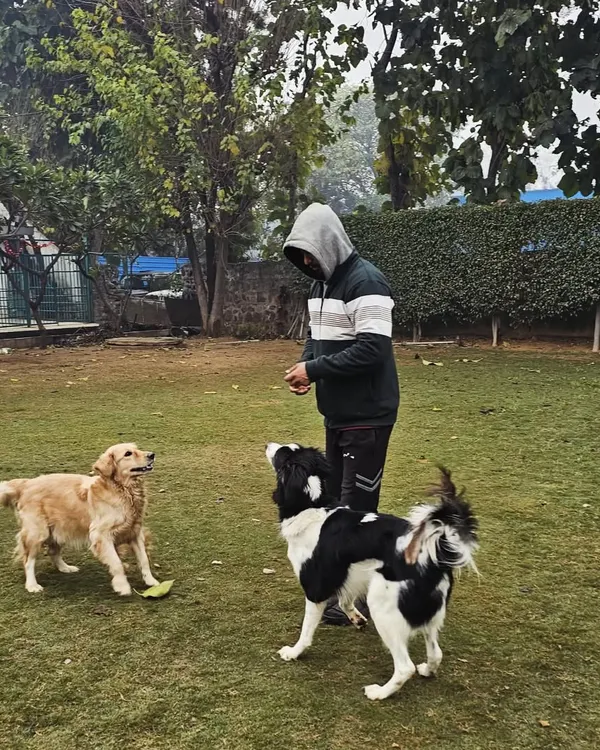
My approach to board and train is fundamentally different from a kennel environment. Your dog lives in my home, with my husband and our resident dogs. This offers constant, gentle exposure in a secure, home-like setting. For cases like Panda, who had severe fear-based reactivity, we didn't force interaction. We used pattern games and decompression walks to find his 'threshold'—the exact distance where he felt safe enough to observe without reacting.
Physical health is the silent variable in behavioral training. As I found with Tyson, we always conduct a pain screening before starting any modification. If a dog is in pain, no amount of training will fix the behavior.
Residential training is not just about the dog; it is about the transition back home. We finish every program with detailed transfer sessions. I teach you the specific cues, handling techniques, and lifestyle changes—such as providing a safe space to retreat to—so that the progress we make here sustains when you get home.
Similar work from other experts
Browse through Curated picks from other experts on mytribe
 7
7Behavior Modification and Reactive Dog Training
Help Your Reactive Dog Find Calm and Confidence
 20
20
Behavior Modification for Dogs With Serious Challenges



Overcoming Your Dog's Anxiety and Fearful Behavior
Building Trust and Positive Dog Training
 16
16
Behavioral Training & Obedience Programs
More from Dog Boarding & Residential Training by Aishani Mathur
More services by Aishani Mathur