Architectural Design Process and Collaborative Craftsmanship
Architecture is a collective act. Our design process merges technical precision with the hand of the artist, bringing traditional craft into the contemporary built environment.
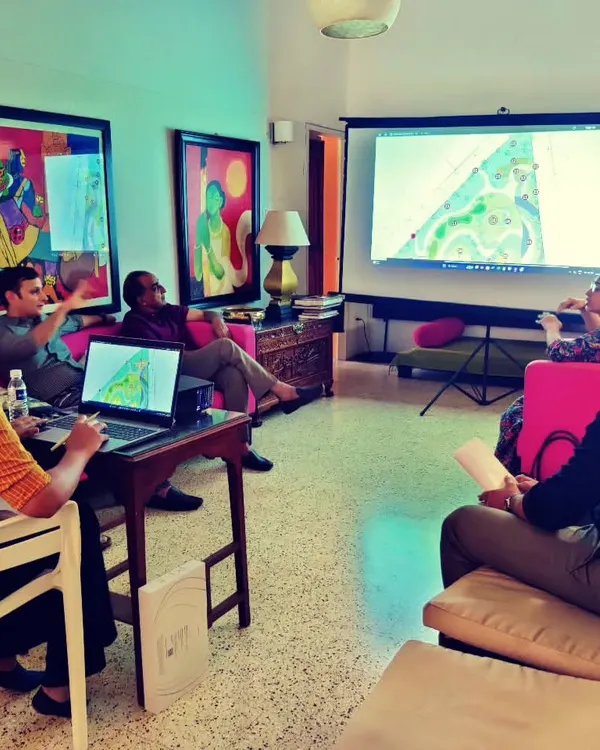
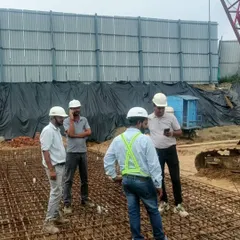
Collaboration is central to our practice. Here, we are on-site with the renowned artist Manjit Bawa, reviewing designs for artworks to be integrated into the LMW Headquarters project, ensuring a deep synthesis of art and architecture.
A large-scale stainless steel installation by artist Rajeev Sethi hangs in the lobby of the LMW Headquarters. Our collaborations with artists are integral to creating buildings that are layered with meaning and cultural resonance.
On-site discussions with artists and craftspeople are a critical part of our design process. This image captures a working session for the LMW Headquarters, where sculptural elements for the building were being reviewed and refined.
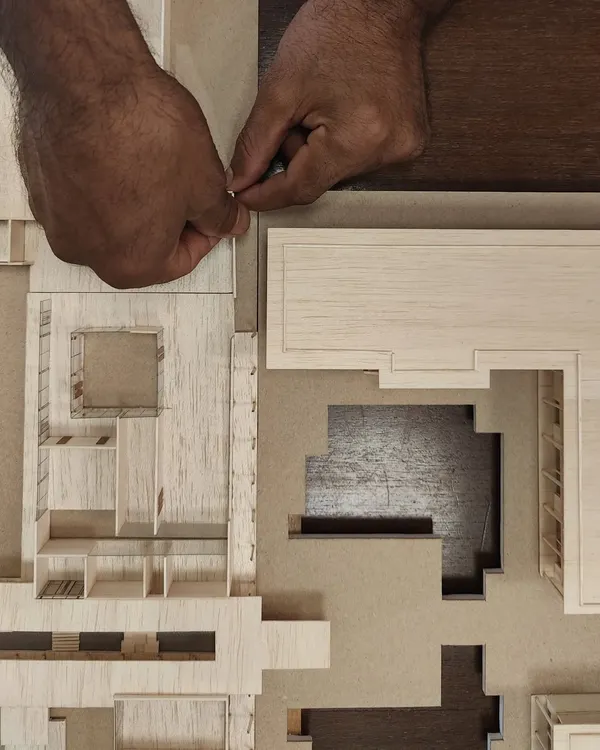
A collection of architectural models at various scales for the Lilavati Lalbhai Library. Physical models are an essential tool in our practice, allowing us to study everything from the building's overall form to the finest construction details.
A highly detailed 1:100 scale model of the Chhatrapati Shivaji Maharaj Vastu Sangrahalaya, crafted by our expert in-house modelmakers. These models are not just representations but tools for understanding and celebrating complex architectural heritage.
A detail of a painted wooden installation created by Kerala artists for the LMW Headquarters. By integrating the work of traditional craftspeople, we aim to create buildings that are rich in texture, narrative, and local identity.
About The Architect's Craft: Process & Collaboration
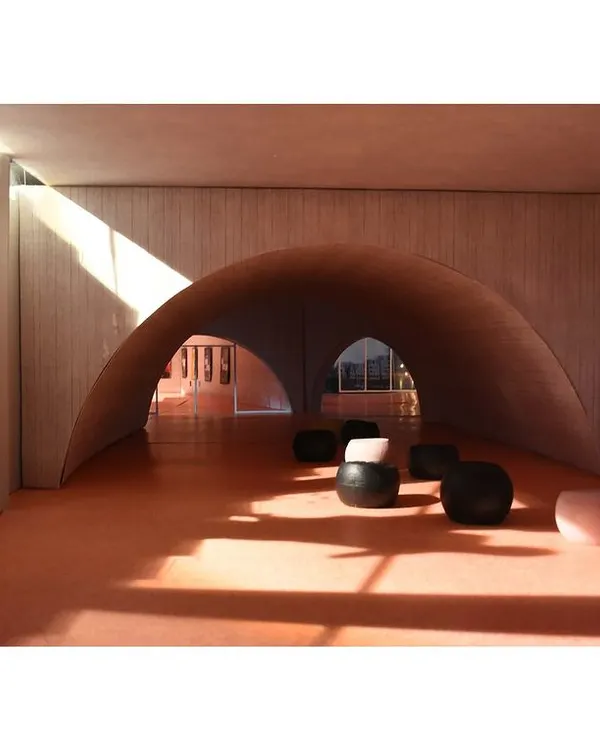
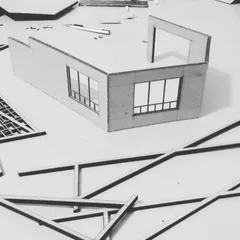
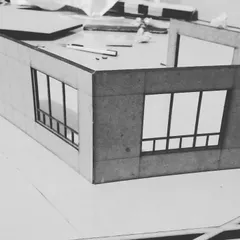
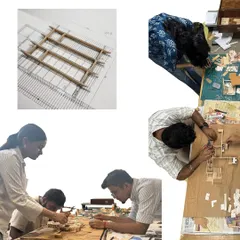
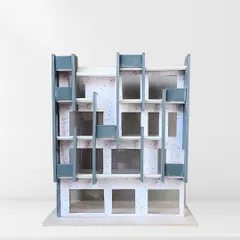
We maintain a rigorous in-house workshop where we construct 1:100 scale balsa wood models for every major project. These models serve as our primary tools to test light ingress, structural volume, and spatial flow long before construction begins. This physical testing ensures that our institutional designs function in harmony with their climate and site context.
Our practice operates on the belief that buildings should be more than concrete boxes. The design process at RMA Architects is iterative and deeply collaborative, requiring us to engage with artists, structural engineers, and craftspeople from the earliest conceptual stages.
The Role of Physical Modeling
We utilize physical models not merely for presentation, but as a critical testing ground. Whether designing a library or a museum expansion, our team builds scale models in balsa wood to understand the building's dialogue with its environment. This allows us to observe how sun-paths affect the interior or how a user experiences the transition between thresholds. By studying these forms at 1:100 scale, we refine the structural bones of a building to ensure it remains responsive to the climate.
Collaborative Synthesis
Architecture achieves its full potential when it integrates other disciplines. At the LMW Headquarters, we collaborated with artist Manjit Bawa to design animal and human motif casts for bridge railings, and with Rajeev Sethi to create large-scale stainless steel installations. This approach prevents a project from becoming a singular, rigid statement. Instead, it creates a layered environment where traditional skills—such as mural painting with natural pigments or metal casting—find a permanent home in modern institutional architecture.
Site-Responsive Methodology
We do not believe in universal, copy-paste design. Every project requires an audit of its history and material palette, whether we are working on a greenfield site or performing adaptive reuse on a heritage structure. Our design process is essentially an exercise in site-specific sensitivity, ensuring that the architecture we create today contributes meaningfully to the future of the landscape.
Similar work from other experts
Browse through Curated picks from other experts on mytribe
 13
13
Our Design Process: From Models to Materials
 19
19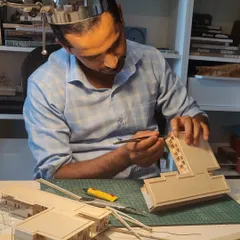
Our Philosophy in Practice
Architectural Design Process: From Idea to Form
 5
5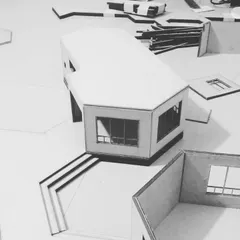
Our Architectural Design Process
Our Architectural Design Process: From Concept to Construction
How We Design: From Concept to Construction
More from Institutional & Cultural Architectural Design by RMA Architects
More services by RMA Architects