Rope Therapy for Spinal Decompression
Using specialized Iyengar wall ropes to safely decompress your spine, release nerve pressure, and regain natural mobility.
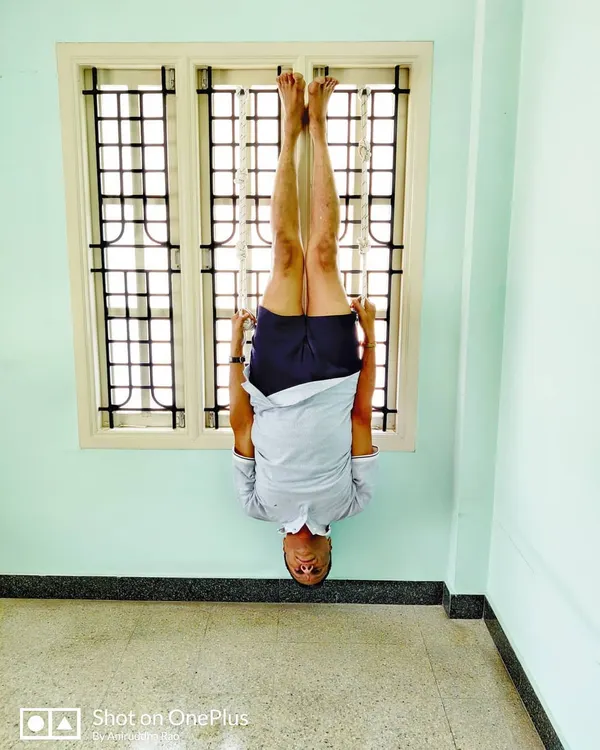
The rope wall allows us to practice inversions like this supported headstand (Niralamba Shirshasana) with complete spinal decompression. It feels incredible as gravity lengthens the spine, and it's a fun way to build confidence upside down.
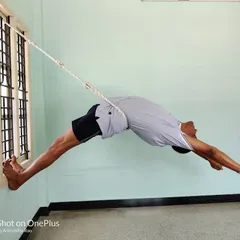
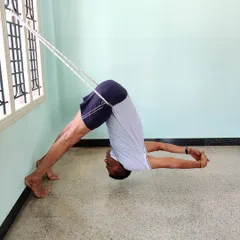
Exploring my own practice at home, I use ropes to work on shoulder flexion and spinal extension. This kind of supported backbend helps build strength and mobility without the risk of compression.
You don't always need a full studio. Here is a simple rope setup on a window, showing how therapeutic yoga can be adapted for your own home practice to maintain consistency in your healing journey.
Using the home setup for a supported headstand. The ropes hold the weight of the legs, allowing the neck and shoulders to remain relaxed while still getting all the benefits of reversing blood flow to the head.
Another angle of the supported inversion, showing how the body can fully release and hang with minimal muscular effort. This state of disengagement is deeply restorative for both the body and mind.
About Rope Therapy for Spinal Decompression
You might be used to pushing through pain, but here, we let gravity do the heavy lifting. Using Iyengar wall ropes, we create gentle traction that pulls the vertebrae apart, giving your spine the space it needs to decompress without you straining a single muscle. It is about letting go and trusting the equipment to hold you, so your nervous system can finally switch off.
How it works
When we talk about spinal decompression, we are not talking about intense force. We are talking about using gravity as a tool. I use the rope wall setup to support your pelvis while you hang upside down. This allows the vertebrae to separate slightly, relieving pressure on the discs and nerves that cause chronic back pain.
Why the rope wall matters
Iyengar yoga uses props for a reason. Often, when we are injured, our muscles clench and guard the area, making it impossible to truly relax. The ropes do the work of holding you up, so your muscles do not have to. This safety allows us to access ranges of motion, like supported backbends or inversions, that might feel risky or impossible on a flat mat.
The process
- Assessment: Every session starts with checking your current pain levels and mobility. We never jump into heavy traction if your body is not ready.
- Gradual Release: We increase the duration in the ropes slowly. As they say in Kannada, Ati amrutam visham (too much of a good thing is poison). We focus on consistent, safe practice rather than pushing your limits on day one.
- Beyond the Spine: We integrate Pranayama (breathwork) during the traction to manage the sensations of deep tissue release.
This is not a quick fix. It is about re-educating your body to trust movement again. Whether you are dealing with a past injury or just the accumulated tightness of a desk job, we build your practice one breath at a time.
Similar work from other experts
Browse through Curated picks from other experts on mytribe
Rope Wall Yoga for Spinal Decompression
Spinal Health & Pain Relief Yoga
Therapeutic Yoga for Back Pain and Spinal Relief
Therapeutic Yoga for a Healthy Spine
 10
10
Rope Yoga Kurunta: Traction and Spinal Extension
Therapeutic Iyengar Yoga for Pain and Injury Management
More from Yoga for Injury Recovery & Therapy by Rakshith Setty
More services by Rakshith Setty