Master Art Fundamentals and Drawing Basics
Real art starts with getting the basics right. We focus on tonal values, composition, and proportions to help you move past stick figures and create work you are proud of.
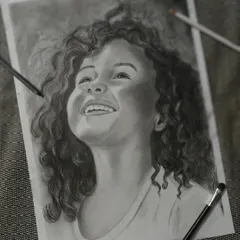
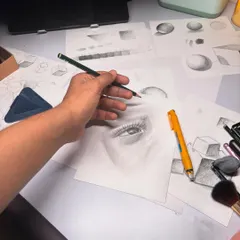
A detailed close-up of a student's pencil portrait exercise. This work showcases techniques for shading skin, rendering realistic eye reflections, and drawing intricate details with graphite.
A student practices the grid method to create an accurate portrait drawing. This foundational technique is excellent for understanding proportion and is a key part of our General Art Foundation course.
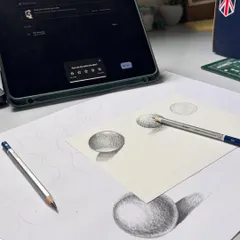
Here, a student is working on a value study exercise. This involves painting geometric shapes with a range of tones from black to white, which is essential for understanding depth and form.
Another view of our tonal study practice. Students create color wheels and swatches in grayscale to master the control of paint and water for creating consistent tones.
About Building a Strong Foundation
We do not believe in watching from afar. If your shading looks flat or your grid measurements are off, we will jump in to fix your technique on the spot. In our small-batch sessions at our Vashi studio, we look at your sketchbook with you, correct your grip, and guide you through the process of seeing subjects as shapes rather than outlines.
Why Foundation Matters
Many students come to us wanting to jump straight into complex portraits, but if you cannot shade a simple sphere or understand tonal values, your drawings will always lack depth. We focus on the 'boring' stuff—composition, light, shadow, and proportion—because these are the tools that make your art look real.
Our Approach to Drawing
- Active Correction: We do not just show you how to do it. We watch you draw, identify where your proportions are going wrong, and help you fix them immediately.
- Exam Prep & Beyond: For students prepping for Elementary and Intermediate Drawing Grade Exams, we use a structured curriculum that covers object rendering, memory drawing, and geometry. This ensures you are not just passing an exam, but actually understanding how to sketch.
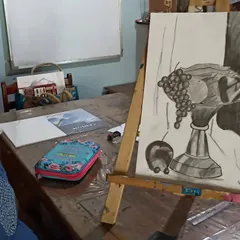
- Vashi Studio Environment: Our studio is a space for focus. We use real setups, not just photos, so you learn how to handle light sources and textures on objects like steel jugs or natural items.
What to Expect
You will spend a lot of time on value studies and grid methods. It might feel repetitive, but this is the work that turns a 'nice try' into a finished piece. Whether you are a complete beginner or an exam candidate, our goal is to build your discipline so you can eventually sketch anything, anywhere, with confidence.
Similar work from other experts
Browse through Curated picks from other experts on mytribe
Pencil and Charcoal Drawing Foundations
Drawing Foundation: Practice & Basics
Sketching and Shading Classes in Bengaluru
 4
4
Art Foundation & Expert Sketching Classes
 6
6

Drawing & Sketching Fundamentals in Koramangala
Realistic Pencil Drawing Fundamentals for Beginners
More from Drawing Grade Exam Preparation by Renuka's Art Zone
More services by Renuka's Art Zone