Clinical Pilates and Reformer Sessions in HSR
Using professional studio equipment to correct alignment and build strength, one precise movement at a time.
I love seeing my clients progress. This client made incredible improvements in her shoulder blade mobility. We worked on specific back extension exercises on the reformer to release stiffness and build strength in her upper back.
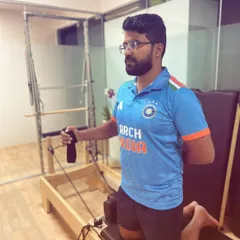
For conditions like sciatica, the reformer can be an amazing tool. It allows us to work on hip mobility and core stability in a supported way, performing movements like pelvic bridges and lunges without putting stress on the lower back.
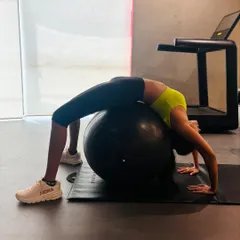
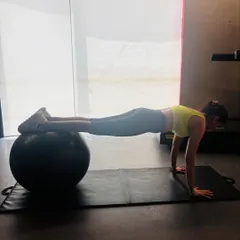
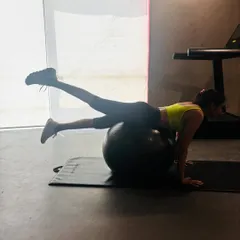
Using props like a small stability ball on the reformer adds another layer of challenge. This exercise targets core stability, balance, and back extensor strength all at once. Proper breathing is key to engaging the diaphragm and core correctly.
It's not about how many reps you do, but how you do them. Here, I'm guiding a client through a reformer stretch, ensuring her alignment is perfect to target the right muscles. This hands-on, quality-focused approach is central to every session I teach.
The Pilates ring is a great prop for providing feedback and resistance. Here, I'm asking my client to concentrate on her mind-muscle connection to activate her back and shoulder muscles correctly. It's this focus that creates real change.
Achieving a split requires both flexibility and strength. The reformer is an excellent tool for working on splits safely, as it supports your body while allowing you to deepen the stretch in your hamstrings and hip flexors with control.
Using slider discs on the floor mimics some of the challenges of a reformer. This movement combines a plank with a pike and leg abduction, requiring immense core strength, flexibility, and body awareness.
About Studio Sessions: Reformer & Props
Most people see the Reformer as a giant metal bed, but here, it is a tool for precision. Because I am a physiotherapist first, I do not just count reps. I use the machine to adjust your alignment and isolate the specific muscles causing your pain, whether it is sciatica, chronic shoulder stiffness, or simple muscular imbalances.
When you walk into my HSR Layout studio, you will not find mindless repetition. My sessions are built around the Reformer, Cadillac, and stability props because they provide the external feedback you simply cannot get on a mat.
Why a Physio-Led Approach Matters
Standard fitness classes often prioritize speed, which can aggravate existing injuries. Since my foundation is 9 years of physiotherapy, I use the equipment to manage conditions like nerve pain, spinal decompression, and post-injury rehabilitation. When we work on hip mobility or shoulder blade stability, the equipment acts as a support system, allowing us to safely target the deep stabilizer muscles that are often ignored.
What to Expect in Our Sessions
- Mind-Muscle Connection: We focus on the quality of the movement. If you are doing a pelvic bridge, we are checking that your glutes are firing correctly and your spine is not compensating.
- Customized Resistance: We use springs and pulleys to grade the load. If you are recovering from an injury, we scale the resistance to match your capacity, not the other way around.
- Prop Integration: From Pilates rings to stability balls, I incorporate props to fix imbalances like 'tech neck' or rounded shoulders effectively.
Whether you are dealing with chronic pain or just want to build deep core strength without the bulk, this space is about purposeful movement. It is about learning how to use your body better, so you can walk out of the studio feeling more aligned than when you arrived.
Similar work from other experts
Browse through Curated picks from other experts on mytribe
Reformer Pilates for Strength and Stability
 31
31
Our PhysioPilates Studio and Equipment
Pilates for Real Strength and Stability
Reformer Pilates for Strength and Posture Correction
 11
11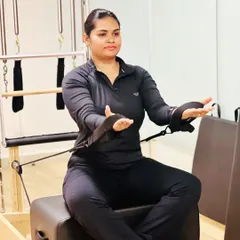
Clinical Pilates for Targeted Injury Rehabilitation
Reformer and Prop-Based Pilates
More from Therapeutic Yoga by Sara Najafi
More services by Sara Najafi