Student Showcase: Robotic Cars & Vehicles
Watch our young engineers build everything from simple switch-controlled cars to autonomous line followers. These are hands-on STEM projects where kids learn to code, wire sensors, and bring their own creations to life.
A student clearly explains the components of her DPDT car, which uses a Double Pole Double Throw switch to control the direction of the DC motors. She then gives a confident demonstration of her working model.
This team presents their solar-powered obstacle-avoiding car. They explain how an IR sensor sends information to an Arduino board to change the car's direction, highlighting its potential use in surveillance and safety.
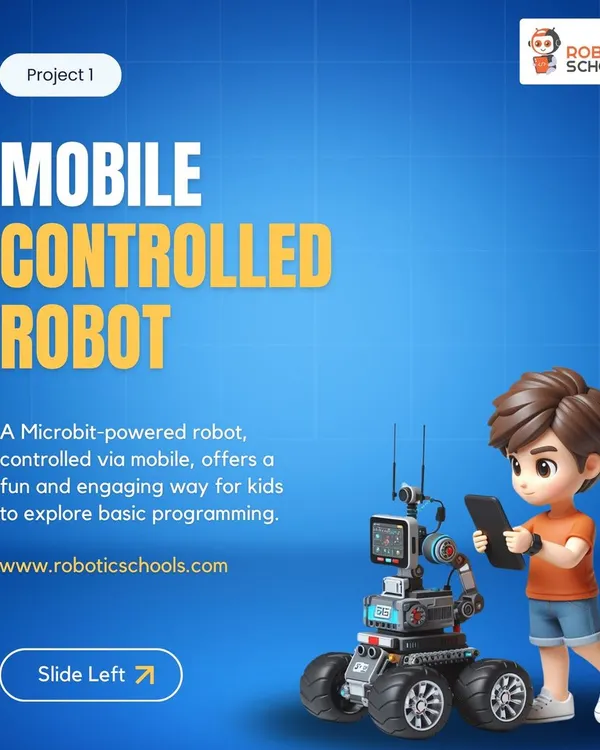
Two students explain the workings of their Bluetooth-controlled car. They detail how an app sends signals to an HC-05 Bluetooth module, which the Arduino then translates to direct the motor driver and wheels.
This team of 8th graders shows off their solar-powered remote-controlled car. They demonstrate how a button box sends signals to control the motors, combining renewable energy with remote operation.
This light-following car, built by two 8th-grade students, is a great example of smart robotics. They explain how two LDR sensors detect a light source, guiding the Arduino to steer the car toward the light.
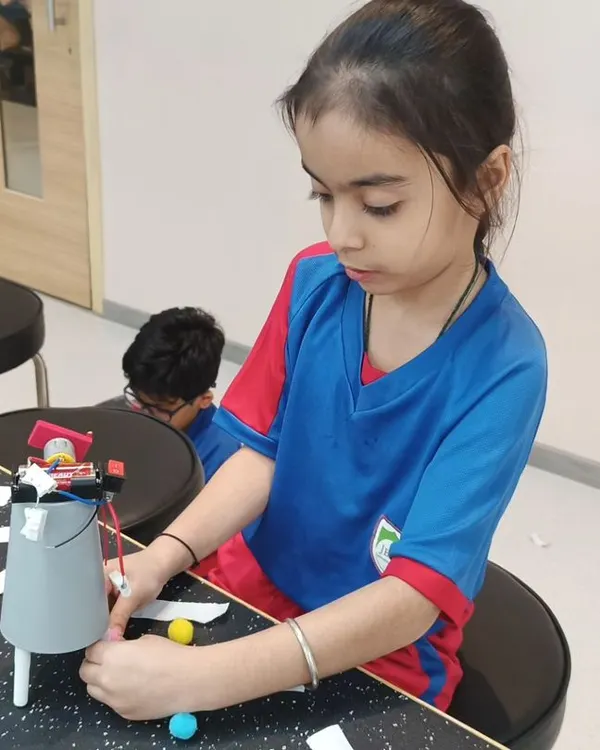
Kiara from Class 5F demonstrates her DPDT car, showcasing her understanding of how switches control mechanical movement. It's a foundational project that builds confidence and skill.
Two students from Class 4B show off the crawling robot they built. They identify the simple components needed, like a motor and switch, and demonstrate how it moves, proving that you can create motion with basic electronics.
Two third-grade students introduce their DPDT car model. Their excitement is contagious as they get ready to show how their creation works, highlighting the fun of hands-on learning at a young age.
About Student Showcase: Robotic Cars & Vehicles
When a student starts here, they do not just follow a manual. They figure out the logic—like how a switch reverses polarity to spin a motor, or how an IR sensor tells an Arduino to stop before hitting a wall. We have two distinct paths: a mechanical module for foundational electronics, and a coding-heavy robotics module for those ready to program their own autonomous vehicles.
Our approach is simple: kids learn best when they are building things that actually move. We skip the heavy theory and go straight into practical experiments. Students start by understanding the basics of circuits, like using DPDT switches to control motor direction, before moving to advanced concepts.
For those ready to step up, we introduce microcontrollers like the Arduino Uno. This is where coding meets hardware. Students learn to interface sensors—like ultrasonic distance sensors for obstacle avoidance or IR sensors for line following—with their own code.
What makes our workshops at HRBR Layout different is the culture of presentation. Every student learns to explain their project, troubleshoot their own connections, and demonstrate their work. Whether it is a solar-powered remote car or a Bluetooth-controlled bot, the goal is for the child to walk away saying, 'I made this.' We provide the complete starter kits, including the breadboards, jumper wires, and motors, so your child only needs to bring their curiosity.
Similar work from other experts
Browse through Curated picks from other experts on mytribe
 6
6
Robotics Project Blueprints for Kids
Robotic Vehicles: Kids Building Real Machines
Student Robotics Projects and Engineering Demonstrations
 10
10Featured STEM Projects and Robotics Workshops
 16
16
Hands-on Robotics and Engineering Workshops
Robotics and Coding Classes for Kids
More from Robotics and Electronics Workshops for Kids by Robomations
More services by Robomations