Robotic Vehicles: Kids Building Real Machines
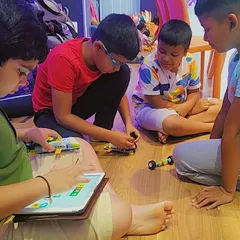
Why just play with cars when your child can code and build them? We transform curious kids into young engineers by teaching them to design, wire, and program their own autonomous robotic vehicles.
I built a Multi-Color Line Follower Bot that can detect and follow tracks of different colors. This project taught me about advanced sensor calibration and coding logic for navigation.
This is my Obstacle Avoider robot. Using an ultrasonic sensor, it intelligently detects and navigates around any hurdles in its path, demonstrating smart, autonomous movement.
We don't just build one type of car; we build innovators. This video shows the evolution of our car projects, from simple remote-controlled vehicles to smarter, more complex bots.
I built a remote control for my car using touch sensors instead of buttons. Each sensor is programmed for a different direction: forward, backward, left, and right.
This is my table follower bot, which uses an ultrasonic sensor to detect the edges of a table and avoid falling off. It's a great project for learning about distance sensing and control.
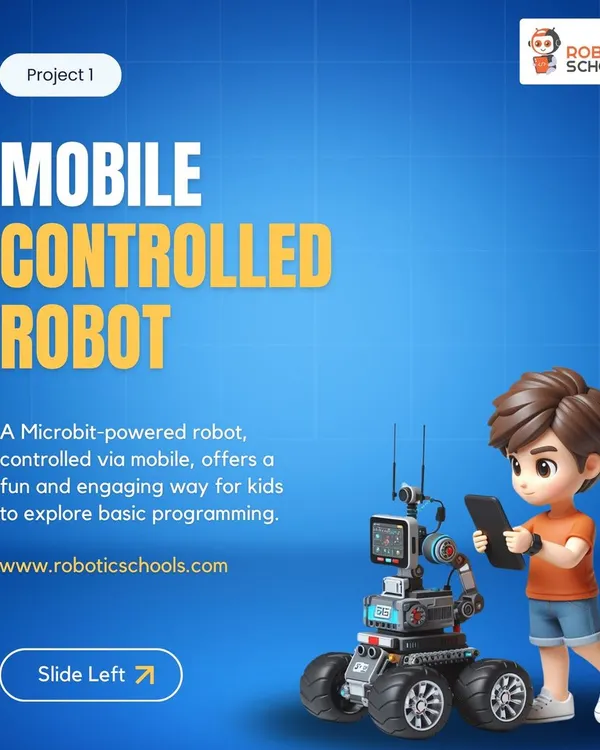
This Bluetooth-controlled car is one of our advanced projects for ages 8 and up. Students build the car from scratch and learn to control it using a smartphone app they help configure.
My "Track Master" is a smart black line follower bot. It uses IR sensors to follow a path with precision and speed, showing how creativity meets technology in robotics.
At just 4.5 years old, I built my own remote-controlled car. This project proves that innovation has no age and that even the youngest kids can learn basic mechanics.
We came to follow the line, but ended up leading the way. Our line follower bots use IR and color sensors to master logic and build bots that move with purpose.
Meet the Bulldozer Bot. It's a powerful machine designed to push, lift, and clear paths. This project teaches about torque, gears, and building robust mechanical structures.
About Robotic Vehicles on the Move
It is not just about snapping plastic parts together. Here, your child learns how sensors actually talk to motors. When they build a line-follower, they are not just following a track; they are debugging their own code to handle curves, speed, and sensor precision in real-time. This is where abstract concepts like voltage and logic become something they can touch, control, and improve.
Building a robot involves more than just curiosity. At our Pitampura lab, we bridge the gap between simple play and real-world engineering. We guide kids through the entire hardware-software lifecycle, moving from visual block coding for beginners to writing actual C++ scripts for Arduino microcontrollers.
The Core Tracks
- Logic & Sensors: We teach kids how to use IR sensors to follow black lines, or ultrasonic sensors to navigate around obstacles. It is a lesson in control theory—understanding exactly how a machine perceives the environment.
- Circuitry & Control: Students work with real components like servo motors, jumper wires, and breadboards. They learn to manage power distribution and handle the inevitable hardware glitches that happen in any engineering project.
- Beyond the Build: Every vehicle serves a purpose. Whether it is a Bluetooth-controlled car operated by a smartphone app or a bulldozer bot designed to push, lift, and clear paths, we emphasize function over aesthetics.
We provide all the tools, but the logic and the code are theirs. We let them fail, debug their errors, and try again until the vehicle moves exactly as they intended. If you are looking for robotics courses in Delhi that prioritize actual skill over theory, this is the place to start.
Similar work from other experts
Browse through Curated picks from other experts on mytribe
Build Your Own Remote Controlled Robot
Student Showcase: Robotic Cars & Vehicles
 6
6
Robotics Project Blueprints for Kids
Build Your Own Robots and Gadgets
Robotics and Coding Classes for Kids
Robotics and STEM Workshops for Kids in Noida
More from Coding & Programming by Be A Robonaut
More services by Be A Robonaut