Hands-on Electronics: Student Projects and Experiments
Watch our students bring science to life through hands-on experiments. From basic LED circuits to sensor-based logic, these projects show how we turn foundational electronics into real-world builds.
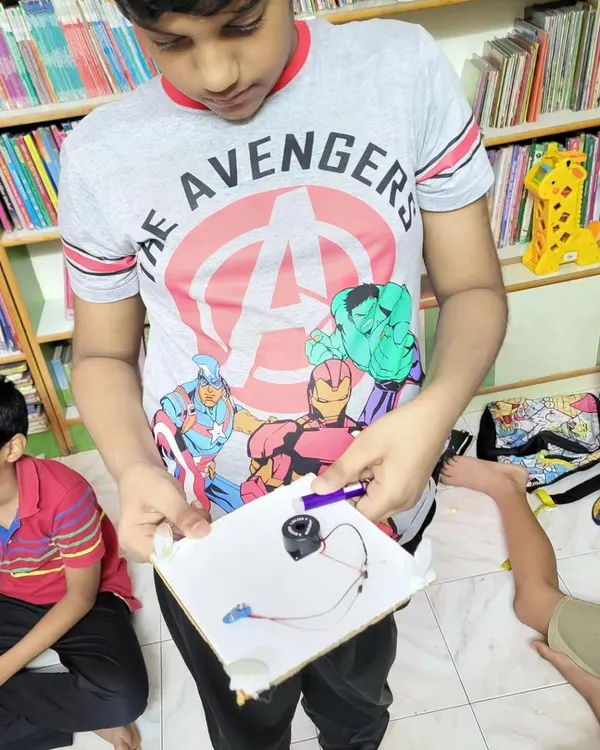
Two young students collaborate on an experiment with an SPST switch and a DC motor. One student explains each component, from the 9-volt battery to the motor, and then demonstrates how flipping the switch completes the circuit.
Inspired by a traffic light, these students use LEDs, resistors, and jumper wires to build their own version. They explain the red, yellow, and green light sequence, connecting a real-world object to robotics components.
This group of students explains their slide switch circuit, which controls two different LEDs. They correctly identify it as an SPDT (Single Pole Double Throw) switch and discuss its use in toys and torches.
A team of students summarizes their exciting month of experiments, including building a traffic signal with a breadboard and push-button switch. The video also shows a student engaging with an AI drawing tool.
This video shows a group of students talking about teamwork and then cuts to a demonstration of a traffic light circuit. It highlights both the collaborative spirit and the practical skills learned in our workshops.
Ashwin from Grade 3 demonstrates his joystick and servo motor experiment. He shows how the joystick sensor sends signals to the Arduino to control the movement of the servo, a key concept in robotics control.
A student demonstrates an ultrasonic sensor circuit. She explains that the sensor's purpose is to measure distance and correctly identifies the Arduino board, jumper wires, and LEDs used to make it work.
This team of three demonstrates their "10 Running Lights" project. They show how turning a trimmer's knob controls the speed and number of glowing LEDs, a great visual lesson in variable resistance.
This trio of Grade 3 students presents their six-LED forward and reverse running light model. They confidently list the components, including transistors and an IC, showing an impressive grasp of circuit components.
Even our first graders get in on the action. This team from Class 1A explains how a potentiometer works to turn an LED on and off, demonstrating that foundational concepts can be taught at any age.
About Student Showcase: Exploring Electronics
Every student here starts with our starter kit—breadboards, jumper wires, and 9V batteries—building their first circuits from scratch. Unlike textbook learning, they wire up SPDT switches or potentiometers to see immediate results, like a light dimming or a motor spinning. It is the perfect way to see if your child is ready to move beyond theory and start building real hardware.
Moving from Theory to Reality
Most students walk in thinking electronics is just about reading diagrams. We change that immediately. By the end of our Junior Electronics & Mechanics module, students are not just memorizing definitions; they are physically connecting components to see how electrical energy transforms into mechanical work.
What Students Actually Build
Whether it is a 1st-grader experimenting with a potentiometer to control an LED or a 4th-grader creating a battery level indicator, the focus is on learning by doing.
- Circuit Fundamentals: Using SPST and SPDT switches to manage current flow in toys and household models.
- Logic & Sequencing: Designing running lights using ICs and resistors to understand patterns.
- Sensor Basics: Integrating ultrasonic or light-dependent resistors to react to the environment.
The Practical Side
We provide everything in our proprietary starter kits. You do not need to hunt for components or buy expensive tools. Everything is designed to be safe and easy to handle for kids, meaning they spend their time testing and debugging—the two most important skills in engineering. If a connection fails, they do not get a lecture; they get to troubleshoot their own wiring until that light blinks. That moment of "I made this, and it works" is exactly what we aim for in every session at our HRBR Layout space.
Similar work from other experts
Browse through Curated picks from other experts on mytribe
 10
10
Electronics & Robotics Projects for Kids
Hands-on Electronics Workshops for Kids
Electronics, Bots & Soldering Workshops
Hands-On STEM Projects and Workshop Highlights in Bengaluru
Robotics Projects and Creative Inventions

Hands-on Science & STEM Projects
More from Robotics and Electronics Workshops for Kids by Robomations
More services by Robomations