The Journey to Black Belt in Traditional Karate
Achieving a black belt in Shorin-ryu is a commitment to consistency, not just a physical test. It is a path of discipline that I have walked and taught since 1992.
Respect is the foundation of everything we do. Students begin and end every class by bowing, a practice that instills humility and gratitude as they prepare for their Black Belt grading examination.
Senior students practice their kata during a selection session for the 2025-26 Black Belt batch. Each movement must be precise, demonstrating a deep understanding of the form's application and history.
Being honored during a Kumite (sparring) Training Seminar in Davanagere. These events are crucial for students to test their skills in a controlled environment and learn practical applications of their techniques.
A moment of appreciation with the organizers of the Kumite seminar. Sharing knowledge with dedicated students across our branches is one of the most rewarding parts of my work.
A group of young karateka at the Kumite Training Seminar in Davanagere. These students learned basic and advanced sparring techniques, preparing them for the next stage of their martial arts journey.
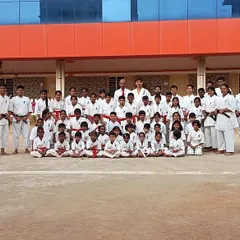
The culmination of years of hard work. Here, I am with the newest group of students who earned their black belts at our 30th Annual Day and Black Belt Awarding Ceremony.
About The Journey to Black Belt
Earning your black belt here is not a process you can rush. We require years of consistent practice, regular attendance at our Kumite seminars, and a deep understanding of our Shorin-ryu basics. If you are looking for a quick certification, this is not the right path for you, but if you want to master the art and test your limits, I am ready to guide you.
True mastery of karate is a lifelong pursuit. When we prepare students for their black belt grading, the focus is not merely on memorizing patterns but on internalizing the spirit of Shorin-ryu. My teachers in Okinawa always reminded me: 'Mada tarinu. Kitae konashite.' (It is still not enough. Train hard.) This philosophy drives everything we do.
My training methodology for advanced students involves three critical pillars:
- Kihon (Basics): We revisit foundational stances and techniques constantly. Without perfect basics, your higher-level forms will not have power.
- Kata (Forms): These are the heart of our system. Students must demonstrate not just the physical movement, but an understanding of the application (Bunkai) behind every technique.
- Kumite (Sparring): This is where theory meets reality. Our seminars in places like Davanagere are designed to test your reflexes and strategy in a controlled but intense environment.
Grading is formal and rigorous. We do not issue ranks lightly because a black belt represents a teacher's endorsement of your character and technical proficiency. We follow a clear, year-long cycle for grading preparation, ensuring that when you step onto the mat for your exam, you are truly ready to hold that rank.
Similar work from other experts
Browse through Curated picks from other experts on mytribe
 5
5


Master Your Path to Black Belt


Karate Belt Grading and Certification
 11
11
The Journey to Kuro Obi: Earning Your Black Belt
 6
6
Kyu Grading and Certification in Okinawan Kobudo
 28
28


The Path to Black Belt: Gradings and Ceremonies
Kyokushin Karate Belt Grading and Progression
More from Karate Programs for Schools & Communities by Suresh Kenichira
More services by Suresh Kenichira