Designing for Higher Learning
We believe an academic campus should be more than a collection of classrooms. We create vibrant spaces where architecture, nature, and community interaction naturally converge.
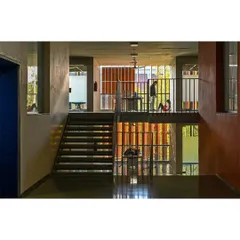
The central spine of the VIT School of Architecture, designed as a multi-level interactive zone. The visual connectivity between floors, with students visible on walkways and in breakout spaces, fosters a dynamic learning environment.
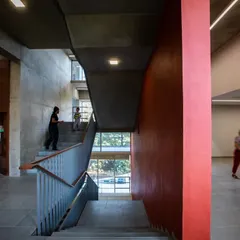
Students collaborating on the steps of a wide corridor at VIT. We designed these transitional spaces to be more than just for circulation, creating informal nooks and seating areas for spontaneous discussions.
A double-height studio classroom at VIT. The mezzanine level provides additional workspace and allows for visual connection and observation, encouraging peer-to-peer learning.
The academic blocks at VIT are designed as a series of interconnected volumes with deep overhangs and recessed windows, creating a play of light and shadow while providing shade.
The central atrium of the Azim Premji University in Bhopal. The space is designed for natural ventilation, with connecting bridges and open corridors that allow air to move freely through the building.
A classroom at Azim Premji University, which opens out onto a landscaped courtyard. This connection to the outdoors provides natural light and a calming view for students.
A landscaped court at Azim Premji University, providing a quiet, green space for students to relax and study between classes. The design is inspired by the climate-responsive courtyards of the region.
The residential blocks of the DRL Leadership Academy set against rolling green mounds. The campus is designed as a low-rise development where the built form is secondary to the landscape.
An internal courtyard at the DRL Leadership Academy, featuring shaded seating areas and trees. These spaces act as cool, comfortable zones for informal learning and interaction.
The entrance to an academic block at the DRL Leadership Academy, showing how a ramp allows people to walk up through the building, blurring the line between circulation and program space.
About Designing for Higher Learning
When planning an academic block, we move beyond just sizing rooms for occupancy. We prioritize the 'in-between' zones, such as the corridors, ramps, and central spines. By designing these as wider, interactive spaces rather than mere circulation paths, we create natural hubs where students and faculty inevitably pause, talk, and exchange ideas. This is where the real learning happens.
Architecture as a Catalyst for Interaction
For us, educational architecture is about fostering a sense of community. In projects like the School of Architecture at VIT, we replaced traditional, static corridors with a central spine that functions as a multi-level social and academic heart. By visually connecting studios and library carrels, we allow peer-to-peer learning to happen in the open. It transforms the act of moving through the building into a shared experience.
Designing with the Climate
A building must belong to its place. Whether we are using local Farsi sandstone as seen in our work at Azim Premji University in Bhopal or planning for passive cooling through North-South orientation, our goal is to minimize dependence on artificial climate control. We use deep overhangs to shield against harsh sun, create open courtyards to channel breeze, and design facades that invite natural light without the glare. This responsiveness makes the building energy-efficient while keeping the spaces pleasant and naturally ventilated for long hours of use.
The Human Scale
Institutional buildings can often feel overwhelming. We consciously choose to work with a human scale, creating pockets of intimacy even within large campuses. This might involve split-level planning, integrating green mounds into the built form, or designing personal window niches. Our aim is to ensure that even in a campus meant for thousands, every student finds a quiet corner to think or a comfortable place to collaborate. We treat master planning as a long-term conversation between the built environment and the landscape, ensuring future expansion remains cohesive and intentional.
Similar work from other experts
Browse through Curated picks from other experts on mytribe
 15
15
Sustainable Institutional Campus Architecture Design
Institutional and Educational Architectural Design
 21
21
Educational Institutions: Designing Functional Learning Spaces
 9
9
Institutional and Educational Campus Design
Institutional and Educational Campus Landscape Design
 41
41
University & Academic Environments
More from Educational & Institutional Architecture by Mindspace
More services by Mindspace