Sensory and Cognitive Learning for Preschoolers
We help children build a concrete understanding of the world through sensory-based learning, turning abstract ideas into hands-on experiences.
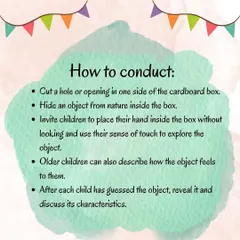
This is a stereognostic activity, where a child identifies geometric solids while blindfolded. This isolates the sense of touch, helping the brain build a stronger, more detailed understanding of shape and form.
Our 'Taste Bottles' help children refine their gustatory sense. By tasting and identifying sweet, sour, and salty solutions, they develop a more nuanced palate and the language to describe their sensory experiences.
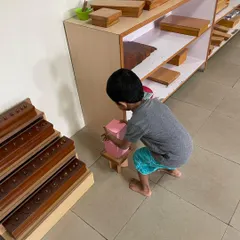
Error and self-correction are fundamental to Montessori learning. This child notices her own mistake while building the Pink Tower and corrects it without any adult intervention, building true problem-solving skills.
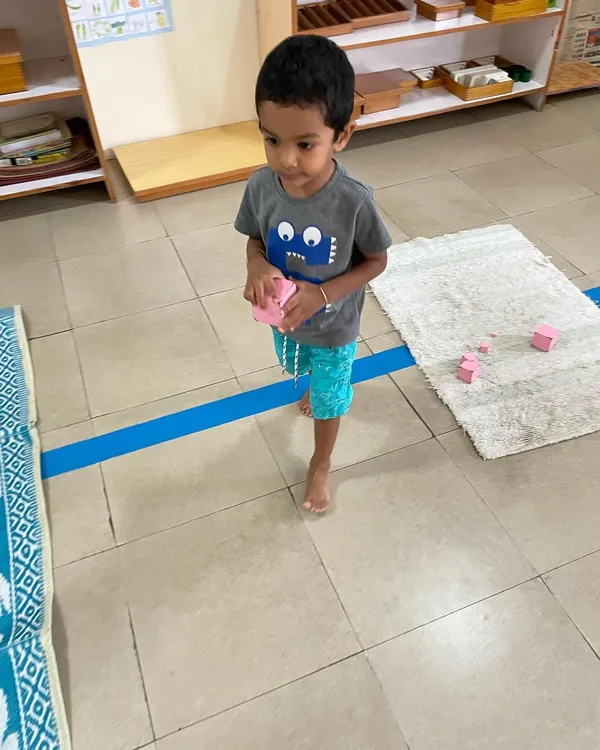
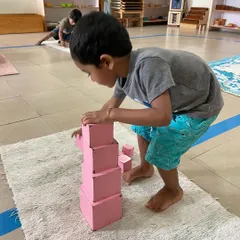
The Pink Tower is a favorite among our little ones. As they build this iconic Montessori material, they are visually discriminating dimensions and developing coordination, focus, and a mathematical mind.
A child proudly sits with his completed Pink Tower. This sensorial material teaches size discrimination and prepares the child for mathematical concepts of cubing and the decimal system.
Here, a child works with the Brown Stairs and Pink Tower. These classic sensorial materials help children understand dimensions, weight, and size relationships, laying a foundation for future math and geometry work.
The Brown Stairs material helps children perceive differences in thickness. As this child arranges the prisms from thickest to thinnest, he is refining his visual perception and building his concentration.
This child is working with the binomial cube, a material that introduces algebraic concepts in a concrete way. He is analyzing, applying, and self-correcting to assemble the cube, an advanced problem-solving exercise.
This four-year-old is demonstrating his grasp of addition. Our hands-on math materials allow children to internalize mathematical concepts, often leading to surprising and wonderful moments like this.
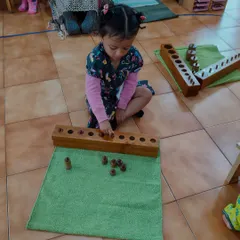
Age is not the criteria for learning in Montessori, only readiness. This 3.6-year-old is exploring large quantities, a precursor to understanding mathematical operations like addition and multiplication.
About Sensory & Cognitive Development: Learning Through the Senses
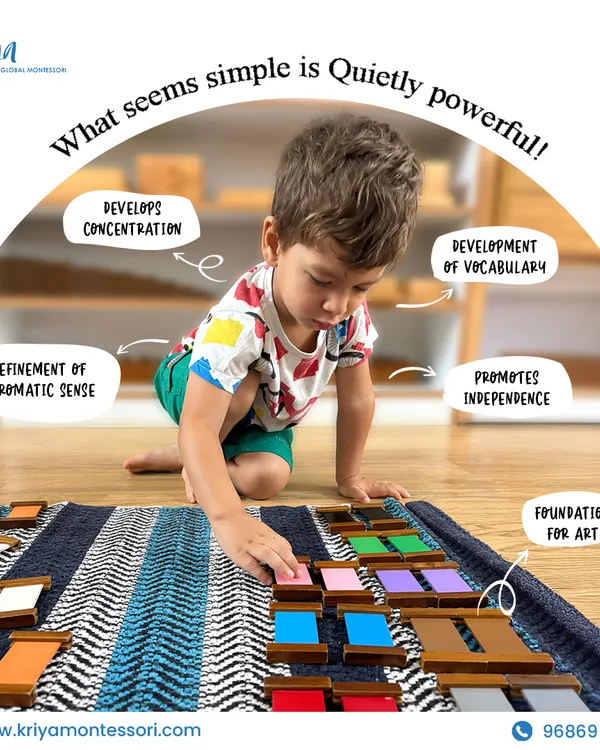
Our materials, like the Pink Tower and stereognostic solids, are scientific tools rather than toys. When a child works with these, they aren't just playing; they are isolating a specific sense—touch, dimension, or weight—to build deep concentration and mental order. This is where real learning happens, as they learn to identify errors and correct themselves without a teacher hovering over them.
At our Haralur campus, the environment is carefully prepared to support the natural cognitive development of every child. We believe that true learning begins with the senses. By using classic Montessori materials like the Brown Stairs, Sound Cylinders, and our Taste Bottles, we allow children to experience concepts like size, volume, sound, and flavour in a concrete, physical way.
Why Sensory-Based Learning Works
Traditional schooling often teaches abstract concepts through lectures. We do the opposite. When a child handles the geometric solids blindfolded in a stereognostic exercise, they are literally building a mental map of shapes that stays with them much longer than a worksheet ever could.
The Role of the Prepared Environment
Everything in our classroom has a purpose. We observe the child's readiness rather than their age. If a child is interested in the Binomial Cube, they are ready to explore algebra physically, regardless of whether they are three or six. The mixed-age environment is critical here; younger children learn by watching the older ones, and older children reinforce their own knowledge by helping their peers.
Building Independence Through 'Work'
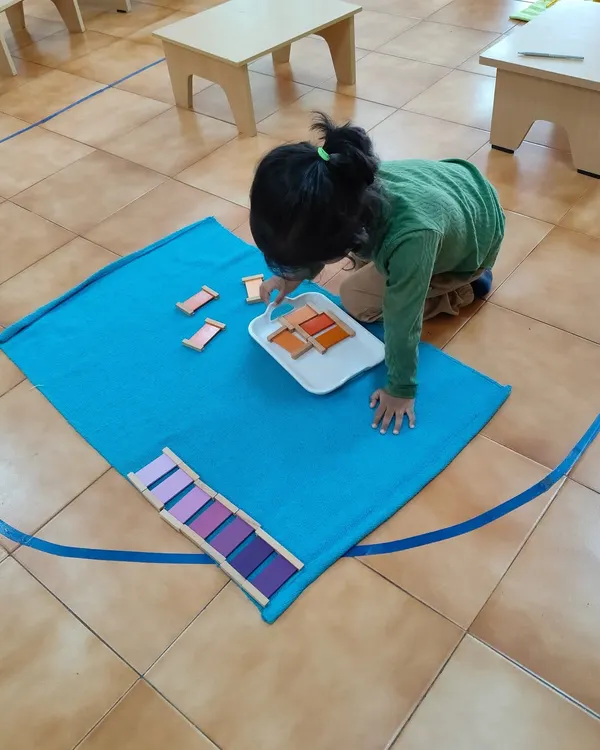
We call these activities 'work' because they require serious, focused effort. When a child completes a complex task—like grading color tablets from darkest to lightest or mastering the Teen Board—the sense of accomplishment is theirs alone. They learn to trust their own observations, which is the cornerstone of the confidence we see our students develop. We don't correct their mistakes for them. Instead, we let them figure out the solution through repetition, which eventually leads to mastery. This process is how we help children grow into capable, self-directed learners who enjoy the act of discovering new things.
Similar work from other experts
Browse through Curated picks from other experts on mytribe
 35
35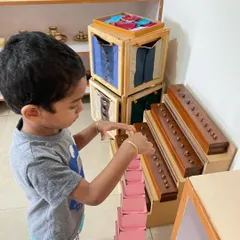
Sensorial Learning in Montessori Education
Sensory Development Activities for Toddlers
 34
34
Awakening the Senses: Sensorial Montessori Learning
Montessori Learning Materials for Early Childhood
 84
84
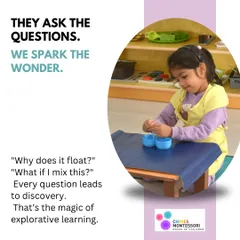
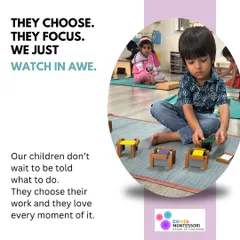
The Montessori Way: Learning in Action
 59
59
Hands-On Montessori Learning: How Children Build Real Skills
More from Montessori Preschool & Daycare by Ken Montessori
More services by Ken Montessori