Montessori Learning Materials for Early Childhood
Explore the scientific design behind our learning tools that help children grasp math and sensorial concepts through tactile, hands-on discovery.
Sensorial education is vital for children aged three to six. The materials are based on years of research and are designed to refine the senses, making children more confident, independent, and observant of the world around them. What the hand feels, the mind remembers.
The bead cabinet is an iconic and aesthetically beautiful part of the Montessori math curriculum. These colorful beads provide a tactile and visual way for children to explore skip counting, multiplication, and the decimal system, making abstract concepts concrete.
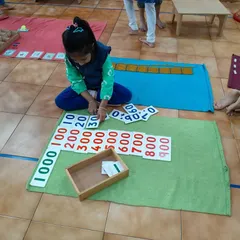
Montessori Math materials, like this hundred board, are designed to help children develop mathematical skills and spatial awareness through hands-on, experiential learning. We always move from concrete concepts to abstract ones.
At Ayelet, children fall in love with math. The transition from concrete materials like the hundred board to abstract concepts is so smooth that children effortlessly absorb and apply what they have learned.
The Montessori Number Rods help children connect the spoken number with its actual quantity. As this child lays out the rods and matches the numerals, she is building a solid, concrete foundation for all future math work.
The Seguin "teen" board is a brilliant material for helping children understand the complex numbers from 11 to 19. It visually and physically demonstrates how these numbers are formed from a ten and a unit, clarifying the basics of our decimal system.
Here, a child uses the multiplication bead bars to learn his times tables. The way he is so engrossed in the activity shows the magic of Montessori math, where learning is a joyful process of discovery, not rote memorization.
Long multiplication can be an abstract and difficult concept. Here, a child uses the checkerboard bead material to perform complex multiplication visually, making the process clear and understandable.
The Stamp Game is a key material that bridges the gap between concrete and abstract math. Children use these small tiles to practice all four arithmetic operations (addition, subtraction, multiplication, and division) with large numbers.
This video shows a child engaged in long division using the Montessori stamp game. The material allows her to physically act out the process of dividing a large number, building true comprehension.
About The Science of Montessori Materials
One thing parents often do not realize is that our materials are self-correcting. When a child uses the bead frame or the stamp game, they do not need me to tell them if their calculation is wrong. The material itself shows them. This control of error is what builds true independence and gives children the confidence to try again without feeling judged or discouraged.
In a traditional classroom, children are often told to memorize numbers. At Ayelet, we do the opposite. We use physical, tangible tools to make abstract math visible. Whether it is the Golden Beads for place value or the Stamp Game for complex division, our materials allow children to hold quantities in their hands.
This is vital because, in these early years, a child’s brain processes concrete information much faster than theoretical concepts. When a child works with the Seguin board, they are not just reciting numbers from 11 to 19; they are physically composing them. This builds a deep, muscle-memory understanding that rote memorization cannot provide.
These are not toys. Each material serves a specific purpose. The Sensorial area, for instance, focuses on refining the senses, which is the necessary precursor to both math and language. When a child works with the Binomial Cube, they are not just stacking blocks; they are subconsciously absorbing complex algebraic concepts.
Our approach ensures that your child is not just learning the answer, but understanding the logic behind the operation. This is why our students transition so smoothly to conventional schools later on. They do not just calculate; they comprehend. If you are curious about how these materials can spark a love for learning in your child, or if you are interested in our teacher training, I would be happy to discuss how this works in our BTM Layout center.
Similar work from other experts
Browse through Curated picks from other experts on mytribe
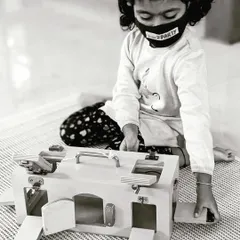
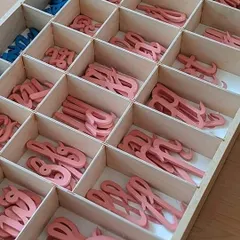
Hands-on Montessori Learning Materials
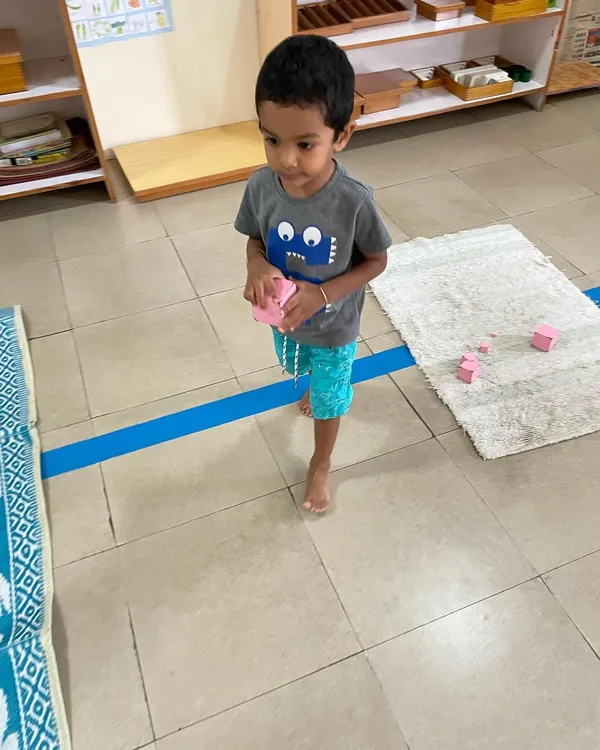 35
35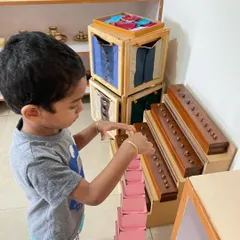
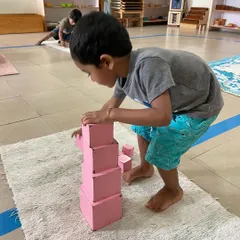
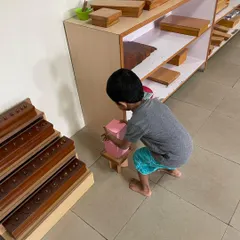
Sensorial Learning in Montessori Education
Sensory and Cognitive Learning for Preschoolers
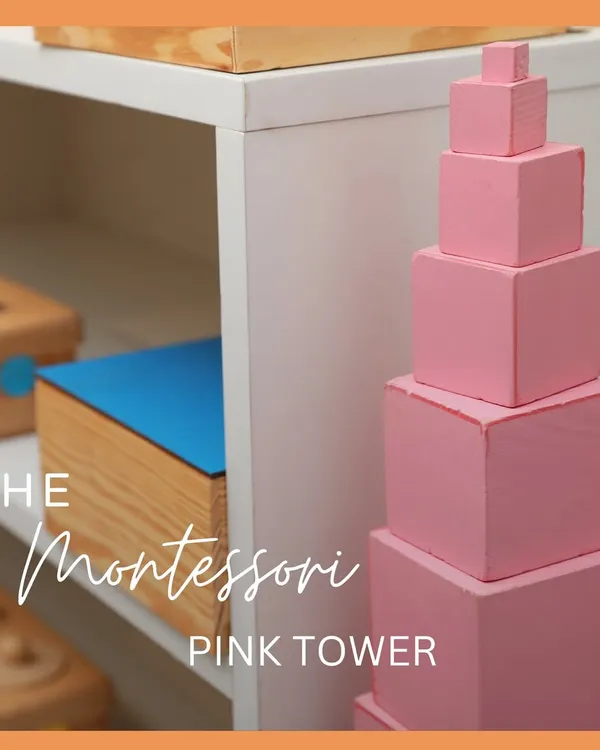 4
4

Montessori Materials and Tools for Learning
The Montessori Method in Action
 8
8
Exploring Montessori Materials: Tools for Deeper Learning
More from Montessori Teacher Training by Ayelet Montessori
More services by Ayelet Montessori