Mastering the Art of Henna Fillers: Grids, Netting & Shading
Learn the professional techniques behind intricate henna designs. I teach you how to achieve perfect symmetry in grids, clean netting, and professional-grade shading to add depth to your artwork.
Here's a beautiful way to use a grid pattern on the back of the hand. In my classes, you'll learn how to fill these grids with tiny floral details to create a rich, textured look.
A close-up look at creating a criss-cross net pattern. I teach my students how to keep their lines straight and evenly spaced, which is the key to a neat and professional finish.
This video demonstrates how powerful shading can be. By filling in the floral and leaf elements, we create a bold, dramatic contrast that makes the entire design stand out.
A finished 'jaali' or net design after the henna stain has developed. This style is very popular for its elegance, and I teach the techniques to make it look flawless.
Filler work isn't always about filling every space. Here, I use simple dot-and-star motifs to create a delicate pattern, leaving negative space for a minimalist yet complete design.
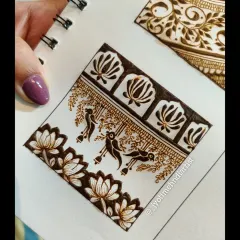
This practice sheet shows a bold filler technique using repeating paisley swirls. It's a great way to fill large areas quickly while maintaining an intricate and flowing look.
A video showing the process of creating the bold paisley filler pattern. You can see how I build up the design element by element, ensuring each swirl is consistent.
About The Art of Fillers: Grids, Netting & Shading
If you ever wonder why some mehndi designs look messy, it is usually because the filler patterns lack consistent spacing. I focus on training my students to slow down and prioritize line weight over speed. Whether you are learning to draw a perfect net (jaali) or mastering 3D shading, we fix your technique so the end result looks polished, intentional, and clean rather than rushed.
Why Filler Technique Changes Everything
Many students come to me because they can draw basic flowers, but their designs feel incomplete. Fillers like grids, netting, and shading are the bridges that connect your motifs. When you master these, you stop just 'filling space' and start creating professional-level artwork.
The Science of a Perfect 'Jaali'
The net pattern (jaali) is a staple in my teaching because it is the ultimate test of cone control. If your pressure isn't steady, your lines will wobble. In my workshops, we use practice sheets to drill the 'straight line' method before moving to the skin. I teach you how to create diamonds that are perfectly uniform, which is the secret to that elegant, full-hand look.
Adding Depth with Shading
Shading is where a 2D design starts to look like 3D art. I show you how to use your henna paste to create contrast. By manipulating the thickness of the paste and the angle of the cone, we create soft gradients that make floral elements pop. It is not about how much henna you apply, but where you place the depth.
My Approach to Teaching
I believe in working from the heart—Mehndi banate hain, dil se. Whether you are in my Wadala studio or joining a video call, we take the time to correct your grip and posture. I provide the sketchbook drills and the practice hands because building muscle memory is the only way to get those clean, sharp lines you see in my gallery. If you are ready to stop rushing and start creating, let us get to work.
Similar work from other experts
Browse through Curated picks from other experts on mytribe
Intricate Mehendi Fillers and Henna Detailing Techniques
The Art of Henna: My Techniques & Design Details
Master Mehndi Fillers, Grids, and Borders
Master Foundational Mehndi Techniques in Mumbai
Mastering Mehndi Patterns, Grids & Borders
Mehendi Technique Showcase: Florals, Shading & Fills
More from Henna Art Classes by Saniya Javed Khan
More services by Saniya Javed Khan